Get Full Government Meeting Transcripts, Videos, & Alerts Forever!
Get email alerts on the Land Use topic
No spam. Unsubscribe anytime.
Board upholds Planning Department—s categorical exemption for 115 Telegraph Hill but approves conditional use with added construction conditions
Summary
After a lengthy public hearing on Nov. 18, the San Francisco Board of Supervisors affirmed the Planning Commission—s categorical exemption for a proposed three‑unit project at 115 Telegraph Hill Boulevard but approved the conditional use authorization only after adopting 11 new construction and staging conditions designed to limit pedestrian, school and slope‑stability risks.
The Board of Supervisors on Nov. 18 considered two consolidated appeals of a Planning Commission decision on a proposed three‑unit development at 115 Telegraph Hill Boulevard: whether the Planning Commission—s categorical exemption from CEQA was proper, and whether the commission—s conditional use authorization (CU) to allow three new units and three parking spaces should be upheld.
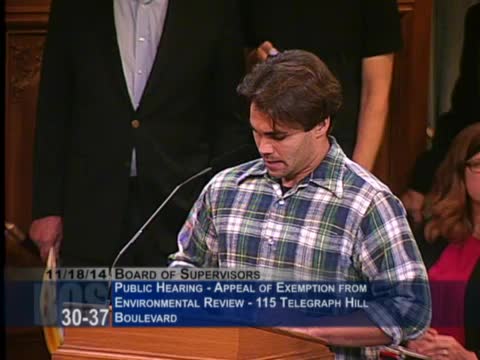
After more than two hours of public testimony from neighbors, geotechnical consultants and project representatives, the board first voted to affirm the Planning Commission—s certification of a categorical exemption from environmental review (CEQA). The vote to affirm the categorical exemption recorded 7 ayes and 3 noes. President Chu said he believed that the record did not present substantial evidence of a fair argument that the project would cause significant environmental effects.
Appellants and many neighbors argued the site—s steep slope, the depth of proposed excavation for an underground garage, potential impacts to slope stability, pedestrian safety at the top of the Filbert Steps, and loss of a public view corridor toward downtown warranted further environmental review. Geotechnical concerns were central: an expert called by opponents said interbedded shale and seepage at the slope merited an Environmental Impact Report; project engineers and the applicant argued DBI review and the Slope Protection Act procedures provide adequate safeguards.
After affirming the CEQA determination, the board considered the conditional use authorization. Members of the public and the Garfield Elementary School principal expressed concern about construction staging — notably concrete truck pumping and truck turning — near the top of Filbert and Kearny streets and the school—s daily operations. Project proponents said they planned staged, on‑site pad staging, a pedestrian tunnel during work, and other measures to limit street impacts; they also agreed to meet with the school district.
President Chu introduced and the board adopted 11 additional conditions specific to construction and staging before approving the conditional use authorization. The conditions included: provision of a well‑lit, naturally ventilated pedestrian tunnel along the Filbert Street stairs for the duration of construction; a flagger stationed at the top of the Filbert Stairs (with extra flaggers during excavation and concrete pours); off‑site queuing for waiting trucks to avoid blocking Telegraph Hill Boulevard; restrictions on the use of Coit Tower parking for construction staging; adherence to applicable weight limits; a prohibition on after‑hours construction (no construction between 5 p.m. and 7 a.m. on weekdays; no Sunday or legal‑holiday construction) until the building is enclosed; requirement that construction personnel park off‑site and shuttle in; a detailed preconstruction plan submitted to multiple city agencies (DBI, DPW, Rec & Park, SFMTA) showing truck routes, expected truck volumes, and staging; mandatory consultation with Garfield Elementary School and residents within 300 feet before finalizing staging and truck routing; maintenance of Muni access to Coit Tower during construction; and stewardship/maintenance agreements for public landscaping and the Filbert stair frontage.
The motion to amend the conditional use authorization to include these conditions and approve the project passed (8 ayes, 2 noes). President Chu moved the motion and Supervisor Farrell seconded it. The board directed project sponsors to meet with SFUSD and local residents to finalize staging and to coordinate monitoring and safety plans.
The board—s action leaves the project approved with the added construction management conditions intended to mitigate pedestrian and school impacts and to require detailed permitting review by DBI and other departments before work begins. Appellants said they sought environmental study to examine geotechnical risks and public‑view impacts; the board—s narrow vote affirms the commission—s initial CEQA finding and conditions the CU on detailed construction control.