Get Full Government Meeting Transcripts, Videos, & Alerts Forever!
Get email alerts on the Labor Employment topic
No spam. Unsubscribe anytime.
Supervisors advance Retail Workers— Bill of Rights with scheduling and retention protections
Summary
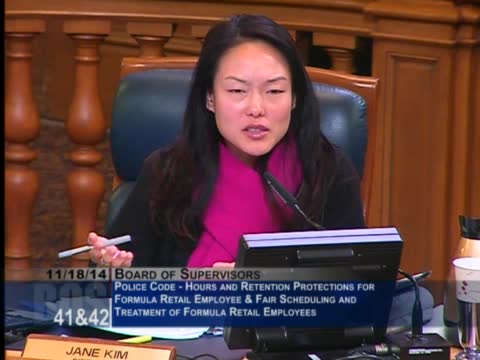
The San Francisco Board of Supervisors on Nov. 18 advanced two companion ordinances known as the Retail Workers— Bill of Rights that would require predictable scheduling, offer existing part‑time workers additional hours before employers hire new staff, and create requirements on employee retention when a formula retail store changes ownership.
The San Francisco Board of Supervisors on Nov. 18 advanced two companion ordinances commonly called the Retail Workers— Bill of Rights, aiming to require large chain employers in the city to post schedules in advance, offer extra hours to current part‑time staff before hiring, retain certain employees after a change in control of a store, and pay workers when schedules change at the last minute.
Supporters said the measures target scheduling practices that leave retail and service workers with unstable hours and unpredictable pay. "All families need strong wages, stable hours, and sane schedules to build a good life in San Francisco," Supervisor Marr said during the hearing.
The package includes two separate ordinances: one addressing hours and retention for formula retail establishments and another setting predictable‑scheduling rules and predictability pay. Key provisions as approved on first reading include a requirement that qualifying employers post work schedules at least 14 days in advance; provide predictability pay of 1 hour when schedule changes are made within 7 days of the shift and 2–4 hours when changes are made within 24 hours; require employers to offer additional hours in writing to current part‑time employees before hiring new workers; and require successor employers to retain employees for 90 days after a change in control when certain conditions are met.
The board amended the ordinances several times before voting. Supervisor Weiner—s amendment changing the threshold for coverage from the ordinance—s baseline to require coverage only of formula retail with 20 or more locations (worldwide) passed first, and the board also adopted an amendment to make the city—s Family Friendly Workplace Ordinance prevail if there is any direct conflict with these predictability rules. Supervisor Breed—s amendment to remove a private right of action so enforcement would rely on city enforcement mechanisms also passed. A separate proposal to exclude janitorial and security contractors briefly surfaced but was withdrawn by the sponsor prior to final votes.
The ordinances were introduced and debated over many committee meetings earlier in the fall, drawing labor groups, worker advocates and business representatives. Supporters, including unions and worker coalitions cited during the hearing, said the rules will help tens of thousands of local workers who face erratic scheduling. Opponents and some small‑business advocates raised concerns about compliance costs, the potential impact on smaller local chains and how contractors would be managed under the law.
Supervisor Marr, who led the bills— presentation to the board, described the coverage as aimed at formula retail establishments with at least 20 employees in the City and County and said the ordinance also covers janitorial and security contractors only when they provide services integral to formula retail businesses under contract.
After several amendment votes and procedural motions at the Nov. 18 full board meeting, items 41 and 42 were passed on first reading as amended (final roll call: 10 ayes, 0 noes on the final combined vote). The board defeated a motion to delay final action for an additional week (4 ayes, 6 noes).
The measures will return for a second reading in the coming meeting calendar. Supporters said further technical and implementation details will be addressed in the ordinance text and through city enforcement rules under the Office of Labor Standards Enforcement.
Moves to change key elements: the threshold for coverage, the interplay with the family‑friendly law, and the private‑right‑of‑action were all decided on Nov. 18, and those changes will be reflected in the ordinance text sent to second reading.