Get Full Government Meeting Transcripts, Videos, & Alerts Forever!
Get email alerts on the Housing Affordability topic
No spam. Unsubscribe anytime.
Mayor Lee tells Board he backs study of absentee ownership, reiterates 30,000‑unit housing pledge
Summary
Mayor Edwin Lee told the Board of Supervisors he supports steps to curb absentee ownership of housing and repeated a pledge to build or rehab 30,000 units by 2020, with half set aside as affordable. Supervisors pressed him on new funding sources and legal limits such as Proposition 13.
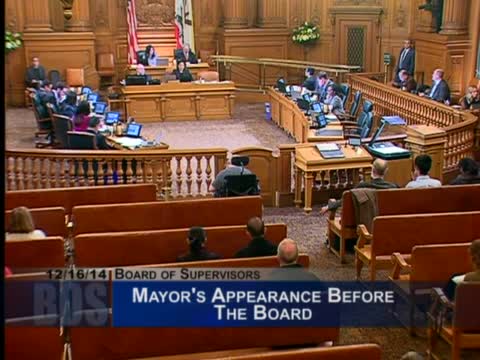
Mayor Edwin Lee told the San Francisco Board of Supervisors on Dec. 16 that he wants the city to do more to keep neighborhoods “vibrant” and to study options to limit absentee ownership of newly built units, after supervisors raised alarm that luxury condos are being bought and left unoccupied.
The mayor opened the 2 p.m. policy discussion by listing recent city accomplishments and by urging members to support social services during the holidays. “We’re making San Francisco more affordable for our working families,” Lee said, while also acknowledging the city is “not satisfied with the status quo.”
Supervisor John Marr led the questioning, citing reporting that in some new condominium developments more than half the units are owned by people who do not live in them. Marr said absentee owners “bid up housing prices” and that unoccupied units can leave “zombie neighborhoods” with shops and schools less active.
Mayor Lee said the city must study legal options and pledged to work with supervisors on legislation. “We need to do some legal research into what we can and cannot do. As you know, California’s Prop 13 makes this a very tricky legal question,” Lee said. He added, “But in principle, I can tell you that I believe in minimizing absenteeism for new construction.”
Lee restated his administration’s housing goals and the recommendations of a 100‑plus‑member housing working group. “I made a very public commitment to construct and rehabilitate some 30,000 new units by 2020, of which 50% will be affordable to low and middle income San Franciscans,” Lee said. He said the city will pursue legislative solutions, use public land for housing and press regional, state and federal partners for funding—while acknowledging there is no silver bullet.
Supervisor David Campos and others asked about funding, the office of housing’s priorities and how the city can prevent investors from removing supply from the market. Lee and his senior advisers emphasized a mix of tools: producing more units, protecting existing naturally affordable housing, funding eviction prevention and using the new public‑lands program to site housing for low, moderate and middle‑income households.
The mayor said the city will “encourage market rate developers to provide more below market rate units in their projects, and streamline the city’s review and permitting processes.” He also described the city’s willingness to advocate at the state and federal level for capital to rehab public housing.
Why it matters: Supervisors framed absentee ownership as a local factor that pushes housing prices higher and potentially weakens neighborhood commercial corridors. The mayor offered political and programmatic next steps but said any regulatory approach must clear state legal constraints such as Proposition 13.
What’s next: Supervisors said they expect follow‑up work with the mayor’s housing office and legal counsel to explore options, and several members indicated they intend to introduce legislation or hearings to pursue funding and legal strategies.
Speakers quoted in this article spoke during the Board of Supervisors meeting on Dec. 16, 2014.