Get Full Government Meeting Transcripts, Videos, & Alerts Forever!
Get email alerts on the Planning Signs topic
No spam. Unsubscribe anytime.
Supervisors pass first reading of planning-code revisions on signs, close billboard loophole
Summary
The Board approved on first reading a planning-code amendment aimed at consolidating awnings, canopies and marquees and clamping down on billboards disguised as business signage. Sponsors said the change closes loopholes and preserves neighborhood character.
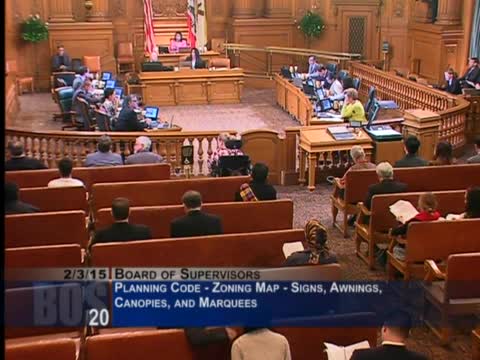
The San Francisco Board of Supervisors passed on first reading an ordinance on Feb. 3 that consolidates definitions and controls for awnings, canopies and marquees and tightens rules aimed at preventing billboards from masquerading as business signs.
"This legislation really rationalizes and cleans up our approach to business signs in San Francisco," Supervisor Scott Wiener said in opening remarks, arguing the code had loopholes that allowed billboard-like displays. Wiener said the ordinance would "permanently close a gigantic loophole" and better align enforcement with voter intent to block new billboards.
Supervisor Jane Kim said she had heard constituent concerns about a provision that retains a 100-foot standard in the C-30 district and was still "exploring what the difference of 4 stories would make" in Transbay and the emerging mixed-use neighborhood; Kim said she was comfortable supporting the planning department's recommendation for now. Supervisor David Chiu asked whether historic signs would be exempt; Wiener responded, "My understanding is that historic signs are exempt from the legislation." The board took the measure on first reading without objection.
Supporters framed the ordinance as a technical and policy cleanup to make business signage consistent with neighborhood character and to enforce prior interim controls on billboard-style signs. The ordinance advances to the second reading, where supervisors said they could consider amendments based on further review and public comment.