San Francisco delays Transbay Transit Center Mello‑Roos vote after closed‑session bargaining; city seeks waivers from developers
Loading...
Summary
The Board of Supervisors opened a public hearing on forming a Mello‑Roos Community Facilities District (CFD) to fund the Transbay Transit Center and the downtown rail extension, then continued the matter for two weeks while city and developers negotiate technical amendments and legal waivers intended to preserve projected funding for the project.
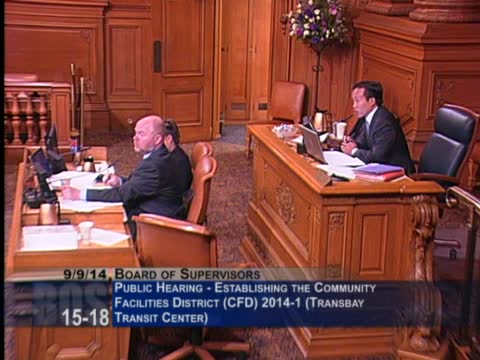
San Francisco supervisors opened a public hearing Tuesday on a proposed Community Facilities District (CFD) to raise money for the Transbay Transit Center and the downtown rail extension, but continued the measure for two weeks after closed‑session discussions about potential litigation and a last‑minute funding adjustment.
Planning Department staff framed the hearing as the second legislative step toward forming the district. “This is the second legislative action, relating to the formation of the Transbay, the Transit Center CFD or Mello Roos District,” Adam Barrett, a Planning Department presenter, told the board during the public hearing.
The CFD would impose an annual special tax on new development in the Transit Center district; revenue projections discussed at the hearing aimed to generate roughly $800 million in net proceeds to help pay for the Transbay Transit Center’s train facilities, a rooftop park and streetscape and open‑space projects. Nadia Sasse, director of the Office of Public Finance, told supervisors the resolutions under consideration would allow bond issuances capped at $1.4 billion but that the staff’s working projection of net bond proceeds available for construction was about $806 million under current assumptions.
Scott Boulay of the Transbay Joint Powers Authority outlined how the CFD fits with other funding sources for the downtown rail extension (DTX), which would bring Caltrain and future high‑speed rail into the new transit center. “There are 19 buildings that are underway in the Transit Center district plan area,” Boulay said, and the CFD proceeds are one piece of a multi‑source financing plan that also includes land sales, tax‑increment revenues and anticipated federal New Starts funds.
During the public hearing dozens of speakers urged the board to approve the CFD unchanged, saying delays would increase costs and imperil transit funding. “Funding delayed is funding denied,” Bob Feinbaum of Save Muni said. Local business groups, neighborhood associations, labor organizations and transit advocates also urged approval.
But developers and their advisors had signaled opposition to the district’s draft escalation terms and the prospect of multi‑hundred‑million‑dollar special taxes tied to the upzoning that enabled much taller tower projects in the plan area. After a closed‑session meeting to obtain legal advice, city staff reported back with a compromise path aimed at preserving the city’s projected revenue while addressing developer concerns.
City negotiators told the board they would seek developer waivers and a technical change to the district’s escalation mechanics: reduce one escalation parameter from 4% to 2% and extend the period during which special taxes can be levied so the district’s cashflows remain sufficient to deliver the same bond proceeds. “The idea is it’s like having a mortgage that goes longer. You can pay slightly less, but the mortgage is for the same amount,” a city staffer identified during the closed‑session report said.
Mr. Rich (city staff reporting after closed session) explained the terms the administration would seek from the developers before bringing the district back for a vote. In return for the longer payment period, developers would be asked to sign four binding waivers: (1) waive any right to sue the city over the CFD; (2) waive the normal 90‑day notice prior to a property‑owner election; (3) agree in writing to vote in favor of formation at the required landowner election; and (4) if the CFD were later invalidated for any reason, agree to negotiate an alternative mechanism that delivers equivalent funding to the city.
Supervisor Kim moved a set of technical amendments to the resolutions and the rate and method of apportionment to clarify the district boundary, the property types subject to tax and consistency with the Transit Center District Plan. Kim said she was “really pleased to see that we are moving forward with the resolution to form the Transbay Transit Center District Community Facilities District and that the city will be securing the entire value of the special taxes as to make the investments” promised in the plan.
Supervisor Scott Wiener, who led board debate last week on the topic, emphasized the regional stakes. “The two go together and they must, go together,” Wiener said of the up‑zoning and the transit build‑out, arguing that any signal of reduced local commitment would jeopardize chances to secure federal and regional dollars for the downtown rail extension.
Action and next steps: the board voted to continue the public hearing and related resolutions for two weeks so staff can circulate the proposed technical amendments and obtain signed waivers from the affected property owners/developers. City finance staff said the modification (lower escalation and longer payment period) is intended to leave projected bond proceeds for the Transbay program unchanged and to avoid litigation that could delay construction financing.
Why it matters: the CFD is intended to fund both transit infrastructure—chiefly the downtown rail extension to connect Caltrain and high‑speed rail to the new Transbay Transit Center—and local open‑space and streetscape improvements that were part of the district plan. Supervisors, the mayor’s office, the TJPA and the Office of Public Finance repeatedly told the board that preserving the projected revenue is critical to meeting construction timetables and to maintaining the city’s ability to draw down federal loans and grants tied to a full funding plan.
What to watch for: staff said the board will return to the matter in two weeks (the board set a continuance) if and only if the city gets the signed waivers. If the waivers are not delivered, the administration said it would instead recommend proceeding on the original terms in the resolutions currently before the board.
Votes and formal actions: the hearing covered three related resolutions (resolution of formation, resolution determining necessity to incur bonded indebtedness, and resolution calling the landowner election). The board continued the items; no final formation vote was taken at the Tuesday meeting.
'Votes at a glance' and additional adopted items from the same meeting are reported in a separate article.