Get Full Government Meeting Transcripts, Videos, & Alerts Forever!
Get email alerts on the Wireless Siting Telecom topic
No spam. Unsubscribe anytime.
Supervisors approve AT&T rooftop cellular facility at 431 Balboa after appeal
Summary
After a lengthy public hearing and an unsuccessful motion to overturn, the Board of Supervisors approved a Planning Commission conditional-use authorization allowing AT&T to install nine rooftop panel antennas at 431 Balboa Street; the vote to approve was 6-5.
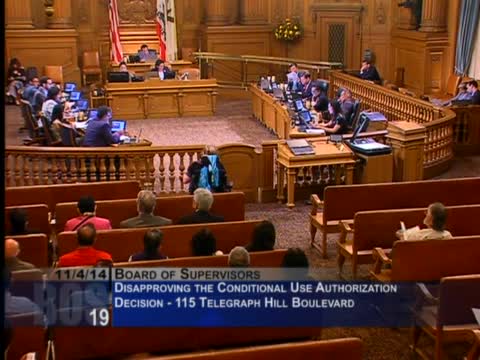
The Board of Supervisors voted to approve a conditional-use authorization for a wireless telecommunications facility proposed by AT&T at 431 Balboa Street in the Inner Richmond on Nov. 4, 2014, after a contested hearing and an appeal from neighbors.
Neighbors and the appellant, Dr. John Omekapo, urged reversal of the Planning Commission decision, citing alleged gaps in community notice, concerns about radio-frequency safety and asserted impacts to housing and business development. "We utilized an FCC approved application and took 8 samples during peak times on Sunday and Monday and found no coverage gap," Dr. John Omekapo told the Board, arguing the carrier had not justified the site.
AT&T and Planning Department staff said the city's independent consultant had verified a capacity and indoor-coverage gap in the area and that a rooftop macro site with nine panel antennas was the "least intrusive" way to close that gap. Anne Marie Rogers of the Planning Department summarized the department's evaluation and described required follow-up steps, including building-permit review, field RF testing and the Department of Public Health's role in on-site testing if residents request it.
AT&T's representative said the company had conducted an extensive alternative-site analysis and its engineer and the city's independent consultant concurred that a substantial service gap existed. "The commission rightfully determined that the project was both necessary and desirable and compatible with the neighborhood," AT&T's director of external affairs said in his presentation to the Board.
During the hearing, supervisors heard testimony from multiple residents who live adjacent to the building and business owners who said the proposed rooftop equipment and related ground-level support equipment posed safety, notice and neighborhood-compatibility concerns. Speakers noted childcare centers and restaurants in the immediate vicinity and asked whether alternative options (for example, distributed antenna systems on utility poles) would be less intrusive.
The Board first considered a motion to overturn the Planning Commission decision (to disapprove the conditional-use authorization); that motion failed on a 5-6 vote. A subsequent motion to approve the Planning Commission decision (item 22) was adopted by roll call: Farrell and several other supervisors voted to approve and the motion carried 6 ayes to 5 noes. The clerk recorded the final action as approval of the conditional-use authorization with the understanding that building permits, public-health review, and field RF testing remain required before activation.
What comes next: If the site moves forward, AT&T must obtain building permits and any required inspections; the Department of Public Health will review RF analyses and field testing will be required before the antennas operate. Residents may request unit- or building-level testing by city staff or carrier-hired engineers.