Get Full Government Meeting Transcripts, Videos, & Alerts Forever!
Get email alerts on the Education Superintendent Evaluation topic
No spam. Unsubscribe anytime.
Albert Lea board workshop narrows first-year evaluation priorities for new superintendent
Summary
At a workshop led by the Minnesota School Boards Association, the Albert Lea Area Schools board and Superintendent Dr. Heil identified personnel, financial stewardship and community engagement as near-term priorities and agreed to finalize evaluation expectations ahead of the Oct. 20 business meeting.
Albert Lea Area Schools held a workshop led by Barb Dorn of the Minnesota School Boards Association on the board’s process for evaluating first-year performance of Superintendent Dr. Heil and to begin setting short-term priorities.
The session focused on using the MSBA/MASA standards-and-elements booklet as a framework for a 1-year evaluation. The board conducted a quick, informal tally of priorities and identified personnel (staffing and professional development) as the top, unanimous item. Other areas receiving multiple board votes included financial controls and asset protection, visibility/approachability and community engagement, and facilities oversight tied to an ongoing facilities study.
The workshop emphasized distinguishing governance from management: the board sets strategic direction while the superintendent manages implementation. Dorn urged the board to limit evaluation expectations to a small number of measurable areas for the remaining nine months of the current year so the superintendent could be fairly assessed on achievable outcomes.
“We simply want to look at your priorities, your higher priorities, and your highest priorities,” Dorn said, adding that “It can be like drinking out of a fire hose the first year for a superintendent.” She recommended 2–3 specific goals or 3–5 standards/elements for a short-term evaluation.
Board members and the superintendent discussed which standards and elements best captured the district’s near-term needs. The board’s informal tally during the workshop produced these high-level signals: personnel (school district operations, element F) received 8 of 8 board votes; several elements under finance and operations received six or more votes; interactions with staff, students and the community received seven votes; and visibility/approachability received six votes. Dorn explained the MSBA’s 4-point rubric for each element and said the rubric is intended to force a nonneutral assessment (no middle/neutral score).
Superintendent Dr. Heil said he aimed to score highly across standards and welcomed clearer, prioritized expectations. “I’d like to be 4 in every area,” he said.
Board members said finances and employee morale were immediate concerns that underlie many other priorities. One board member said, “I think finances has to be a focus. It just has to,” and another identified employee morale and student outcomes as linked priorities.
The board and superintendent also discussed facilities planning and community engagement. Trustees and district staff described plans to bring Wold (the district’s facilities consultant) into a community-facing process so residents can provide input on facility options before the board considers decisions tied to funding or building changes. Chair Clyde said the facilities review and the strategic plan must align with stewardship of district finances and recommended community involvement through a task force.
Dorn reviewed legal and procedural constraints: evaluations may be discussed in closed session under Minnesota open-meeting rules when personnel data are involved, but the superintendent may request the evaluation occur in open session. She also cautioned about broad 360-degree surveys as the primary evaluation tool, recommending instead that any wider stakeholder feedback be framed around culture and climate and used as supplemental information rather than the board’s evaluative decision.
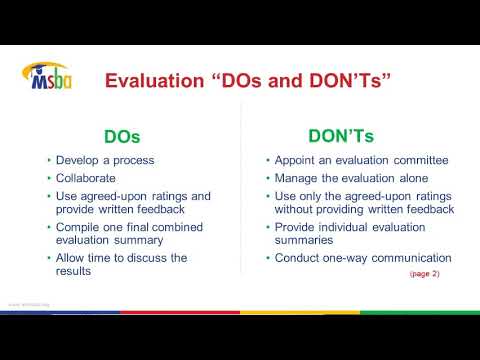
Next steps set out at the workshop included Dorn preparing a written summary of the board’s preliminary tallies and alignments (to be delivered to staff), board members reading the MSBA/MASA booklet and the number-4 (“highly effective”) element descriptions, and the board returning electronic ballot responses to staff to refine the set of evaluation elements. The board aimed to approve a set of evaluation expectations at its business meeting on Oct. 20 and to hold a mid‑year check-in in January or February with a summative review at the end of the evaluation year or earlier in a third contract year if contract decisions must be made.
Barb Dorn emphasized evidence and documentation: sample evidence items and a chair’s summary template are appended in the booklet to help the board produce an objective combined evaluation summary at an open meeting following any closed-session discussion.
The board scheduled the strategic-plan discussion for the next study session and asked members to review the booklet’s high-bar element descriptions before reconvening. Dorn said she would produce a color-coded summary showing where the superintendent’s priorities aligned with the board’s preliminary priorities.
Votes/Formal actions recorded during the meeting were limited to routine agenda approval at the start of the session; the workshop itself produced consensus direction and next steps rather than a formal final action.
The board will review Dorn’s summary and the MSBA booklet, provide written input to staff, and consider a finalized set of evaluation expectations at the Oct. 20 business meeting. Dorn said she would send a summary with tallies and alignment indicators to district staff by the end of the week.