Get Full Government Meeting Transcripts, Videos, & Alerts Forever!
Get email alerts on the Municipal Budget topic
No spam. Unsubscribe anytime.
Eagle Pass holds second reading of FY2026 budget; council approves pay-scale change, will finalize contributions next week
Summary
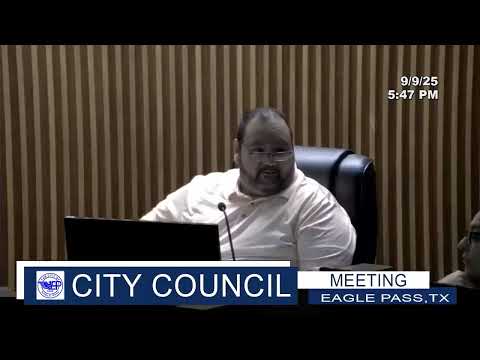
At a Sept. 9 special meeting the Eagle Pass City Council held the second reading of the city's FY2025-26 budget, approved a motion changing the employee step cap and approved the ordinance on second reading while directing staff to return with final details on outside contributions and CIP prioritization for final adoption on Sept. 16.
The City Council of Eagle Pass held the public hearing and second reading of the ordinance adopting the fiscal year 2025-26 budget on Sept. 9 and voted to approve the ordinance on second reading while agreeing to several policy clarifications and follow-ups before final adoption on Sept. 16.
City staff presented an updated budget book showing small changes in expenditures since the council's August review and told the council the package remains on schedule for formal adoption on Sept. 16. Finance staff described a modest reduction in the previously reported surplus and itemized changes to specific funds; staff asked council for direction on a set of requested outside contributions.
Why it matters: the budget sets spending priorities and fund balances for the coming fiscal year and includes allocations that affect local nonprofits, emergency services and capital projects. Council action on compensation policy also affects the city's payroll obligations and future hiring and retention.
Council asked staff to return next week with a recommended formal agreement for outside contributions, and the council approved the budget ordinance on second reading while placing several items for additional detail before final adoption. During the hearing, staff listed requested contributions from outside entities and staff's recommendations: Maverick County District Attorney (requested $80,000, asked for a $5,000 increase from last year's $75,000), SWAT (previous city contribution $25,000; the applicant sought an increase of up to $95,000, for a request to $120,000), disaster-relief ($50,000, no change), Veterans of Foreign Wars (VFW) requested an increase from $5,000 to $10,000, the VITA program requested $3,500 (a $500 increase), and a new request from the MCHD Foundation for $2,500. City staff recommended funding the DA at $80,000, keeping SWAT at $25,000, maintaining disaster relief at $50,000, funding VFW at $10,000, VITA at $3,500, council discretion at $25,000 and the MCHD Foundation at $2,500.
Council members asked for written agreements or interlocal conditions tying contributions to measurable uses, with Councilman Diaz specifically asking that increased funding to the district attorney be conditioned on prosecution of domestic-violence cases or similarly specified outcomes. Staff said they will prepare interlocal or reimbursement-style language so funds can be released on a reimbursement basis or tied to deliverables rather than issued as unconditional one-time payments.
Council also spent substantial time on compensation policy embedded in the budget. Councilman Garcia moved to approve the budget ordinance on second reading with a change to the city's step pay plan: remove the 14-step cap so steps would continue past step 14 and apply a cost-of-living adjustment across all steps. The motion also clarified that longevity pay remains separate and unchanged, and council discussed a separate, merit-based pool for department directors (directors only) that would be considered and structured by administration. The council approved the motion on second reading; staff was asked to provide the fiscal impact analysis for the proposed step-cap removal and the across-the-board percentage before final adoption.
On the capital improvement program, staff reported a public ranking exercise in which 403 individuals submitted project priorities. Staff and the evaluation panel's rankings aligned closely for most projects, though parks and certain subdivision items showed variance. Council discussed giving additional weight to safety-related projects (noting the city's 2020 drainage master plan), and staff said the city engineer is already reviewing that master plan to identify viable, fundable drainage projects and to return with a prioritized CIP list for council consideration.
Council directed staff to: (1) draft agreements or conditional reimbursement language for outside contributions, (2) return a fiscal-impact analysis of the proposed pay-scale change and director merit pool, and (3) reconcile the evaluation panel and public CIP rankings and present a consolidated, implementable project list at the Sept. 16 final reading.
The council closed the public hearing and voted to approve the ordinance on second reading with the stated directions for follow-up. Final budget adoption remains scheduled for Sept. 16 at 5:30 p.m.
The city manager and finance director said staff will present the requested details at the final hearing next week.