Get Full Government Meeting Transcripts, Videos, & Alerts Forever!
Get email alerts on the Dei Higher Education topic
No spam. Unsubscribe anytime.
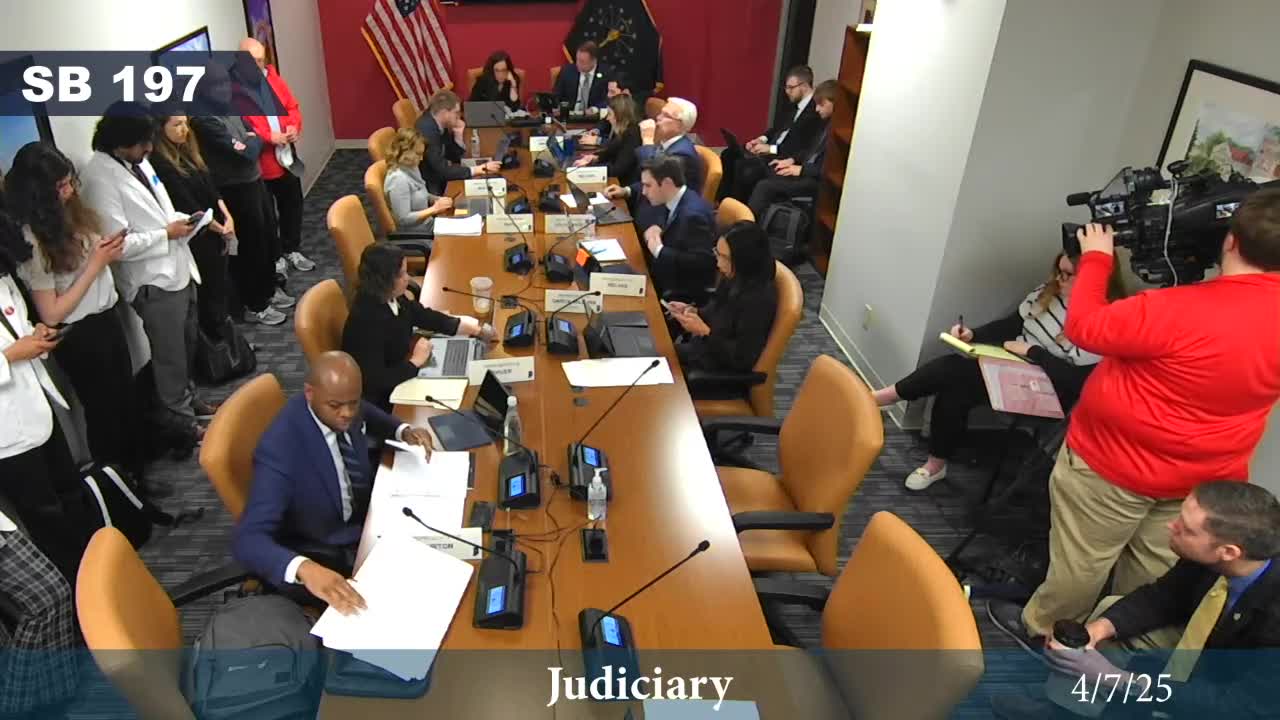
Committee approves amended SB289 after hours of testimony on DEI, fines and academic impact
Summary
After extended public testimony, the Indiana House Judiciary Committee voted to adopt amendment 11 and then passed Senate Bill 289 as amended; the session’s testimony focused on the bill’s scope, proposed civil penalties and effects on higher‑education and medical training.
The Indiana House Judiciary Committee on April 7 moved Senate Bill 289 forward after adopting an amendment that sponsors said narrowed the bill’s scope. The panel voted 8‑2 to adopt amendment 11 and later passed the bill as amended, 7‑3, following several hours of public testimony from university faculty, physicians, medical students and civil‑liberties advocates.
Senator John Byrne, sponsor of SB289, told the committee the measure is intended to enshrine “equal treatment under the law” in state practice and to respond to recent federal developments. "One of the most important principles of American government is equal treatment under the law," Senator Byrne said, referencing the U.S. Supreme Court decision in Students for Fair Admissions v. Harvard and federal executive actions as background for the bill. He said the amended text focuses on prohibiting actions that treat people differently on the basis of specified personal characteristics rather than prescribing particular curricular language.
The most contested provision through testimony was what committee members and witnesses called “Chapter 7” — a cause of action in the bill that, as described in committee testimony, could impose civil penalties in the $50,000–$100,000 range for some violations. Multiple witnesses warned that those penalties, and the bill’s language as originally drafted, could create a chilling effect on classroom instruction, university DEI offices, donor‑funded programs and the recruitment and retention work universities perform.
Laura D’Agostino, an attorney with the Pacific Legal Foundation, testified in support of SB289 as amended, saying the bill advances “equality by ending discrimination and race‑ and sex‑based preferences by state entities.” By contrast, Kurt Miceli of Do No Harm Action, a medical‑education‑focused advocacy group, testified the present role of DEI in medical schools and licensing is “discriminatory, divisive, and destructive,” and urged the committee to restrict DEI requirements in licensing and admissions.
Many medical students, physicians and public‑interest advocates opposed the bill or urged narrowing Chapter 7. Testimony from medical students and faculty emphasized accreditation and training requirements. Multiple witnesses noted the Liaison Committee on Medical Education (LCME) and other national accreditation standards require teaching about social and cultural factors that influence patient care. Medical students testified that DEI‑related programming — such as training on cultural competence, linguistic accessibility and work to recruit and retain clinicians from underrepresented backgrounds — is central to patient care and to Indiana’s ability to recruit and keep medical talent.
Several faculty and witnesses urged the committee to strike or significantly scale back Chapter 7’s financial penalties if the bill moves forward. ‘‘The maximum fine as was just mentioned for class A misdemeanor in Indiana is $5,000 and for a felony is $10,000. So we think that the $50,000 to $100,000 seems extreme,’’ said Sarah Comfort, public policy director at Marion County Commission on Youth, summarizing testimony about potential consequences for individual educators.
Committee supporters said the adopted amendment (Amendment 11) narrowed the measure to focus on prohibited actions rather than broad curriculum mandates and included some carve‑outs for private donor funds, but committee debate exposed remaining concerns about ambiguity for licensing exams, clinical training and reasonable accommodations in higher education and K‑12.
Votes at a glance: Amendment 11 (narrowing and focusing provisions) — recorded roll call 8 yes / 2 no — passed. Final committee action: SB289 passed as amended, 7 yes / 3 no.
Why it matters: The bill touches higher education policy, state contracting and professional licensing standards and has prompted intense testimony from medical educators, students, civil‑liberties groups and faith and community organizations. Witnesses warned that unclear language and steep penalties could prompt institutions to curtail programs, cancel cultural events or scale back training that addresses health disparities, while supporters argued the bill protects equal treatment under law and reins in certain DEI practices.
Common themes in testimony: concerns about Chapter 7 penalties and unintended litigation exposure for faculty or institutions; the relationship between accreditation/licensure standards and state law; the role of DEI offices in recruitment, retention and student support; and the bill’s potential effects on rural and underrepresented students and on Indiana’s ability to attract and retain medical professionals.
Sources: Committee debate, roll calls and public testimony given April 7 before the Indiana House Judiciary Committee.