Get Full Government Meeting Transcripts, Videos, & Alerts Forever!
Get email alerts on the Postsecondary Athletics topic
No spam. Unsubscribe anytime.
Committee rejects most postsecondary grievance and enforcement amendments but advances contested athletic eligibility bill
Summary
The Senate committee held a lengthy hearing on House Bill 1041, which addresses athletic eligibility and grievance procedures at postsecondary institutions. Several proposed amendments to expand grievance rights, add civil remedies, or extend K–12 protections to higher education were defeated; the underlying bill passed committee.
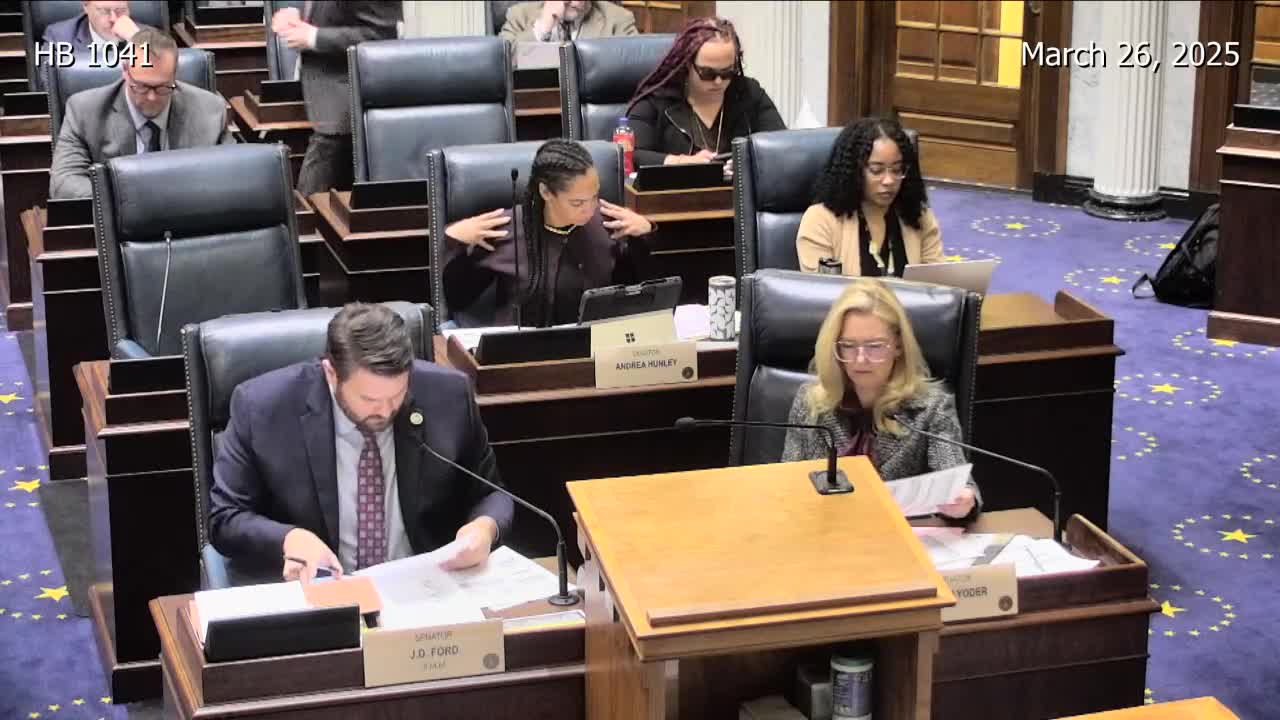
The Senate Education, Career and Technical Development Committee heard House Bill 1041 on March 26, which would set procedures related to athletic eligibility and grievances at public and private postsecondary institutions. Committee members debated multiple amendments that would have broadened who may file grievances, added disciplinary options for bad‑faith complaints, and created civil causes of action.
Senator J.D. Ford offered amendments intended to permit student athletes who say they lost an athletic opportunity to file grievances with the institution; he described one change as narrowing who may submit a grievance ‘‘a student who is deprived of an athletic opportunity or otherwise directly or indirectly injured may submit a grievance to [the institution].’’ Committee sponsor Senator Donato opposed several of Ford’s proposals, saying the bill was intended to match the K–12 space and that some suggested changes expanded the bill beyond that purpose.
Most of Ford’s amendments were defeated on roll calls. Examples:
• An amendment to extend K–12 grievance language into postsecondary institutions failed at roll call.
• An amendment allowing disciplinary action when a student files a grievance ‘‘in bad faith’’ (including revoking eligibility) was defeated.
• Two related amendments that would have prohibited requiring student athletes to expose private body parts as part of grievance resolution and that would have created a civil cause of action were also defeated by recorded votes.
Committee members repeatedly framed their votes as a choice between preserving the bill author’s intent to mirror K–12 rules and expanding the measure into broader employment or civil‑rights territory at colleges and universities. The committee ultimately reported HB1041 out of committee on a 9 to 4 vote.
Quote from the hearing
"As a complaint, it just amends language providing who may submit a grievance to the state educational institution...a student who is deprived of an athletic opportunity or otherwise directly or indirectly injured may submit a grievance..." —Senator J.D. Ford, proposing an amendment to HB1041.
What’s next: HB1041 was reported out of committee and will proceed to further floor consideration; proponents and opponents told the committee they expect additional discussion as the measure moves forward.