Get Full Government Meeting Transcripts, Videos, & Alerts Forever!
Get email alerts on the Education Deregulation topic
No spam. Unsubscribe anytime.
Senate committee amends and advances large education deregulation bill; social‑emotional learning language removed
Summary
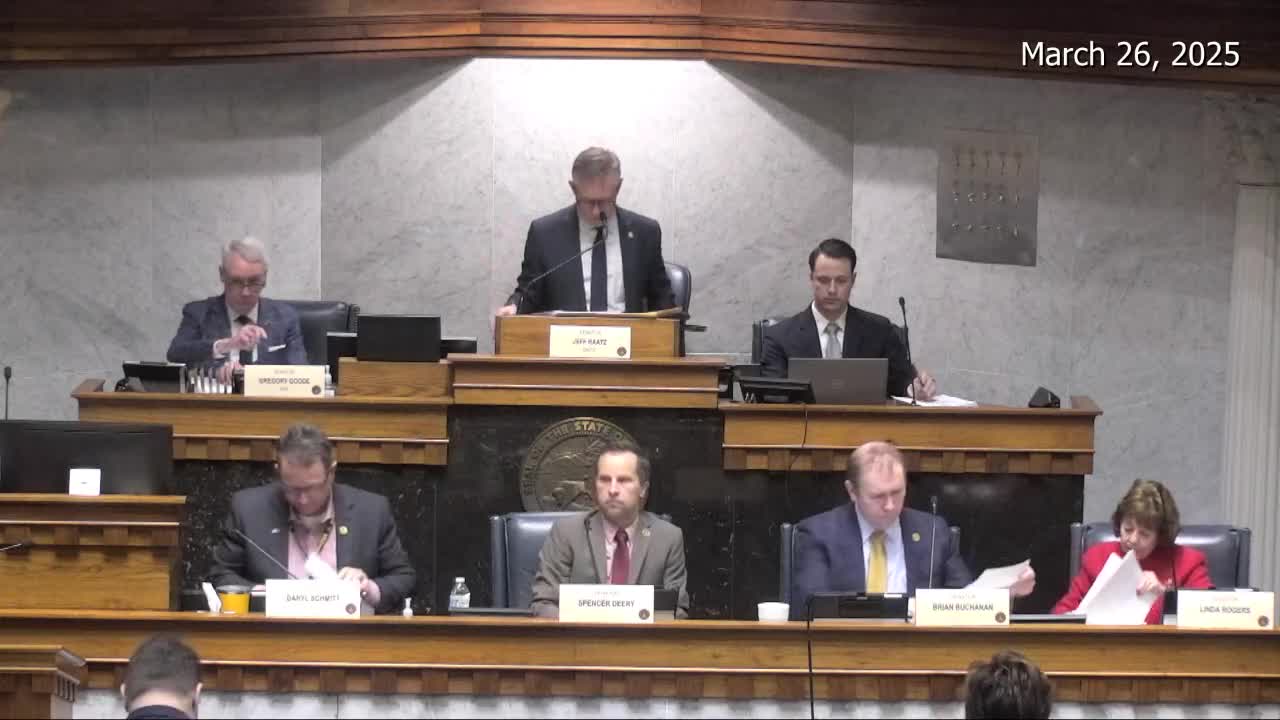
The Senate Education, Career and Technical Development Committee on March 26 considered House Bill 1002, a 135‑page package of changes to Title 20 of Indiana law; senators debated a string of amendments on charter authorizers, fees, emergency medical equipment and social‑emotional learning and advanced the bill as amended to Appropriations.
The Senate Education, Career and Technical Development Committee on March 26 considered House Bill 1002, a 135‑page package of changes to Title 20 of Indiana law that the bill sponsor described as a ‘‘deregulation’’ clean‑up. Committee members debated multiple amendments that would affect charter authorizers, school board transparency, requirements for emergency equipment, fees for non‑curricular supplies and provisions on social‑emotional learning.
The bill’s sponsor and the committee’s chair described the underlying bill as a broad rewrite and removal of outdated language across state education code; senators spent the hearing offering and voting on more than a dozen amendments before moving HB1002 as amended and recommitting it to the Committee on Appropriations.
Supporters said the bill pares back obsolete requirements and clarifies certain duties; opponents warned some changes would remove statutory protections or introduce new costs. Senator Fadi Kadura, who offered several amendments, described one proposal as ‘‘collecting information, putting that information on the website so that we can be informed when it comes to fiscal issues.’’ He argued the amendment would have the Department of Education assess whether additional school buildings are needed in a district so state spending could be better planned.
Several charter‑related amendments failed. An amendment that would have required a charter school authorizer to be located in the same county as the proposed school was defeated after roll call. Proposals to require charter boards to file reports about membership and to move toward elected charter boards were also rejected by the committee.
The committee accepted an amendment that restores a ‘‘shall’’ requirement for schools to have an operational automated external defibrillator (AED) and a written, site‑specific plan for responding to sudden cardiac arrest at practices and events; that amendment was taken by consent.
Lawmakers debated a high‑profile amendment on fees for school supplies. Senator Linda Rogers, who offered the change, said the amendment would permit a governing body ‘‘to assess a reasonable fee for certain supplies and materials’’ that are not already defined as curricular materials under code. Rogers said reasonable would be understood as what the school corporation pays, and that the amendment ‘‘puts our school corporations kind of at a disadvantage not knowing what to do, and this kind of puts it together.’’ After discussion and suggested clarifying language, the committee adopted that amendment by roll call (recorded in committee as 9 to 4 in favor).
Another amendment, offered by Senator Gary Byrne, removed several references to social‑emotional learning (SEL) and trauma‑informed care from HB1002. Byrne said the change was part of the committee’s deregulatory intent and argued teachers should ‘‘focus on academic rigor, math, science, reading, and writing.’’ Senator J.D. Ford opposed that amendment on the record, saying SEL ‘‘improves academic performance. It enhances their mental health, it builds stronger relationships.’’ The committee approved the amendment to remove the SEL language by roll call (8 to 4).
Several amendments were withdrawn or defeated after debate; other technical fixes and local‑specific provisions were accepted by consent. Chair Rotz said the committee had spent weeks reviewing the 135‑page bill and that many of the proposed changes were intended to eliminate outdated language or to restore provisions that the House removed.
At the end of the hearing the committee voted to move HB1002 as amended with a recommit to Appropriations; the roll call on the final motion was recorded as 8 to 4 in favor.
What’s next: HB1002 was advanced as amended to the Appropriations Committee for further consideration and potential inclusion in the budget process.
Quotes from the hearing
"All what it is is collecting information, putting that information on the website so that we can be informed when it comes to fiscal issues," —Senator Fadi Kadura, describing an amendment to have the Department of Education evaluate building needs.
"Reasonable would mean what the school corporation is paying. So that would be considered reasonable," —Senator Linda Rogers, explaining a provision that would let school corporations charge a reasonable fee for supplies that are not defined as curricular materials.
"It improves academic performance. It enhances their mental health, it builds stronger relationships. And so for those reasons, I can't support your amendment," —Senator J.D. Ford, opposing the amendment to remove social‑emotional learning language.
Ending note: The committee’s action on HB1002 folded together many local and statewide policy debates — school finance, charter authorization, emergency medical preparedness, and classroom practice — into a single, large rewrite of education code. The bill will next meet appropriators for review of fiscal implications.