Get Full Government Meeting Transcripts, Videos, & Alerts Forever!
Get email alerts on the Budget And Cip topic
No spam. Unsubscribe anytime.
Lancaster County budget team urges council to adopt 10‑year capital plan and fund ERP replacement
Summary
County budget staff presented a 10‑year capital improvement plan and urged council to fund a multi‑year enterprise resource planning (ERP) replacement, saying current finance and HR systems are antiquated and slow decision‑making.
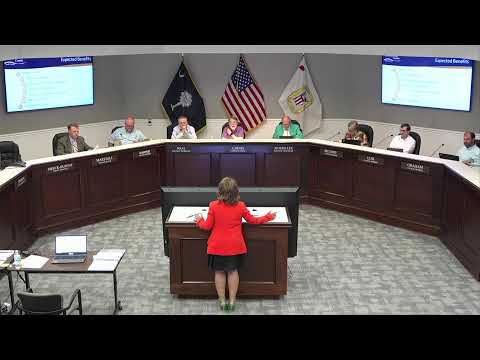
Lancaster County budget staff asked the County Council Committee of the Whole on Wednesday to adopt a 10‑year capital improvement plan and to approve funding for a multi‑year enterprise resource planning (ERP) replacement that would modernize finance, human resources and asset management systems. "My name is Jamie Probusnak, and I am your budget director for Lancaster County," Budget Director Jamie Probusnak said as she outlined the proposed capital projects and funding scenarios.
The county's adopted 10‑year plan lists 72 projects with an estimated total life‑cycle cost of about $358.3 million (dollars shown in the plan are current as of the plan’s 2021 baseline). Probusnak told council that 27 projects are priorities for fiscal 2026, representing ongoing work and scheduled items that would require roughly $44 million, and that departments added another $6.0 million in new capital requests during the budget process.
Probusnak said council adoption of the CIP is a planning action that does not itself commit money. "There is no monetary commitment when you adopt the capital improvement plan ordinance," she said. She explained that funding occurs when the council appropriates money in the annual budget ordinance and that capital projects create ongoing operating costs once assets come online.
Deputy County Administrator Stephanie Snowden and Finance staff described the county's urgent need for an ERP replacement. "We've had the same financial software since 1998," Snowden said, noting the current system forces manual work and fragmented "data silos" across departments. Snowden and other staff said the current mix of standalone systems requires manual reconciliation for routine tasks such as payroll, benefits summaries, and month‑end reporting.
Snowden described the ERP project as a multi‑year implementation with both one‑time and ongoing costs. The administration provided council with a notional four‑year budget for the ERP — a planning figure in the budget packet — and said the county had completed vendor evaluations and would return to council with a recommended contract and an implementation timeline if members choose to move forward.
Probusnak reviewed funding options for capital projects, including pay‑as‑you‑go from fund balance, existing capital replacement millage (the fund 11 millage), project‑specific grants, impact fees, and borrowing. Presentations included scenarios showing how fund 11 millage and property value changes affect the fund’s capacity to finance rolling stock and replacement equipment.
Council members asked staff to refine the CIP numbers once the auditor certifies the property tax base, and to return with precise millage and projected revenues before approving additional allocations from the capital replacement fund. Probusnak said staff will return with updated revenue estimates and a recommended prioritization for the projects listed for fiscal 2026.
The county administrator and budget team emphasized the ERP project's role beyond finance: staff said an integrated system would provide real‑time reporting for departments, automate many manual processes, reduce duplication of effort, and improve audit trails.
If council moves forward with the ERP and the CIP items recommended for fiscal 2026, staff said they will present a detailed implementation plan and proposed funding sources as part of the administrator’s recommended budget.