Get Full Government Meeting Transcripts, Videos, & Alerts Forever!
Get email alerts on the Parks Alcohol Policy topic
No spam. Unsubscribe anytime.
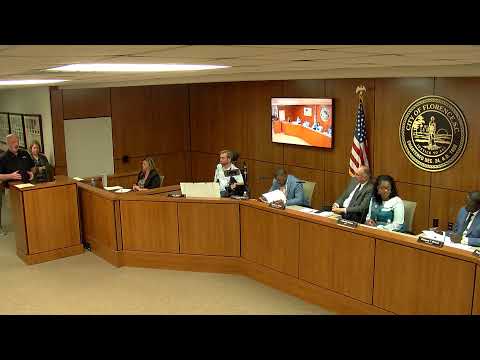
Council approves limited beer-and-wine permits at select park venues after debate over safety and liability
Summary
The Florence City Council voted to permit private groups to sell and serve beer and wine at specified locations in Timberland Park and at other city venues, provided permittees meet insurance and policing requirements.
The Florence City Council approved a resolution to designate certain public spaces where approved groups may sell, serve and consume beer and wine during permitted special events.
The approved resolution lists the pickleball courts and spectator areas, tennis courts and spectator areas, the amphitheater, and the amphitheater lawn at Timberland Park as permitted locations for beer-and-wine at private, permitted events. City staff said the permit will require applicants to obtain a special‑use permit, hire officers under the city’s “officers in blue” program and provide a general liability insurance certificate naming the city as certificate holder.
Victoria (staff member) explained to council that the designated areas were chosen so that alcohol would not be allowed at playgrounds or other open areas. The city manager and Police Chief confirmed that permittees must carry a $1 million general liability policy and that the city will be listed as the certificate holder. “We would have no involvement except to actually sign that permit,” the city manager said, adding that the private organization—not the city—would handle sales and distribution.
Council members expressed mixed views. Councilman Braddock and others cautioned that Timberland Park is in a residential neighborhood and includes playgrounds and nearby homes, raising concerns about rowdy behavior and whether policing and insurance requirements are sufficient. “This park’s in a residential area where we have playgrounds,” Braddock said, arguing the park’s mixed‑use character makes it different from more‑contained venues such as the soccer complex.
Supporters said the requirement that permittees hire officers and provide insurance would mitigate many risks and that similar arrangements exist for other venues the city already permits. Several council members asked whether limits on servings, hours, or physically contained alcohol areas could be imposed; staff said they would research specific permit conditions and could propose ordinance language if the council wanted to add limits. A stated insurance limit is $1,000,000.
The resolution faced a motion to defer but that motion was withdrawn after council members learned a pickleball tournament under discussion had a near‑term date. The council then voted in favor of the resolution; the transcript records the motion as adopted with a voice vote (“ayes have it”), but does not provide a roll‑call or numerical tally.
Why it matters: the change allows private organizations to run alcohol‑service events in park spaces that previously were closed to alcoholic sales, potentially increasing use and revenue from tournaments and events while raising neighborhood concerns about public safety and park character.
Implementation and next steps: permit applications must specify event setup and comply with insurance and officer staffing requirements; staff said it can add restrictions by ordinance or tailor conditions under the permit process. Staff also acknowledged they would need to flesh out the details (serving limits, barriers, hours) for specific events.