Get Full Government Meeting Transcripts, Videos, & Alerts Forever!
Get email alerts on the Vape Registry topic
No spam. Unsubscribe anytime.
Committee delays vape product registry after hours of testimony; sponsors set implementation timetable and retailers press for open-system carve-out
Summary
The Finance, Ways and Means Committee on April 1 heard hours of testimony on House Bill 9-68, a proposal to create a vape-product registry and user fee for enforcement. After extended public testimony from vape shop owners, an industry attorney and convenience-store representatives, the committee agreed to roll the bill one week for further work.
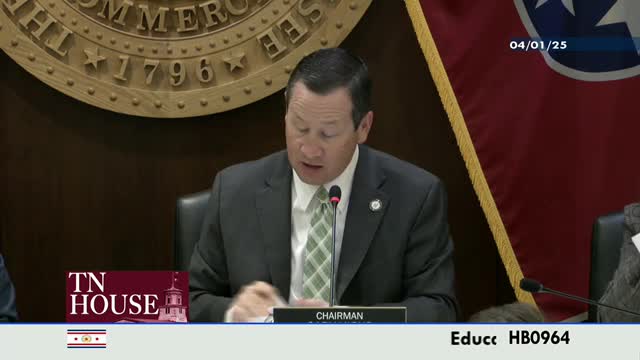
The House Finance, Ways and Means Committee received extended testimony on House Bill 9-68 on April 1, a bill sponsored by Chairman Hawk that would create a state vape-product registry, impose a user fee for enforcement, and require manufacturers and retailers to document FDA authorization or filings. After more than two hours of oral testimony, sponsors and members agreed to roll the bill one week for additional work.
Chairman Hawk framed the bill as an enforcement tool to keep illegal, unapproved vape products off store shelves. Hawk said federal law makes it illegal to sell vape products that are not either approved by FDA or properly in the FDA authorization process, and the bill would establish a Tennessee registry and a user fee to fund enforcement. Hawk outlined an implementation calendar in committee: the user-fee portion would begin July 1, 2025; manufacturers must show Department of Revenue by Aug. 1, 2025 that they are in the FDA review process; the registry would be created Jan. 1, 2026; and retailers would have 60 days after the registry is published to sell remaining nonconforming product.
Public testimony split along lines familiar to recent debates over vaping regulation. Danny Gillis, president of the Tennessee Smokefree Association and owner of multiple 21-and-over vape shops, asked lawmakers to exempt "open systems" — refillable devices and e-liquids commonly used in harm-reduction retail shops — from a registry intended to target inexpensive, prefilled disposable devices. "We're asking one thing today, carve out open systems vaping, the backbone of our industry," Gillis told the committee.
Greg Trautman, an attorney representing open-system advocates, warned that states that adopted registry laws faced enforcement problems. "In Kentucky, they passed this bill last year. It took effect January 1. It's been an enforcement nightmare," he said, urging careful drafting to avoid selective enforcement and unintended market capture by large firms.
Retail and convenience-store representatives urged strong, enforceable age-verification rules. The Tennessee Fuel and Convenience Store Association's representative told the committee that TFCA supports a universal carding requirement and a wholesale-style tax administered by the Department of Revenue, saying the association believes a registry and carding provide law enforcement clarity without upending compliant retailers.
Small-shop owners urged the committee not to treat all retailers the same. Knoxville Vapor owner Bill Livesey said the bill as drafted risked putting small, lawful specialty shops out of business and "handing this industry over to big tobacco." Livesey also told the committee that his stores and others routinely card customers and comply with inspections.
Sponsor Hawk said the bill is designed to target illegal imports and products that are irresponsible for youth-targeted marketing, and he noted law-enforcement support for a registry that would make it clearer which products are legal in Tennessee. Still, members and witnesses agreed more drafting work was needed. Representative Parkinson asked whether the sponsor would accept further deliberation or an amendment to protect open systems; Hawk said he was "amenable to conversation" and the committee later voted, without objection, to roll House Bill 9-68 for one week.
Ending: After several hours of testimony and questions about enforcement, FDA approvals and business impacts, the committee rolled House Bill 9-68 one week to allow sponsors and stakeholders more time to refine technical details, including definitions of "open systems," the registry scope and enforcement funding.