Get Full Government Meeting Transcripts, Videos, & Alerts Forever!
Get email alerts on the Private Security topic
No spam. Unsubscribe anytime.
Committee approves enhanced armed-guard license that would let private security carry rifles, shotguns with psychological screening
Summary
Senate Bill 13-84, as amended, would create an enhanced armed guard license allowing private security personnel who meet experience prerequisites to carry long guns and to require psychological evaluations; the committee approved the measure and sent it to the calendar.
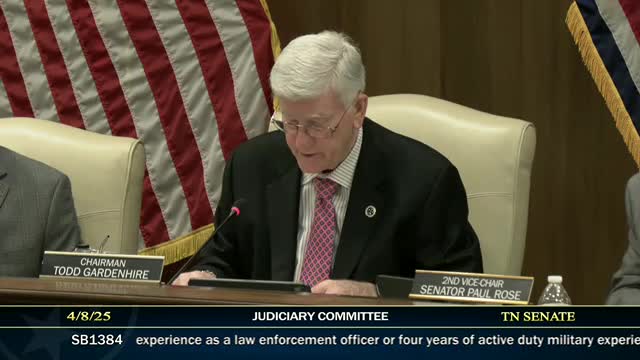
The Senate Judiciary Committee voted to advance Senate Bill 13-84, which would create an "enhanced armed guard" license under the Department of Commerce and Insurance allowing private security officers who meet experience requirements to carry rifles and shotguns as part of their duties.
Sponsor Chandra Watson explained the bill makes available an enhanced license to currently licensed armed guards who either have five years of law-enforcement experience, are retired in good standing from law enforcement, or have four years of active-duty military experience with an honorable discharge. The bill requires a psychological evaluation before initial approval and allows the state to require an annual psychological evaluation on renewal.
Sen. Sara Lamar asked whether the bill contains safeguards to exclude people with a history of mental-health issues. Watson said the bill requires applicants to be in good standing as an armed guard, to meet the experience/retirement/military criteria, and to pass the psychological evaluation; the evaluation can be required annually on renewal.
Committee action: After adopting two technical amendments the committee voted unanimously to advance the bill; the roll call recorded eight ayes and the bill was placed on the calendar.
Why it matters: The measure expands carrying authority for private security and adds a regulatory gate—experience plus psychological screening—intended to balance employer flexibility with public-safety oversight.
Next steps: The bill was reported to the calendar for further consideration by the full Senate.