Get Full Government Meeting Transcripts, Videos, & Alerts Forever!
Get email alerts on the Firearms Policy topic
No spam. Unsubscribe anytime.
Long-gun carry bill sparks broad opposition from safety agencies; committee deadlocks
Summary
Senate Bill 12-27, proposing to treat public carry of long guns the same as handguns, drew opposition from the Department of Safety, Tennessee Bureau of Investigation and local law enforcement. Supporters cited recent U.S. Supreme Court rulings; committee deadlocked 4-4 and the bill did not advance.
Senate Bill 12-27, introduced by Sen. Lowe, would replace references to "handgun" in many statutes with the broader term "firearm," effectively aligning Tennessee law with post-Bruen U.S. Supreme Court precedent and allowing legal public carry of long guns in similar contexts as handguns.
Department of Safety legislative director Elizabeth Stroker testified the department has concerns about permitting long guns in public spaces where citizens ordinarily see only handguns: “There are obvious concerns when you are talking about allowing someone to carry a high-capacity style rifle in front of courts, in front of jails, in front of schools,” she said, warning of public alarm and law-enforcement complications.
The Tennessee Bureau of Investigation echoed the safety concerns, saying the bureau believes current law is consistent with the Second Amendment and that the proposed change would endanger public safety. Jimmy Musick, testifying for the sheriffs and chiefs, told the panel that carrying a long gun in public could prompt immediate, defensive law-enforcement responses and increase the likelihood of violent misunderstandings.
Supporters argued the measure is a constitutional alignment—the sponsor said long arms were the "predicate" for the Second Amendment and that Bruen requires re-examination of distinctions between types of firearms. Dozens of witnesses, on both sides, addressed the panel.
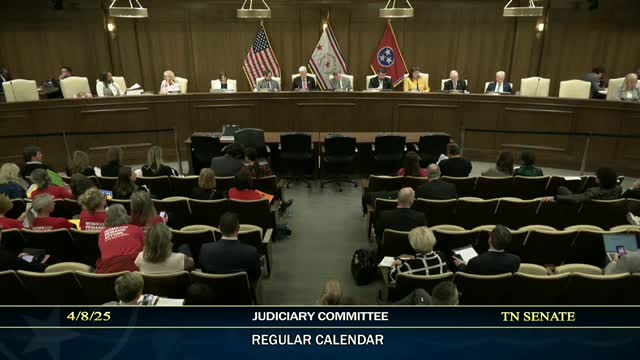
Committee action: The vote resulted in a 4-4 tie; the measure did not advance out of committee and remains in committee for further consideration.
Why it matters: The bill put the committee at the intersection of constitutional law and everyday public-safety practice. Law-enforcement officials emphasized operational concerns; constitutional proponents emphasized legal consistency and rights expansion.