Get Full Government Meeting Transcripts, Videos, & Alerts Forever!
Get email alerts on the Use Of Force Property Crime topic
No spam. Unsubscribe anytime.
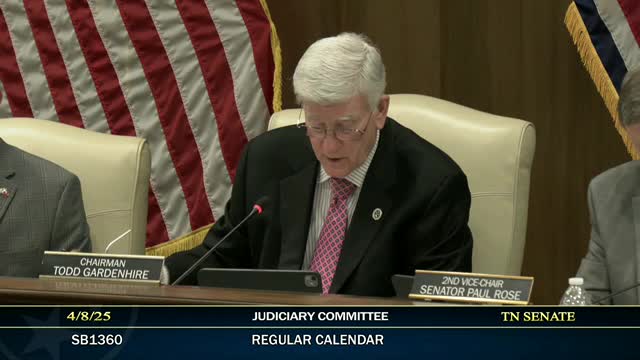
Senate committee hears hours of testimony on bill to allow deadly force to protect property; measure stays in committee
Summary
The Senate Judiciary Committee debated Senate Bill 14-07, which would allow use of deadly force in limited property-crime scenarios. Witnesses including Moms Demand Action, the Tennessee District Attorneys General Conference and the Tennessee Bureau of Investigation urged rejection or major limits; the bill failed to advance out of committee.
The Senate Judiciary Committee debated Senate Bill 14-07 on May 15, a proposal that would allow a person under specific circumstances to use deadly force to prevent or stop certain property crimes, including nighttime burglary, robbery, arson and theft.
Supporters, led by sponsor Sen. Roger Hensley, said the measure would protect citizens in rural areas where emergency response can be slow and give property owners lawful options when confronted with violent theft. “In rural areas it may take 15, 20 minutes for law enforcement to get to your house,” Hensley said, asking the committee to consider that practical reality.
Opponents sharply criticized the measure as expanding permission to use lethal force in situations where property—not human life—is the central concern. Linda McFadgen Ketchum of Moms Demand Action told the committee, “Property becomes more important than human life,” and warned an expansion would invite “shoot first, ask questions later.”
Steven Crump, executive director of the Tennessee District Attorneys General Conference, pressed the committee on jury confusion and prosecutorial consequences, saying the bill “diminishes the value of life in this state.” Patrick Powell, policy director at the Tennessee Bureau of Investigation, gave a scenario to show how time of day could produce radically different outcomes for otherwise identical acts.
The committee also considered a proposed amendment that would have limited the new justification to vehicles and to property worth $10,000 or more. That amendment failed on a voice vote. After extended public testimony and panel questioning the committee took a roll call; the bill did not advance and was held in committee.
Why it matters: The bill touched off a broader debate about the balance between public safety, rural realities of delayed emergency response and the state's longstanding legal preference for preserving life over property. Members of the legal and law-enforcement communities warned the law could make prosecutorial and charging decisions more fraught and would be difficult for juries to apply consistently.
Committee action and next steps: After public comment and panel testimony the committee voted; the measure did not clear committee and stayed for further work rather than going to calendar.