Get Full Government Meeting Transcripts, Videos, & Alerts Forever!
Get email alerts on the Municipal Budget And Finance topic
No spam. Unsubscribe anytime.
Wellington staff recommends putting most one-time proceeds into reserves, stormwater and PBSO substation
Summary
Village staff proposed a plan for one-time revenues from multiple land sales and litigation proceeds: replenish facility reserves, expand a rate-stabilization reserve, fund stormwater pump upgrades in the Acme Improvement District, and set aside money for a PBSO substation and an environmental/open-space reserve.
Village finance staff presented a long-range finance plan recommending how to allocate several one-time receipts and proposed continuing utility and assessment rate changes.
Lede: Finance staff urged council to allocate the proceeds from several expected one-time receipts — the sale of a 10-acre site, a foreclosure settlement with Palm Beach Polo, the sale of Kpark and anticipated proceeds from PFAS-related litigation — to a mix of reserves and capital projects.
Nut graf: The staff list included restoring facility and infrastructure reserves, expanding a rate-stabilization reserve, dedicating funds to Acme Improvement District stormwater pump work and creating an environmental and open-space reserve. The presentation included specific dollar recommendations and a proposed timetable tied to projected receipts.
Allocation recommendations: Staff identified the first near-term receipt as proceeds from a 10-acre site sale (approx. $11,000,000). Their recommendation for that $11 million was: 1) restore facility and infrastructure reserves with $7,000,000 (bringing that reserve back toward a $10,000,000 target), 2) place $3,000,000 into the rate-stabilization reserve (a fund staff said should ultimately equal roughly one mill, approximately $12,000,000), and 3) appropriate roughly $1,000,000 for athletic-field improvements.
From a foreclosure settlement with Palm Beach Polo (roughly $9.3 million anticipated), the staff recommended creating an "environmental resilience and open space reserve" of $6,000,000 for projects and grant matches, and directing the remaining roughly $3,300,000 to the Acme Improvement District stormwater pump program (a capital program staff estimated at ~$43,000,000 over time).
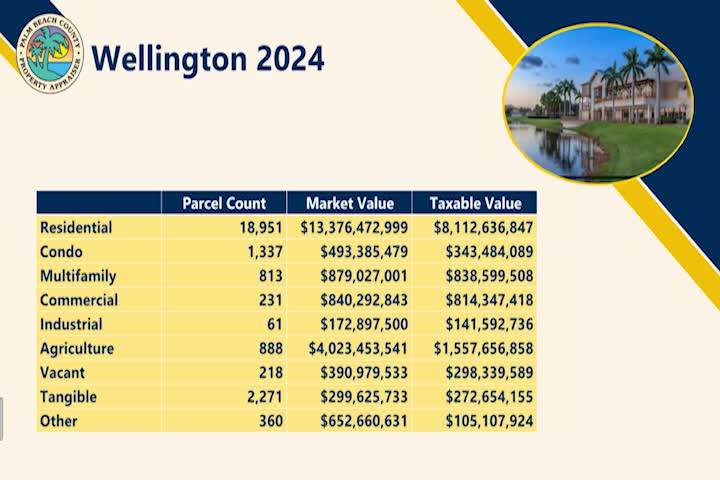
For the sale of Kpark (projected market and taxable values discussed by staff), the recommendations were: assign up to $8,000,000 to reach the rate-stabilization reserve target (noting timing could span 12—24 months), appropriate $22,000,000 for construction of a PBSO substation (staff noted design funding is already in the FY budget), appropriate $10,000,000 to the Acme stormwater plan, and assign remaining proceeds (~$7,000,000) to the facility and infrastructure reserve.
Utilities and assessments: Staff recommended continuing a previously adopted utility rate program (the third year of an approximately 10% annual increase) in line with the village—s rate consultant to address cost pressures and capital needs; staff also recommended continuing borrowing for utility capital projects through low-interest state revolving funds and continuing modest annual increases in solid-waste user charges tied to contract escalation clauses.
Acme Improvement District: Staff again highlighted the Acme pump station program as a major multi-year capital need and proposed an Acme assessment increase from $2.55 to $2.75 per unit (staff said the current Acme rate was $2.55 and earlier increases had been adopted two years prior).
Process notes: Staff said several proceeds would arrive in phases (PFAS litigation funds are to be paid in installments and many receipts will be spread over 12—24 months), and that capital projects should follow typical budgeting and design reviews. No formal appropriation votes were taken at the visioning session; staff asked for direction to use the sales and litigation receipts for the purposes listed once the dollars materialize.
Ending: Staff said the proposed allocations would strengthen reserves, provide match funding for grant programs and fund urgent critical infrastructure (stormwater in Acme and a PBSO substation) while preserving the village—s fiscal flexibility.