Get Full Government Meeting Transcripts, Videos, & Alerts Forever!
Get email alerts on the Tax Policy topic
No spam. Unsubscribe anytime.
Council refers citywide taxation-policy work to finance committee after staff presentation
Summary
Council accepted a staff presentation proposing a formal taxation policy framework covering fees, assessments and levies and voted unanimously to refer the effort to the Finance Committee for detailed work sessions.
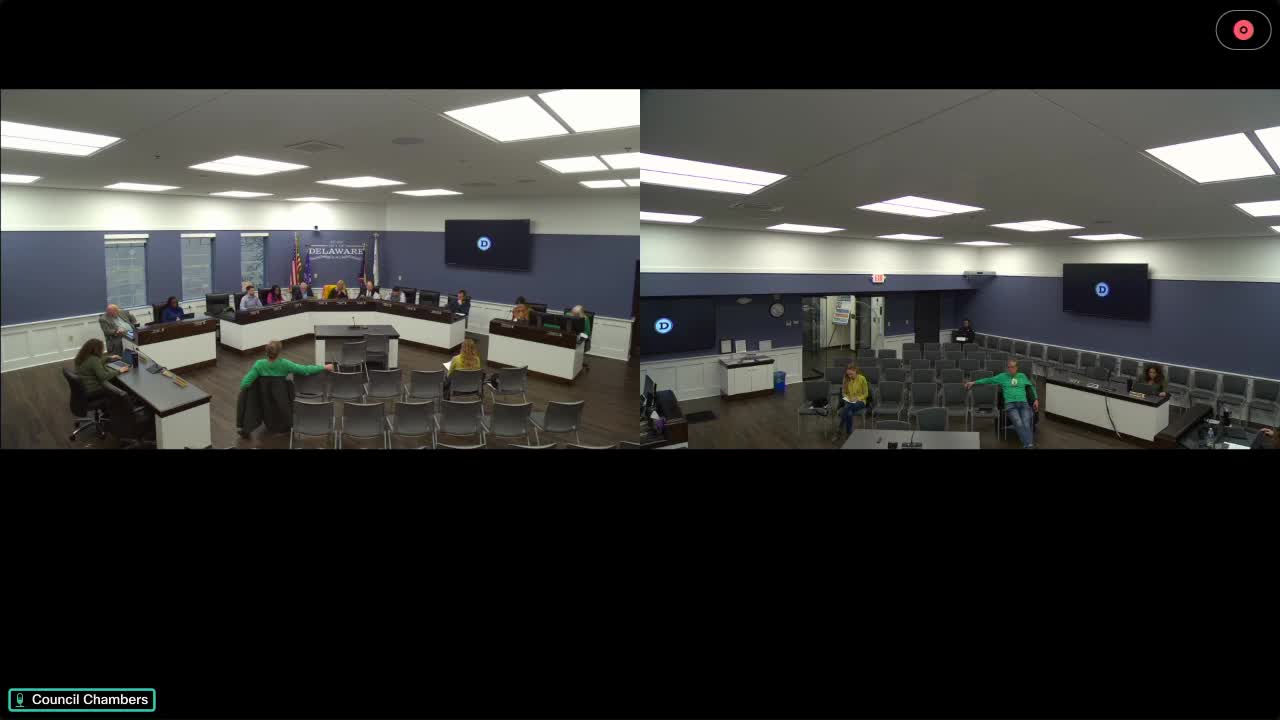
Delaware City Council on April 7 heard a presentation from staff and the city’s municipal advisor outlining a proposed taxation policy intended to guide future decisions about taxes, fees and assessments. Council voted unanimously to refer the topic to the Finance Committee for detailed work sessions.
Staff said the taxation policy would be a concise, public document that defines purpose, objectives and processes for when and how the city pursues different revenue sources — including income tax, property tax levies, special assessments, impact fees and user-rate structures. Staff described the policy as a tool to align long-term capital planning, operating budgets and community priorities rather than a single levy proposal.
Alicia Malone (finance staff) and City Manager Brake framed the policy as a mechanism to address growing capital needs such as street repairs and utility projects, to set benchmarks for fund balances, and to create a predictable review cycle that ties tax and fee adjustments to capital and operating planning. Staff said the work could involve 4 to 6 committee work sessions of about two hours each, with staff preparing comparative analyses and options for council review during the budget process.
Council discussion touched on examples from other municipalities, protections for small downtown businesses, and the distribution of tax burdens between residents, businesses and new development. Staff noted options such as targeted special-assessment districts for neighborhood road work and incentives or fee structures to retain businesses while funding long-term infrastructure needs. The municipal advisor, David Conley, was referenced as having guided the initial framing of the policy.
Action taken: Ms. Fraser moved and Mr. Hoffman seconded a motion to refer the taxation-policy conversation to the Finance Committee. Roll call: Haynes — yes; Hoffman — yes; Fraser — yes; Vice Mayor Schaefer — yes; Mayor Bridal — yes. Outcome: referral approved. Finance-committee staff work was described as likely to occur through spring and summer and to feed into the capital and operating budget cycles.
Why it matters: Council and staff characterized the policy as an effort to make revenue decisions more transparent and consistent across administrations, to preserve current priorities such as crediting taxpayers where appropriate, and to provide a framework for evaluating revenue options—rather than immediately proposing tax increases.
Next steps: Staff recommended forming the working group within the Finance Committee, preparing revenue and fee inventories, and scheduling the 4–6 work sessions. The committee will present a draft policy back to full council for discussion and possible adoption before the next budget cycle.