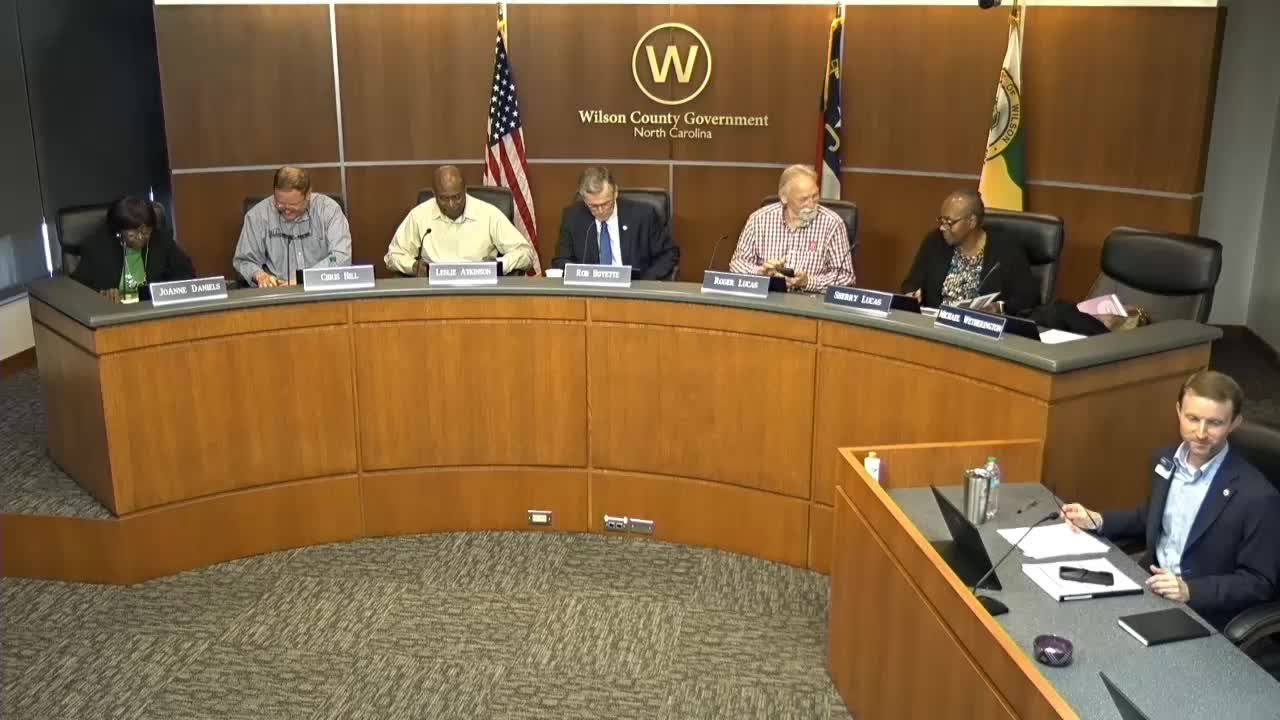
Wilson Community College asks Wilson County for $3 million in capital funds, stresses need for public safety training facility
Loading...
Summary
Wilson Community College President Dr. Jamie Woods told the Wilson County Board of Commissioners the college is seeking about $2.93 million in operating support and roughly $3 million in capital funding for facility repairs, a new public safety training building and other campus needs.
Wilson Community College President Dr. Jamie Woods told the Wilson County Board of Commissioners at a recess meeting that the college is asking the county to include roughly $2,934,071 in operating support and about $3,000,000 in capital funding in its 2025–26 budget to cover salary increases, deferred maintenance and a proposed public safety training facility.
Why it matters: College officials said the capital request would fund critical repairs and upgrades — from a replacement roof on Building J to parking-lot repairs — and would support a new public safety building intended to house Basic Law Enforcement and fire training that administrators said is now conducted in cramped, aged or temporary spaces.
The college’s finance vice president, Jessica Jones, told commissioners the budget includes a salary-related increase of $85,458 — about 3% over the previous year — intended to align locally funded employee pay with anticipated state increases. Jones said the college is also asking for capital allocations for campus repairs and renovation, including a request to add roughly $150,000 to complete a previously started roof replacement on Building J after contractors identified additional interior work. Jones listed other capital asks with amounts provided in the presentation: parking-lot repairs ($202,000), a traffic-flow collaboration fund to address congestion adjacent to nearby schools ($150,000), a greenhouse laboratory for the agribusiness technology program ($100,000) and $40,000 to purchase a replacement maintenance vehicle. She said chiller units serving Buildings A–C have reached end of life and a replacement would entail a long lead time (Jones cited about 36 weeks).
Dr. Woods framed the public safety building request as the college’s most significant near-term facility need. She said Basic Law Enforcement Academy instruction is currently in shared space in the lower level of Building J and that fire academy trainees work in space described as trailers that are more than 30 years old. "We don't want someone to get hurt," Woods said when describing the site constraints and the need for a more suitable training environment. Woods said the college reviewed comparable facilities at similar-size institutions and noted that construction costs for specialized training spaces — with locker rooms, kitchens and simulated training areas — can run roughly $500 per square foot, a figure she described as "a little seems a little expensive" but consistent with the outfitting required for public-safety instruction.
Woods also said the college has state capital infrastructure funds previously set aside for a health sciences building and that the college intends to redirect some of those dollars toward the public safety project because of the immediate need. She asked the county for whatever level of support the budget could bear.
On workforce and program connections, Woods described coordination with local law enforcement and fire leadership, naming Sheriff Woodard and Chief Boykin (both identified in the presentation as local public-safety partners) and saying those agencies told the college the facilities' age and condition hamper recruitment and training. Jones described recent on-campus investments paid from carryover county funds — upgrades to HVAC controls, completion of a Building G HVAC replacement and renovations to create EMS and simulation spaces — and said these changes supported a new full-time director for the college’s EMS program. Woods said Kyle (the EMS program lead referenced in the presentation) was pursuing program accreditation and that preliminary feedback was positive; she said the college expects work on accreditation to be complete by summer with potential follow-up by fall.
Commissioners asked clarifying questions about the public safety site and partnerships. When asked where the proposed building would be sited, Woods said the college would look at the 301 training area where much of fire training is now held and confirmed that the property is county property. Woods said the college would continue to coordinate with the city and local agencies on aspects such as the firing range and shared training times but that, if the new facility is built, some shared uses of the existing training area would likely change.
The presentation included multiple line-item figures for repair and replacement needs; Jones told commissioners the college had "depleted" its campus repair fund in recent years and was seeking the county allocation to avoid repeatedly returning with smaller requests. Jones summarized the overall plan by restating the college’s operating and capital asks and thanking the commissioners for prior support.
Ending: Commissioners did not vote on the college request at the meeting; the presentation concluded with questions from the board and a transition to the Wilson County Schools budget presentation.