Get Full Government Meeting Transcripts, Videos, & Alerts Forever!
Get email alerts on the Budget 2025 26 topic
No spam. Unsubscribe anytime.
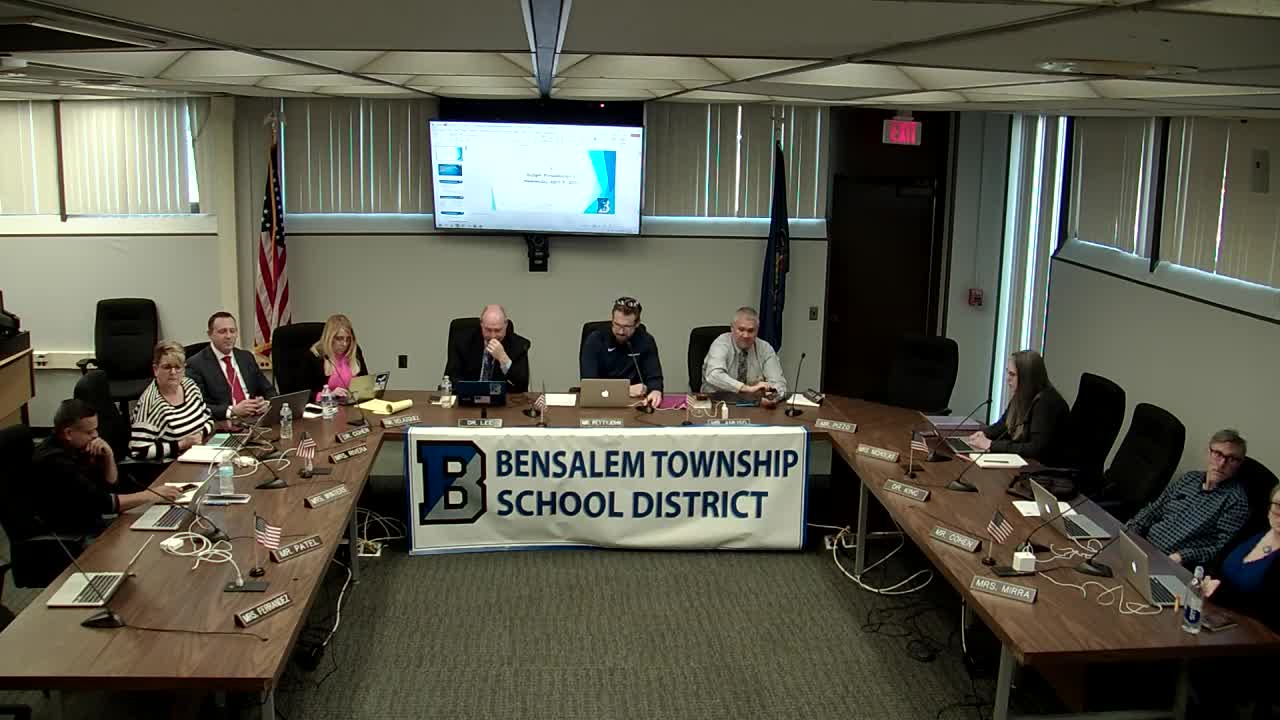
Bensalem budget work session: administrators warn of multimillion‑dollar shortfall; staff request seven teaching positions
Summary
Administrators told the Bensalem Township School District board that the draft 2025–26 general fund budget shows a multimillion‑dollar gap under current revenue assumptions and that several operational pressures — rising special‑education enrollment, pension contribution increases, device replacement cycles, and possible federal changes to school‑meal eligibility — could widen the gap.
Bensalem Township School District administrators presented a series of department budget briefings at a budget work session that followed the board’s business meeting. Presenters said the district faces a projected budget shortage of about $7.26 million without additional local revenue; applying the district’s full Act 1 tax index (4.8% as presented) would reduce the shortfall to roughly $2.4 million.
Superintendent and business‑office staff summarized revenue and expenditure assumptions used in the draft budget. The business office reported preliminary total expenditures of about $188.0 million after a set of late changes and estimated total revenues of about $180.4 million with no tax increase, producing the larger gap. With the Act 1 increase the staff showed, revenues would rise to roughly $185.0 million and the gap would narrow to roughly $2.4 million.
Key budget drivers and departmental highlights
Special services: Dr. (name in transcript: Dr.) Cohen, director of Special Services, said the district has roughly 1,550 students receiving special‑education services (a figure that has risen year over year) and that the federal IDEA allocation used in planning was $1,560,000. Cohen reiterated that special‑education costs can vary widely by student and that state and federal funding cover only a portion of total special‑education expenditures.
Teaching and learning: Director Donna Migg walked the board through a curriculum renewal cycle (chapter 4 of the Pennsylvania School Code) and said the Teaching & Learning proposed budget is $2,221,529, an increase driven by a new elementary math curriculum, professional development and inflationary cost increases.
Staffing requests: Administrators requested seven new teaching positions (the district estimated an average cost “just under $125,000 each” in the presentation), totaling roughly $873,862 in added payroll and related costs; staff also reported retirement/attrition savings that partially offset personnel increases. The board and staff noted that any staffing increases affect the charter‑tuition formula (staff cited a roughly 17% effect on charter charges for every dollar added to the general fund expenditures).
Instructional allocations: Presenters described per‑pupil allotments for building budgets: elementary per‑pupil allotment reported at $97, middle‑school allotment at $130 and high‑school allotment near $277 (presenters explained these figures cover classroom supplies and building‑level operational items, not salaries or central curricular purchases).
IT and devices: IT Director Nicholas Cammarano reported districtwide one‑to‑one devices for grades 1–12 and a four‑year Chromebook replacement cycle that is a large cost driver. He warned that newly announced tariffs (described in the presentation as a near‑term 25% tariff on some imports) could increase equipment costs beyond current estimates.
Transportation and facilities: The transportation presentation (presented by district staff in place of the absent transportation director) outlined an 85‑vehicle bus fleet (65 full‑size buses, seven midsize, three lift buses and 10 minibuses) plus 25 vans. Staff said they will recommend purchasing an additional two to four vans to meet expanding special‑education transportation needs rather than outsourcing runs to the intermediate unit. Facilities manager Kevin Curry described district building assets (approximately 1.3 million square feet across nine schools and roughly 300 acres of grounds), and noted rising costs for utilities, HVAC repairs and contracted services.
Athletics and activities: Director John Mullaney presented the athletics and activities budget. He said the department’s current budget is about $448,050 and proposed an increase of approximately $36,750 to cover uniforms, equipment, marching band costs and rental versus purchase decisions for timing equipment at track meets.
School food program and federal proposals: Food service supervisor Jenna Demargin briefed the board on Community Eligibility Provision (CEP), the federal policy that currently allows the district to offer free lunch to all students. Staff described a pending House budget proposal under discussion in Washington that would raise the eligibility threshold from 25% to 60%, require income verification of every free/reduced application, and curtail categorical eligibility tied to SNAP/TANF/Medicaid. District staff said those federal proposals were not enacted law at the time of the presentation, but if adopted they could reduce or change CEP eligibility, increase administrative workload and raise unpaid meal debt that cannot be covered by the food‑service enterprise fund.
Pensions and long‑term liabilities: Business‑office staff warned about growing employer contribution rates for the state retirement system; presentation slides showed current employer contribution rates above 33% with projected further increases under actuarial assumptions. Staff urged the board to consider long‑term plans to address pension‑driven cost growth.
Why it matters: Administrators presented multiple operating pressures that together widen the gap between projected revenue and expenditures: rising special‑education placements and costs, pension contribution volatility, device replacement cycles, and potential federal changes to school‑meal rules. The board will consider these items as it develops the preliminary budget and the May proposed property‑tax resolution.