Get Full Government Meeting Transcripts, Videos, & Alerts Forever!
Get email alerts on the Street Maintenance topic
No spam. Unsubscribe anytime.
Council presses DPW on pothole response, street sweeping coverage and hazardous‑waste drop‑off capacity
Summary
Council members used the April 17 Public Works Committee meeting to press DPW for faster pothole response, clearer street‑sweeping maps and expanded hazardous‑waste (Tax Drop) access after winter and storm impacts caused heavy demand and long lines at drop‑off sites.
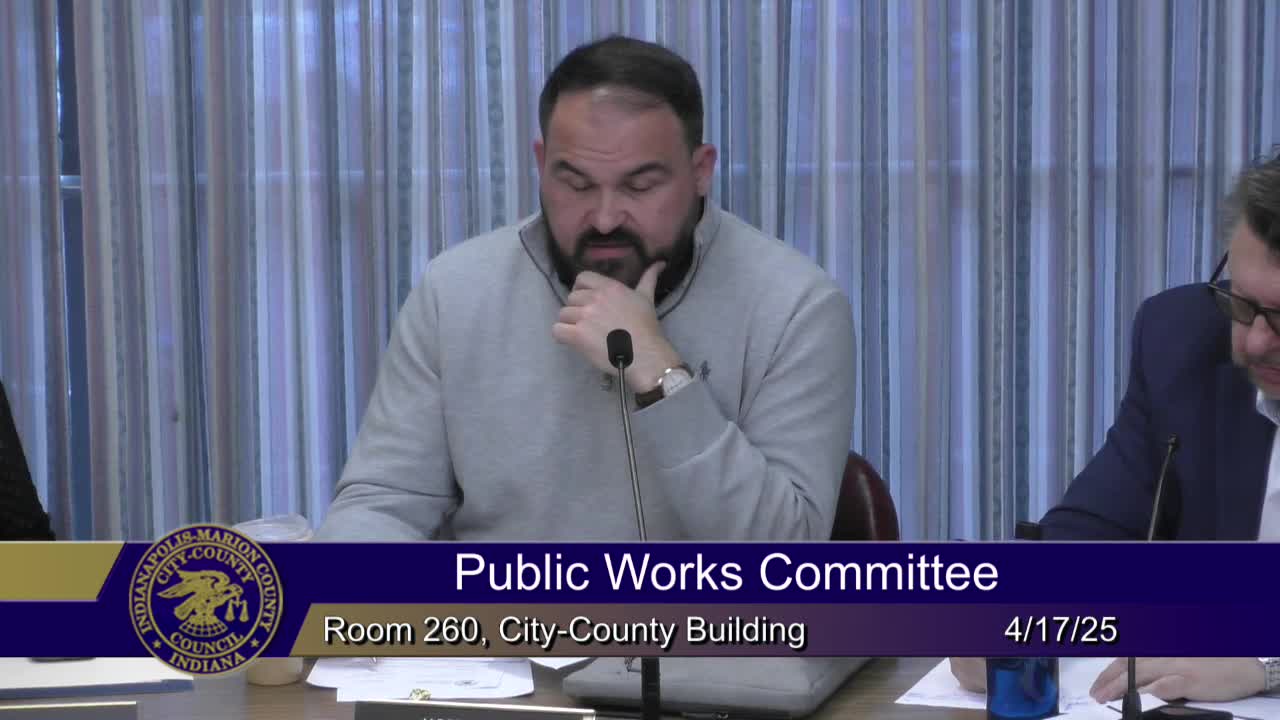
A range of council members on April 17 pressed Indianapolis Department of Public Works officials about pothole repair times, the extent of street‑sweeping coverage and hazardous‑waste drop‑off capacity amid heavy winter and storm work.
Councilor Jared Evans and others described delayed pothole repairs and suggested contracting or additional crews to accelerate early‑season catch‑up. Director Todd Wilson said crews prioritized thoroughfares first and were working extended shifts; he also cited weather‑related delays: “We had some favorable weather this year to get through that. I know the winter has been challenged for weather as well... when it's raining, we can't get out there and fill potholes,” Wilson said. DPW reported 2,627 tons of asphalt used for patching and 30,000 potholes addressed in the season’s first three months, and noted crews used about 21,000 tons of salt during snow response.
Councilors sought clarity on the city’s street‑sweeping program and whether the contractor CEG still performs sweeping in portions of the CSO area (central county). Tim Cochran, administrator of street sweeping and traffic operations, said the city sweeps arterials county‑line to county‑line once a year and sweeps arterials within the CSO area more frequently under contract. He described a division of duties that includes a contracted sweep area and DPW’s in‑house sweeping operations.
Several councilors raised concerns about the Mayor’s Action Center (MAC) work‑order process, where residents reported cases closed publicly when a work order had merely been assigned internally. Sam Barris, DPW chief financial officer, said the department and MAC are working on better public‑facing status displays and pointed to duplicate reports as an explanation for some closed cases. “That's something that we've been working through with their team,” Barris said.
Councilors also pressed for more hazardous‑waste drop‑off capacity. Councilor Krista Carlino and others said long lines at Tax Drop locations (notably Perry Township Government Center) were creating traffic and access problems; DPW said it would continue to explore additional locations and frequency and coordinate with partners to reduce wait times.
Why it matters: pothole damage, sweeping schedules and hazardous‑waste access are frequent constituent complaints that affect safety, local traffic and neighborhood quality of life. Councilors asked DPW to present clearer maps and schedules, explore contractor options for rapid pothole catch‑up early in the season, and commit to more frequent Tax Drop access in the short term if new locations cannot be found.
What’s next: DPW said it will provide a more detailed breakdown of sweeping assets and planned schedules, a list of available street‑sweeping trucks and a deeper look at the tort‑claim process and budget interactions related to vehicle damage from road conditions.