Get Full Government Meeting Transcripts, Videos, & Alerts Forever!
Get email alerts on the Solid Waste topic
No spam. Unsubscribe anytime.
Indianapolis awards major solid‑waste contracts; Lakeshore Recycling Systems to begin collections Jan. 1, 2026; universal curbside recycling planned for 2028
Summary
DPW told the Public Works Committee on April 17 that Lakeshore Recycling Systems will begin newly awarded curbside collection contracts on Jan. 1, 2026, while Waste Management will process recyclables at a planned new $60 million MRF; the city plans a phased move to universal curbside recycling beginning in 2028.
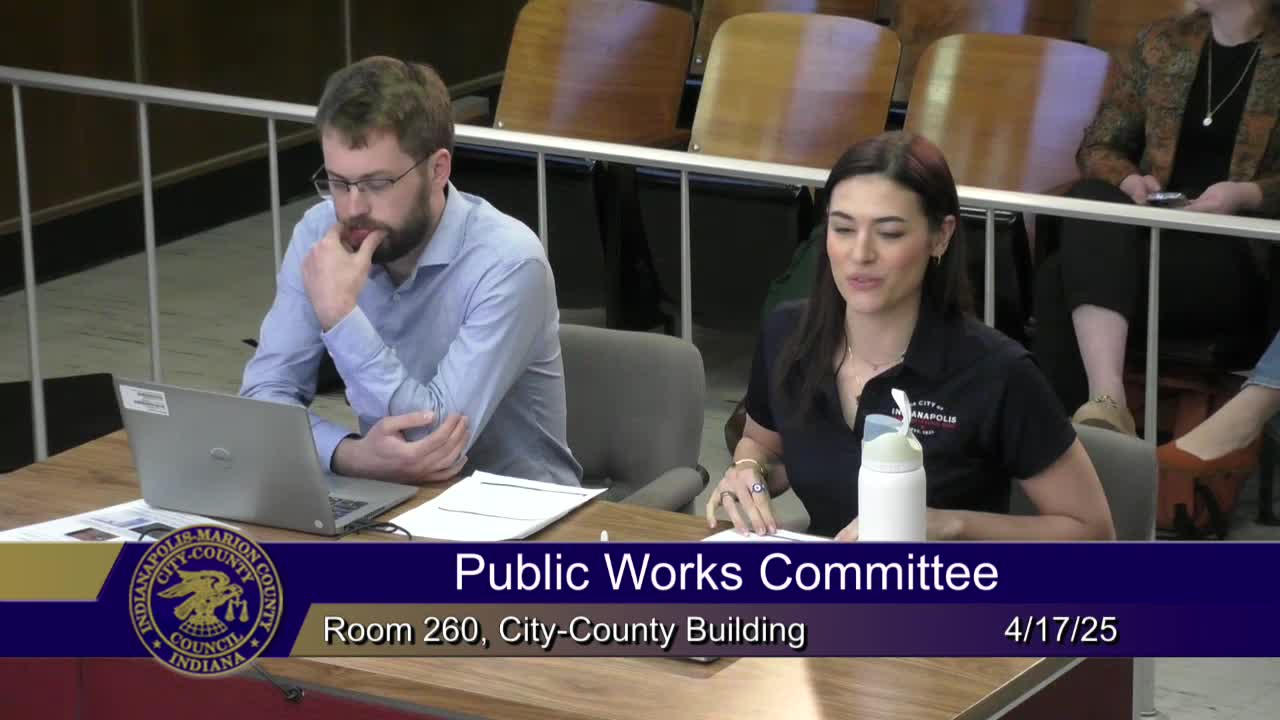
The Indianapolis Department of Public Works outlined a multi‑year solid‑waste procurement plan to the Public Works Committee on April 17, 2025, including vendor awards, transition timing and a planned shift to universal curbside recycling in 2028.
DPW said Lakeshore Recycling Systems (LRS) won the collection contract for several districts — specifically districts 1, 2, 3, 4, 6, 9 and 10 — covering about 57,000 units; DPW crews and AFSCME Local 725 will continue to service districts 5, 7, 8 and 11 (about 20,000 units). LRS’s collection contracts take effect Jan. 1, 2026, DPW said. Sean Rock, deputy director of solid waste, said LRS is hiring local staff and will bring personnel from its head office to Indianapolis during the transition period.
On processing and disposal, Natalie (Deputy/Administrator, Solid Waste) told the committee that Waste Management (WM) will process the city’s recyclable materials and plans to build a new $60 million materials‑recovery facility (MRF) to replace an older plant on the city’s west side (the former Ray’s facility). ReWorld (formerly Covanta) will remain the primary disposer for non‑recyclable waste through its waste‑to‑energy facility; Southside Landfill will be a secondary disposal and organics (leaf) site.
DPW said the new contracts produce immediate savings on collection: the average per‑unit monthly trash fee under existing contracts is about $11.25, and the new contract starts at $7.88 per unit per month. DPW’s financial summary projects more than $7 million in annual savings in 2026, growing to more than $10 million later in the contract term. The department estimated roughly $13 million would be the first full‑year cost for a universal curbside recycling program that would serve about 277,000 units; DPW plans a $3.87 per‑unit per‑month charge for that universal recycling service once rolled out.
Between 2026 and 2027 DPW will continue subscription (optional) biweekly curbside recycling at a slightly reduced price; beginning in 2028 the city will begin a phased transition to universal curbside recycling. Natalie said the start date was chosen to allow continuity of existing services, allow WM to open the new MRF and provide time for an education and outreach campaign aimed at lowering contamination in the recycling stream.
DPW stressed cart logistics: residents currently with vendor carts (WM or Republic) will receive new uniform carts from the incoming contractor prior to transition; those outgoing vendor carts will be collected by the incumbent vendors and recycled. DPW negotiated ownership of carts under the new agreements so the city retains the carts at the end of the contract term.
Procurement process: DPW said the procurement team included DPW solid waste, policy and planning, finance and the office of sustainability, and was overseen by the city purchasing division and an external consultant. Staff said they provided a 30‑day public comment window on the draft RFP and used a scoring process with multiple DPW offices signing nondisclosure agreements for fairness.
Councilors asked operational questions about cart deployment, how the transition will be billed and whether the department had firm commitments on the MRF location. DPW said LRS will coordinate closely with incumbent vendors and the city to transfer subscription customers, and Daniel Stevenson, administrator strategy and tech, said the new WM MRF will replace the old Ray’s facility on the west side (exact cross streets not provided in presentation).
Why it matters: DPW described this as a large, multi‑year procurement that will change how many residents receive collection and how recycling is processed in Indianapolis, while producing near‑term savings for trash collection costs. The timing and public education campaign are central to the city’s plan to limit contamination and hold down processing costs once universal curbside recycling begins.
Noted caveats: DPW officials repeatedly warned that recycling processing costs depend on commodity markets and contamination rates; those variables affect long‑term fiscal outcomes for the recycling stream. The department committed to continued updates to the committee as transition activity accelerates through 2025.
Selected quotes: “Beginning in 2028, the city in partnership with LRS will begin to transition to universal curbside recycling,” Natalie said. “Cascade did our deployment when we deployed 60,000 carts back in 2010. So I know they're capable of doing this,” Sean Rock said about the cart vendor and deployment plans.
What’s next: contracts take effect Jan. 1, 2026; DPW and LRS said they will increase meeting cadence as the transition approaches and will present additional details about cart rollout, billing transfer for subscription customers and the education plan to the committee.