Get Full Government Meeting Transcripts, Videos, & Alerts Forever!
Get email alerts on the Budget Compensation topic
No spam. Unsubscribe anytime.
RISD trustees and staff map several pay scenarios as state funding talks continue
Summary
Superintendent Tabitha Branham and district finance and HR leaders on April 17 presented the Board of Trustees with multiple compensation scenarios, market-adjustment proposals and personnel requests, while saying a final recommendation depends on the Texas Legislature's pending decisions about funding and allowable uses.
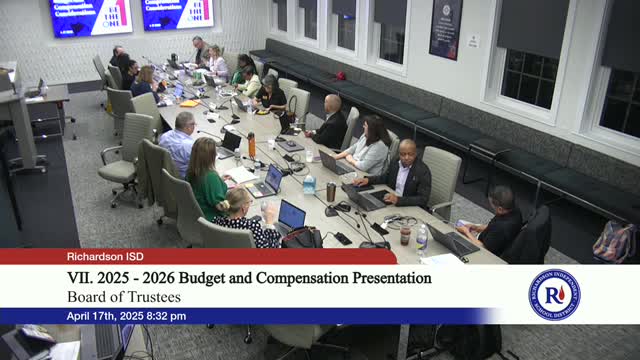
Superintendent Tabitha Branham and district finance and HR officials briefed the Richardson ISD Board of Trustees on April 17 on developing the 2025—6 budget and a package of compensation scenarios for employees in light of ongoing state legislative activity.
"One of the most important things that we as a team of 8 can do is determine how we are going to compensate our staff," Branham told the board, anchoring a presentation that walked trustees through three illustrative raise models, market adjustments for several hard-to-recruit job classes and a set of personnel additions the administration says are needed for special education, pre-K expansion and the district's child-care academies.
Staff presented three high-level scenarios: a conservative model built on a roughly 2.5% across-the-board increase for teacher types and non'teacher employees with a new starting teacher salary modeled at about $61,700; a middle model with a 3% across-the-board increase and a $62,000 starting teacher salary; and a more aggressive model that raises the teacher schedule (illustrative starting salary $63,000) and applies a 3% increase for non-teacher staff. Each scenario was presented as a cost estimate before accounting for potential new state funding.
District staff noted several other cost elements shown in the slides: market adjustments they flagged for job groups furthest below the market (assistant principals, licensed specialists in school psychology and speech/language, selected campus executive assistants, and certain instructional and special-education paraprofessionals) with an estimated combined cost of about $1.6 million; new personnel needs tied primarily to special education, pre-K expansion and the Little Rams/Wildcats child learning academy (roughly $5.6 million in personnel additions listed); non-personnel increases of about $430,000; and targeted budget decreases/efficiencies of roughly $2.3 million.
Staff explained the difficulty of finalizing a recommendation while the Texas Legislature continues to consider education funding bills. They said legal language in draft bills matters for budget design because some proposals limit how districts must spend any new state revenue (examples cited by staff: language that would require a large share of new money to be spent as salary increases for classroom teachers only, rather than as a broader compensation package).
Trustees asked about the effect of last year's raise on retention and veteran staffing. District HR reported a decline in turnover (from about 17% down to 13%) and an increase in experienced teachers, changes staff attributed in part to the board's prior compensation choices. Trustees also probed options such as increasing the district contribution to employee health insurance; staff presented the estimated cost of raising the monthly district contribution from $313 to $350 (about $1.8 million) or to $375 (about $2.9 million), and noted the legislature's treatment of health-insurance contributions could affect what counts as salary under funding formulas.
Board members generally favored a bold approach to preserves momentum on teacher pay. Trustees asked staff to refine scenario 3 (adjusted teacher schedule plus targeted market adjustments), to provide clearer compression analysis and to return with final costed recommendations once legislative outcomes are known. No formal action was taken at the April 17 meeting.