Get Full Government Meeting Transcripts, Videos, & Alerts Forever!
Get email alerts on the Public Transit A Train Godzone topic
No spam. Unsubscribe anytime.
DCTA tells Highland Village board A Train ridership is recovering, highlights GoZone use and rail-trail links
Summary
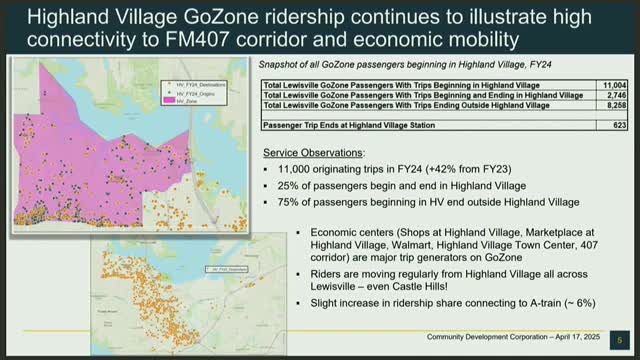
DCTA staff reported that A Train commuter rail ridership is recovering toward pre-pandemic levels, highlighted concentrated GoZone demand along FM 407, and described rail-trail counters and wayfinding efforts tied to multimodal connections at the Highland Village/Lewisville Lake station.
Paul, a DCTA representative, told the Highland Village Community Development Corporation that DCTA is seeing recovery on its A Train commuter rail and growth in on-demand GoZone trips concentrated along the FM 407 corridor. “We're seeing within our data sets ... a concentration along that 407 corridor,” Paul said, noting GoZone activity also shows movement to and from Lewisville.
The presentation cited a national APTA dataset showing the A Train ranked sixth among commuter rails for recovery; DCTA projects “upwards of almost 300,000 rides for FY25,” Paul said. He described DCTA’s A Train Enhancement Program as a multi-part effort to speed service, extend the line farther south to Downtown Carrollton to improve regional connections, and eventually aim for a 15-minute train frequency goal.
Why the extra ridership in October? Paul attributed an October spike to large events such as the state fair, which also boosted ridership on DART and Trinity Metro lines. At the Highland Village/Lewisville Lake station, DCTA presented trail-counter data showing an average of about 41 pedestrians and 19 cyclists at the station-area counter; presenters cautioned those counts capture trail users adjacent to the station, not a breakdown of how many Highland Village residents rode the train.
Council and meeting participants asked for more granular boarding data. One attendee asked how many Highland Village residents use the train; DCTA said it could derive closer metrics from pass data and follow up with station-specific averages. An audience member asked whether Flower Mound had declined GoZone; Paul said Flower Mound opted for a different mobility product that focuses on transporting elderly and disabled residents across Denton County.
DCTA staff emphasized multimodal and place-making measures to integrate the rail into member cities: a 19-mile A Train rail-trail runs alongside stations, and DCTA is working to connect trails, stations and downtowns through signage, wayfinding and promotional campaigns. Paul said DCTA has a new marketing agency and is pursuing sponsorship and signage opportunities to increase awareness; he suggested directional signs along trails (for example: “A Train — X miles”) to show connectivity to downtown destinations and airports. He also flagged the potential value for riders if the corridor eventually provided a direct two-seat commute to DFW Airport, which he described as a possible “game changer.”
On proposed new stations, Corinth was described as “being considered” but not part of an active plan: Paul said DCTA is prepared to have conversations if Corinth’s staff are ready, but there has been no detailed agreement. “There’s been no deal made, no detailed conversation in that regard,” he said.
The presentation noted safety and data limitations. DCTA and questioners discussed micro-mobility on trails (e-bikes and scooters), and DCTA agreed to follow up to clarify how counters classify scooters versus bicycles. DCTA also said it would coordinate with member cities on trail wayfinding, signage, and marketing to promote ridership.
DCTA's remarks were followed by council and resident questions about safety standards when DCTA service interfaces with other regional rail operators; DCTA said it manages its own safety program and cannot speak for other operators’ programs.
Meeting participants asked DCTA to provide more detailed, Highland Village–specific ridership and boarding counts and to return with follow-up materials. The presentation closed with DCTA inviting continued coordination on wayfinding, promotional campaigns and the long-range A Train enhancement plan.