Get Full Government Meeting Transcripts, Videos, & Alerts Forever!
Get email alerts on the Opioid Treatment Zoning topic
No spam. Unsubscribe anytime.
Prince George’s Council committee holds bills to create zoning category for opioid treatment centers after debate over access and safeguards
Summary
The Planning, Housing & Economic Development Committee on April 17 held two measures — CB 27-2025 and CR 43-2025 — that would create a new principal-use category for opioid treatment centers and allow applicants to begin permit review under new standards.
The Planning, Housing & Economic Development Committee on April 17 held two measures — CB 27-2025 and CR 43-2025 — that would create a new principal-use category for opioid treatment centers and allow applicants to begin permit review under new standards.
Supporters and county staff said the zoning change responds to a large treatment shortfall in Prince George’s County. Anya Makarova, senior adviser to the Prince George’s County Board of Health, told the committee, "Prince George's County continuously ranks number 3 for opioid related deaths after Baltimore City and Baltimore County," and said a University of Maryland School of Medicine needs assessment estimated about "4,800 Prince Georgians over the age of 15 are in need of opioid treatment." Makarova said the county currently has only one licensed opioid treatment facility.
The bills would formally define opioid treatment centers — including language that they be "by appointment only" — and authorize the use in a set of commercial and office-type zones. Staff told the committee the draft shortens a prior 1,000-foot special-exception locational buffer to a 500-foot distance from residential zones and planned residential sites. Planning staff also revised off-street parking requirements to match levels for medical offices and removed certain vehicle-access adequacy and additional health-and-safety requirements that technical staff said are not typically set by zoning.
Proponents described modern opioid treatment as outpatient medical care. Yuri Guzman, representing an ownership group called Avenue to Health, said current programs "function closer to medical offices than to methadone centers," that services are "by appointment" and that centers "are very highly regulated both by the state and the federal government." Guzman said the special-exception process can make it functionally impossible for a new operator to open because an applicant must secure a lease and spend a year or more seeking approvals before applying for a required state license.
Planning Director Lakeisha Hall told the committee her office had not completed detailed analysis of how many parcels in each zone would be affected and therefore had no formal position. David Warner, principal counsel for the Maryland-National Capital Park and Planning Commission, and the zoning hearing examiner urged technical clarifications: the examiner suggested adding language to the resolution to prevent permits being issued before the ordinance’s effective date, and Warner explained that the industrial (IE) zone generally contains warehouse and distribution uses and is not where medical office uses typically locate.
Several council members asked for more mapping and legal review before the bills proceed. Council Member Harrison and others urged a targeted study or mapping exercise to show which parcels would be eligible under a 500-foot buffer, asked whether the county would face legal exposure for treating opioid facilities differently than methadone clinics, and requested comparisons to how nearby jurisdictions regulate such facilities. Health staff emphasized the public-health justification for action but said they did not have capacity to complete an in-depth land-use study themselves.
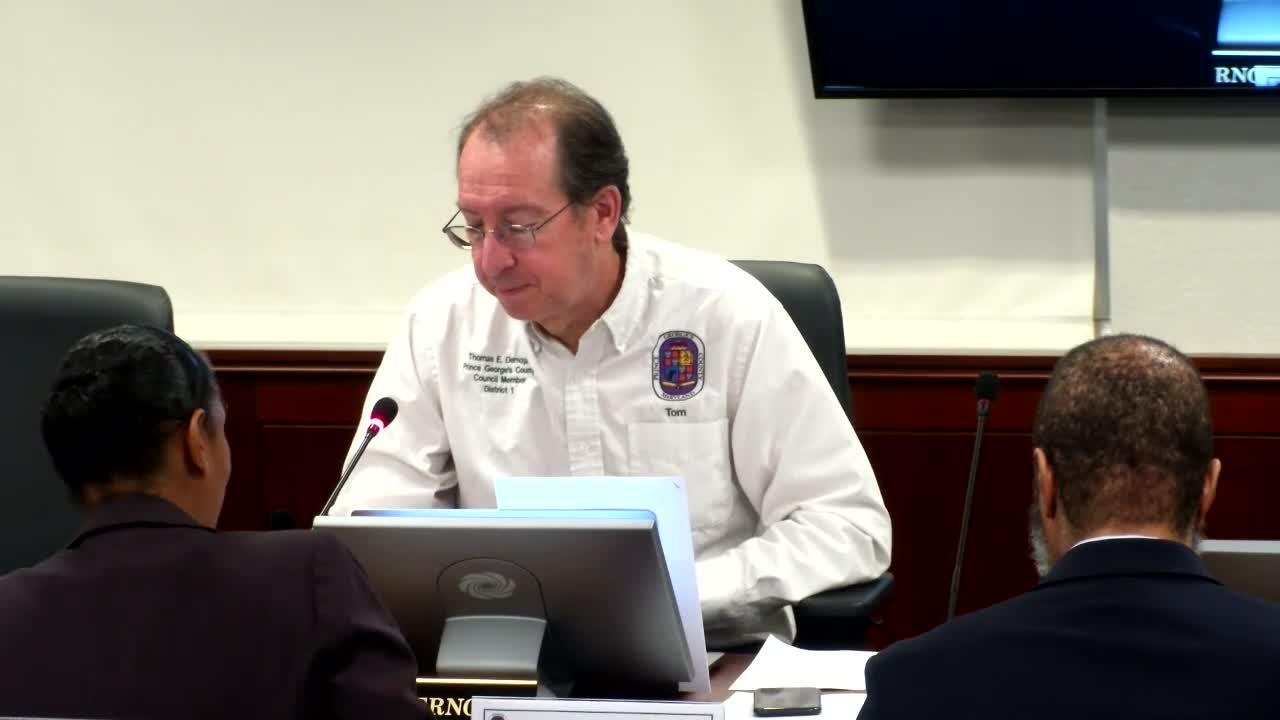
Chair DeNoga moved to hold CB 27-2025; the motion passed on a 3-0 roll call. Chair DeNoga then moved to hold CR 43-2025; that motion also passed 3-0. Committee members said they expect staff to provide a map of zones that would be acceptable under the current draft, a summary of how peer jurisdictions regulate opioid treatment centers, and suggested limited drafting edits (for example, the examiner’s proposed "no permit before effective date" language) before the bills return to committee.
The committee’s action was procedural: both measures were held for further work rather than advanced. Committee members and staff also discussed implementation risks, including potential legal challenges and the practical limits of a by‑right approach in areas dense with residential zones.
Votes at a glance
- Motion to hold CB 27-2025 (ordinance creating opioid treatment center use): mover Chair DeNoga; roll-call: Chair DeNoga — Aye; Council Member Harrison — Aye; Council Member Hawkins — Aye. Outcome: motion to hold carried (3-0).
- Motion to hold CR 43-2025 (resolution enabling applicants to apply under proposed standards): mover Council Member (motion seconded by Harrison); roll-call: Chair DeNoga — Aye; Council Member Harrison — Aye; Council Member Hawkins — Aye. Outcome: motion to hold carried (3-0).
The committee requested follow-up materials, including a map of parcels that would be permissible under the draft rules, comparative zoning language from other Maryland jurisdictions, and review of potential legal exposure. The bills will return to a future PHED meeting after those materials are prepared.