Get Full Government Meeting Transcripts, Videos, & Alerts Forever!
Get email alerts on the Juvenile Lifer Resentencing topic
No spam. Unsubscribe anytime.
State Appellate Defender Office asks lawmakers for funding to represent juvenile lifers after recent court rulings
Summary
Marlena Davin of the State Appellate Defender Office told a House appropriations subcommittee the office needs funding to expand its juvenile lifer unit to handle resentencing required by recent Michigan and U.S. Supreme Court decisions, and outlined timelines and staffing requests.
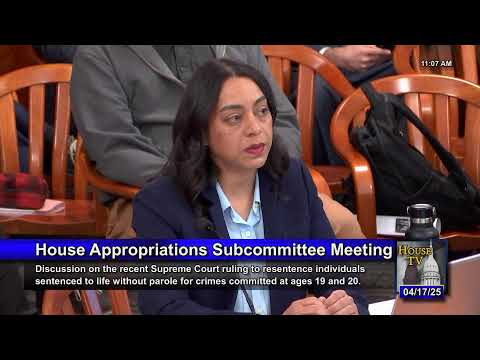
Marlena Davin, deputy director and acting director of the State Appellate Defender Office (SADO), told the Michigan House Appropriations Subcommittee on Corrections and Judiciary that the office seeks $2.3 million to add 14.5 positions to its juvenile lifer unit so it can represent people entitled to resentencing under recent court rulings.
Davin said the request is driven by a wave of appellate decisions that expanded resentencing eligibility beyond those under 18. “We want to be able to represent as many people as possible,” she told committee members, adding that SADO estimates the juvenile lifer unit could represent roughly 300 people if properly funded.
The request comes after decades of litigation beginning with the U.S. Supreme Court’s 2012 Miller decision and its 2016 Montgomery ruling, which found mandatory life-without-parole sentences for people 17 and younger unconstitutional without individualized sentencing findings. Davin told the committee Michigan had about 363 people initially entitled to resentencing under those precedents and that SADO represented “about 193” of them during that period. She described how subsequent state high-court decisions (Parks, Poole) extended similar relief to 18-year-olds and that more recent cases (identified in testimony as Sarnacki and Taylor) extend the issue to people who were 19 or 20 at the time of their offenses.
Davin outlined statutory and scheduling constraints prosecutors and defense counsel face. She cited the statute identified in testimony as “76925a,” saying prosecutors have 180 days from a decision becoming final to file motions seeking life without parole; because of appeal windows the effective deadline can be extended. She told the committee that, based on current calculations, prosecutors have until Jan. 5, 2026, to decide whether to file motions for the group affected by the Sarnacki/Taylor decisions and until Dec. 29, 2025, for the group affected by Poole. If prosecutors file motions, Davin said the defense generally has 14 days to answer; contested Miller hearings can take a week or longer and often require substantial prehearing preparation.
Davin described SADO’s juvenile lifer unit history and outcomes. She said the original unit staffed by 11 people handled the early resentencings and went to 43 contested Miller hearings; nine of those resulted in life without parole at trial, and six of those have been reversed on appeal. She told lawmakers the office aims to limit repeated hearings and appeals by providing “very good representation” that meets appellate standards.
The $2.3 million Cernicki/Taylor (as cited in testimony) request would fund attorneys, mitigation specialists, reentry staff, paralegals and support personnel. Davin also said the package would include two mitigation specialists for the Michigan Appellate Assigned Counsel System (MACS), whose roster, she said, is already strained. Separately, she described a second $2.3 million request to add 12 full-time employees over a multi-year, phased plan to reduce appellate attorney caseloads to court-recommended levels.
Davin emphasized SADO’s Project Reentry, which she said began as a volunteer effort in 2016 and now provides planning used in resentencing to help prosecutors and judges assess post-release plans. “Reentry is a public-safety issue,” she said, and described the unit’s workshops, a publicly available reentry guide and voluntary services intended to improve success after release. She told the committee SADO does not directly fund housing or services but refers clients to resources and helps craft plans prosecutors and courts can evaluate.
Committee members sought clarifications during a question-and-answer period. Davin confirmed the resentencing process does not erase convictions: “The convictions are staying in place,” she said, adding that resentencing determines whether a defendant receives life without parole or a term-of-years sentence subject to parole. She also said some people affected by the rulings will not be released until middle age or later depending on minimum terms and parole decisions.
Davin said SADO has discussed coordination with prosecutors and planned a meeting with a prosecuting attorney identified in testimony as “Pam” to discuss timelines and budgets. She said prosecutors have discretion whether to file motions and that in the prior round many prosecutors filed motions and later withdrew them after learning more about individual cases.
Davin described several ancillary requests: baseline funding to implement a collective bargaining agreement to raise salaries toward parity with the attorney general’s office and trial defenders; a small fund to pay interns to build a pipeline of public defenders; and additional staff for other SADO units.
No formal votes or motions on the budget requests were recorded in the transcript of the subcommittee session. Davin provided contact information and offered to supply additional data, including age and recidivism breakdowns she said her office could provide on request.
Why it matters: Davin told lawmakers the requested funding is intended to ensure constitutionally adequate representation in complex resentencing proceedings and to reduce the likelihood of appellate reversals that require rehearings. She framed the reentry work as a public-safety investment aimed at successful reintegration for people who entered prison as teenagers or young adults.
What’s next: Davin said SADO staff will continue coordinating with prosecutors; prosecutors’ filing deadlines cited in testimony are Dec. 29, 2025 (Poole group) and Jan. 5, 2026 (Sarnacki/Taylor group). The committee did not take a final action on SADO’s budget requests during the session recorded in the transcript.