Get Full Government Meeting Transcripts, Videos, & Alerts Forever!
Get email alerts on the Emergency Management topic
No spam. Unsubscribe anytime.
Snohomish County emergency management briefs Lynnwood council on NIMS, EOC roles and local readiness
Summary
Snohomish County Department of Emergency Management told Lynnwood council members how the county supports local responses, explained National Incident Management System roles for elected officials and outlined plans for updated county and city emergency plans, training, volunteer programs and equipment.
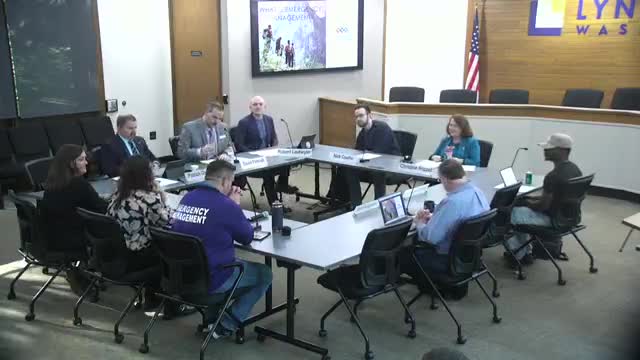
Snohomish County Department of Emergency Management officials briefed the Lynnwood City Council Wednesday on how county emergency management supports city responses, the roles elected officials play under the National Incident Management System and planned updates to county and city emergency plans.
The presentation, delivered by Lucia Schmidt, director of the Snohomish County Department of Emergency Management, and Deputy Director Dara Salmon, and training by Jared Dippel, the department’s readiness program manager, explained when the county’s Emergency Operations Center (EOC) and other support functions would activate and what local leaders can expect to do. Deputy Chief Chuck Steichen, Lynnwood’s point of contact with the county, described the city EOC setup and local staffing challenges.
The briefing matters because city officials will be expected to make time-sensitive policy decisions — including emergency declarations, delegations of purchasing authority and prioritization of scarce resources — as incidents scale beyond department capabilities. Schmidt emphasized the county’s role as “connective tissue” between agencies during incidents that exceed local operating procedures.
County officials said the department performs preparedness work before incidents, operational coordination during incidents and after-action improvement afterward. “We are active before, during and after emergencies,” Lucia Schmidt told the council, describing the county’s duty officer program that provides 24/7 on-call support and the department’s ability to scale up to an activated EOC when needed. Schmidt also noted the department has about 20 staff and that some positions are federally grant-funded and “the future of those grants is in question,” which may require reassessing service levels.
Dara Salmon outlined an upcoming countywide update to the comprehensive emergency management plan (CEMP). The timeline presented calls for draft plans to be submitted to the state by the end of 2025 and then a multi-year cycle of updates. Salmon said the county will hold a workshop with Lynnwood staff at the end of April to document Lynnwood-specific capabilities and points of contact.
Jared Dippel presented a condensed overview of the National Incident Management System (NIMS) and the Incident Command System (ICS) for senior officials, adapted from FEMA course G-402. He described the different operational roles—incident command in the field, the EOC, multi-agency coordination groups (MAC groups) and the joint information system used for public messaging—and emphasized, “the incident commander is the first position you establish; the incident commander is the last role to demobilize.” Dippel encouraged councils to pre-authorize delegations to incident commanders for items such as suspending procurement rules during proclamations of emergency.
The county described several operational resources it provides: drone teams for damage assessment and thermal imaging; mobile IT trailers with Starlink internet for remote command posts; a cache of radios and logistical supplies; and about 150 auxiliary ham-radio volunteers who provide redundant communications. Dippel and Schmidt both highlighted training and exercises: the county said it provides roughly 40% of emergency-management training in Washington and plans more exercises, culminating in a Southern Whidbey Island fault functional exercise in 2027 that Lynnwood’s EOC is expected to stand up for.
Officials briefed council members on volunteer and community programs. The county plans to reinvigorate Community Emergency Response Team (CERT) training, and Lynnwood staff described outreach to faith-based organizations to staff community points of distribution (CPODs) for mass feeding and supplies in a wide-area incident. Chief Steichen said Meadowdale High School is identified as a potential CPOD site; staff are still confirming additional locations.
Council members asked about thresholds for cities to form independent emergency-management departments (citing Bothell, Everett and Marysville) and about cert and search-and-rescue coordination. Schmidt said Hamilton-size and administrative capacity matter: “a department smaller than three people will be struggling to keep its head above water,” and she described trade-offs between local departments and the economies of scale a county program offers. On search-and-rescue, the county coordinates with the sheriff’s office and provides equipment and claims support when volunteers are injured.
Deputy Chief Chuck Steichen described Lynnwood’s EOC organization and recent staffing turnover. He said the city’s EOC follows an ICS-like structure with an EOC manager, public information, planning, operations and logistics/finance pieces and that positions generally have two assigned staff for redundancy. Steichen and county staff said it is difficult to sustain continuous 24/7 EOC operations for more than one to two weeks without outside augmentation. Steichen proposed exploring a South Snohomish County “zone EOC” that would pool EOC staffing and expertise across several adjacent cities for longer, large-scale events.
Officials also described how declarations work: the mayor may proclaim an emergency to expedite procurement and activate plans, but local code typically requires council review and affirmation within a set period. Dippel noted federal assistance under the Stafford Act is decided afterward and involves cost-share formulas; he cautioned councils not to assume federal reimbursement will cover all local costs.
The council extended its meeting by unanimous voice vote during the session to finish the briefing.
Council members requested follow-up: a written list of Lynnwood’s EOC staff and alternates for council use (to be shared with council, not posted publicly), a summary report after planned fall tabletop and exercises and clarification of rendezvous and communications procedures for council if phone networks are disrupted. Officials said Starlink and other satellite/auxiliary communications are being incorporated into city and county contingency plans.
The briefing concluded with officials urging continued training, pre-positioned contracts for equipment and supplies, and development of delegations of authority that could be signed in advance to speed emergency response.
The county said the next steps are the Lynnwood workshop on the CEMP update later that month, continued CERT and CPOD training with faith-based partners, scheduling of EOC exercises for Lynnwood staff in September and October, and pursuing a countywide plan submission to the state by the end of 2025. Council members said they want a post-exercise briefing this fall to address outstanding governance and notification questions.