Get Full Government Meeting Transcripts, Videos, & Alerts Forever!
Get email alerts on the Seismic Safety topic
No spam. Unsubscribe anytime.
Building Inspection Commission approves ordinance to inventory concrete and tilt‑up buildings, adopt voluntary retrofit standards
Summary
The Building Inspection Commission voted unanimously to approve Board of Supervisors file 250,211, directing a citywide screening of potentially vulnerable concrete and tilt‑up buildings and creating voluntary retrofit standards for owners who opt to upgrade their properties.
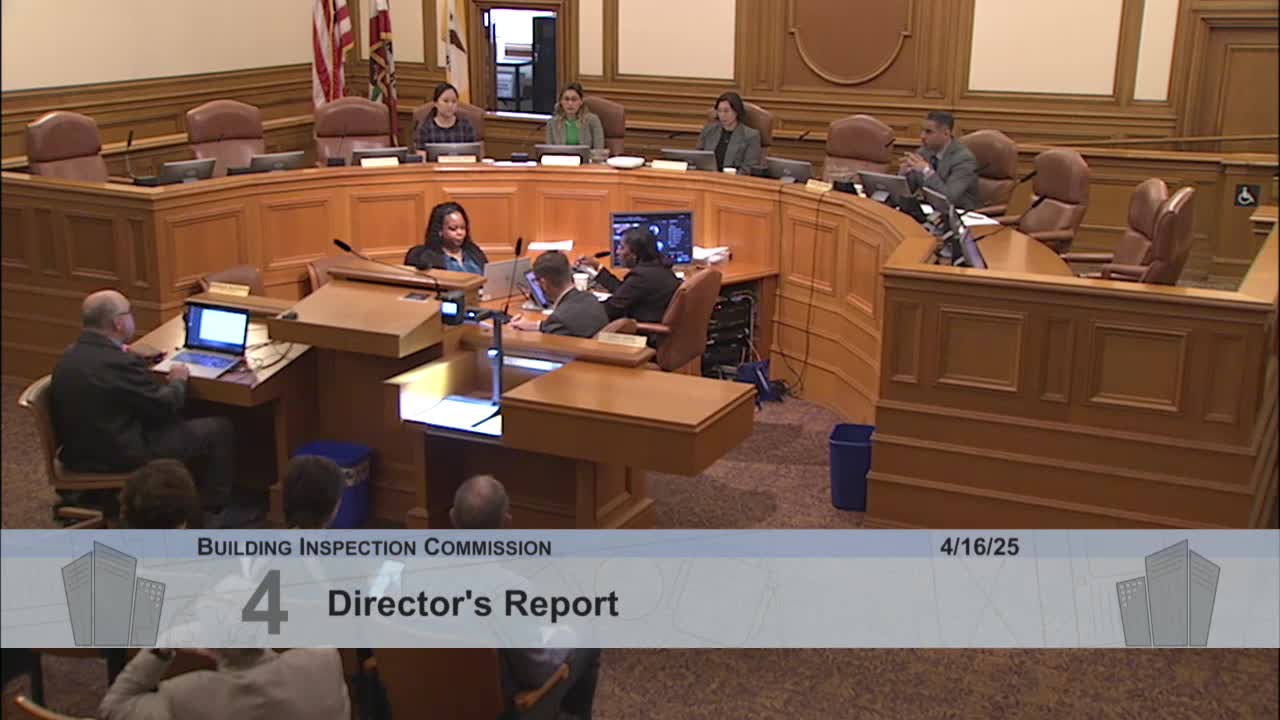
The Building Inspection Commission voted unanimously Wednesday to approve Board of Supervisors file 250,211, a measure to screen San Francisco’s inventory of potentially seismically vulnerable concrete and tilt‑up buildings and to add voluntary seismic retrofit standards to the building code.
The ordinance, introduced by Supervisor Myrna Melgar, requires owners of roughly 4,000 buildings identified by city screening to hire a licensed engineer to complete and submit a screening checklist to the Department of Building Inspection (DBI). The checklist is intended to identify which structures are actually constructed of reinforced concrete or tilt‑up panels and therefore warrant further evaluation. Laurel Matthews of the Office of Resilience and Capital Planning told the commission the checklist “would cost about 300 to $3,200 per building in engineering fees.”
Why it matters: Many San Francisco buildings were constructed before modern seismic standards were established. Supporters say a clearer inventory and a voluntary retrofit option will give building owners better information and a pathway to strengthen structures before a major quake.
Supporters and technical staff described the program as a cautious, phased approach. Supervisor Myrna Melgar, sponsor of the legislation, framed the proposal in historical and safety terms, saying in part, “When the next major earthquake hits, we must be certain that reinforced concrete buildings throughout San Francisco, regardless of age, live up to their promise of earthquake resistant safety and stay as resilient as the Beacons warehouse did for a hundred and 19 years.” Laurel Matthews, who presented technical details for the Office of Resilience and Capital Planning, told commissioners the bill’s purpose is to improve the city’s data and to give property owners a clear, non‑mandatory retrofit option: “This legislation does not mandate retrofits. I want to be really clear about that.”
The ordinance creates a screening step to confirm which buildings are concrete or tilt‑up and establishes two voluntary retrofit standards—intended to give owners certainty about acceptable retrofit approaches. Code Advisory Committee Chair Ned Fenny described the committee’s review of the proposal, saying the committee had “unanimously approved the legislation,” and noted the package includes the inventory effort, engineering criteria and a 20‑year incentive that staff and stakeholders discussed.
Staff and stakeholders emphasized practical limits and next steps. Matthews and others said it is difficult to tell a building’s structural system from the street; engineers often must inspect drawings or interiors. The city will conduct outreach, prepare a webpage, train DBI staff, and mail property owners. Matthews said her office and DBI had worked with a stakeholder group—developers, trade organizations, historic‑preservation and tenant advocates—to refine the approach and to keep screening costs as low as possible. She also said the city received a FEMA grant to develop a financing guide to help owners plan retrofit funding.
Public commenters pressed both for stronger action and for transparency. Rincon Point Neighborhoods Association representative David Osgood described an existing resilience database and urged the city to act more forcefully on known risks; structural engineer Joe Maffei, who consulted on the technical work, told commissioners the proposal is “a very important first step.” Other commenters and technical speakers discussed the high cost and disruption of concrete retrofits, the need for tenant protections, and the difficulty of identifying concrete buildings without engineering review.
The commission’s vote: Commissioner Newman moved to approve file 250,211; Commissioner Chavez seconded. The roll call showed Commissioners Chavez, Ming, Newman and Williams voting yes. The motion carried unanimously.
Next steps and caveats: The ordinance establishes voluntary retrofit standards and a city screening process; it does not impose mandatory retrofits. The legislation’s drafters and supporters said mandatory programs would require additional measures—financing, tenant protections, and other supports—that were not part of this ordinance. DBI and the Office of Resilience said they will continue stakeholder outreach and technical refinement as the program is implemented.