Get Full Government Meeting Transcripts, Videos, & Alerts Forever!
Get email alerts on the Water Quality Pfas topic
No spam. Unsubscribe anytime.
Sweetwater Authority reports lower PFAS levels after Loveland transfer; staff to issue RFQ for treatment options
Summary
Sweetwater Authority staff told the April 9 board meeting that sampling shows lower concentrations of key PFAS compounds in the reservoir and treated water after a March transfer from Lake Loveland. Staff will issue a request for qualifications for engineering firms to analyze options and costs for treatment and mitigation.
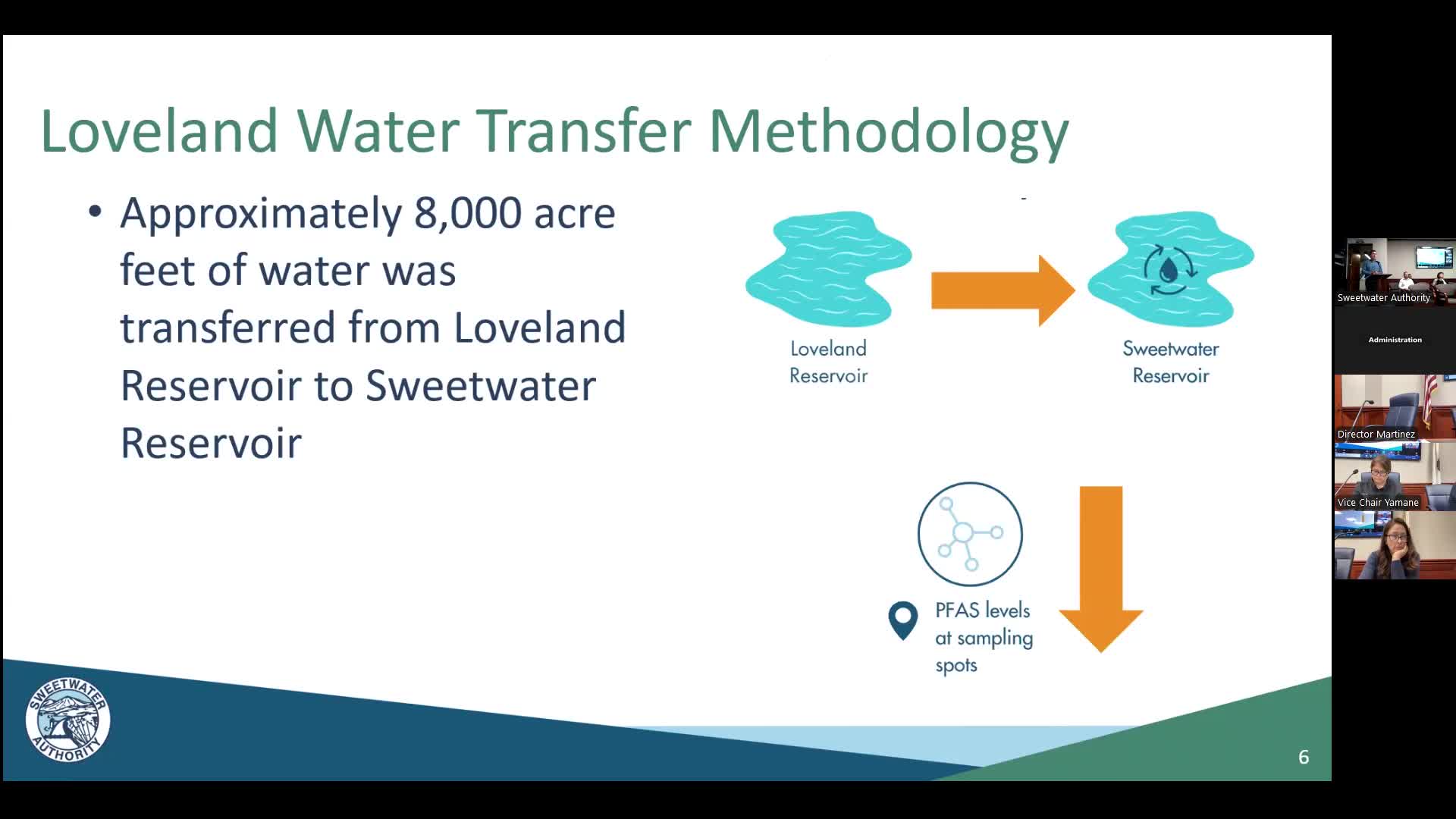
Sweetwater Authority staff reported April 9 that recent sampling shows lower concentrations of some per- and polyfluoroalkyl substances, or PFAS, in Sweetwater Reservoir and in treated water after a March transfer of roughly 8,000 acre-feet from Lake Loveland.
The board received an overview of sampling conducted between October 2024 and March 2025 and a staff explanation of trends across the watershed. “In March we transferred approximately 8,000 acre feet bringing Sweetwater Reservoir from around 40% up to about 64% capacity and that did make a difference,” staff member Justin told the board. Justin said treated-water concentrations of PFOA fell from about 9.4 parts per trillion to about 7.9 parts per trillion, and PFOS declined from about 5.7 ppt to about 3 ppt at the treatment plant clearwell effluent.
Why it matters: those PFOS levels are below the future federal maximum contaminant level of 4 ppt cited in the presentation, and staff said reductions are visible both at the reservoir intake and in the finished water delivered to customers. The general manager said staff will post the detailed dataset on the authority’s PFAS education website in the days following the meeting.
Staff emphasized that the observed reductions reflect a combination of changing flows, source-water blending and treatment effects rather than a single definitive cause. “Lower levels at higher flows could still be more significant, for example, than higher levels at trickle flow,” Justin said, noting the need for mass-balance analysis and additional sampling. Board members and commenters asked for more frequent sampling and for the historical UCMR monitoring dataset to be presented alongside the new sampling so the public can see the full picture.
Board action and next steps: the board’s packet notes that the authority previously voted to support two state bills intended to phase out PFAS in consumer products and to establish a PFAS mitigation fund (Senate Bill 682 and Senate Bill 454). At the April 9 meeting staff told the board they will prepare and issue a request for qualifications for an engineering consultant to analyze PFAS data, evaluate treatment technologies and provide cost estimates; staff said they intend to release that RFQ “within the next few weeks.”
Public comment: a resident asked whether dilution from added water was the reason for lower levels; staff replied that dilution and source-water differences are part of the explanation but that more analysis is required. Another resident asked that staff consider the wider public-safety and fire-season implications of moving water between reservoirs.
What’s next: staff will publish the sampling data on the PFAS education website and return with consultant procurement documents and further analysis for board review. The authority also said it will continue quarterly UCMR sampling and post results when available.