Get Full Government Meeting Transcripts, Videos, & Alerts Forever!
Get email alerts on the Higher Education Funding Michigan topic
No spam. Unsubscribe anytime.
Michigan public universities tell appropriations subcommittee they need reinvestment; praise Michigan Achievement Scholarship
Summary
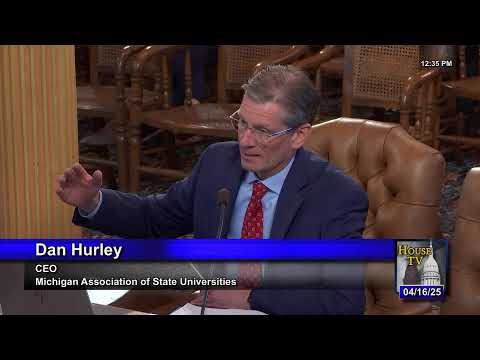
Dr. Daniel Hurley, CEO of the Michigan Association of State Universities, told the House Appropriations Subcommittee on Higher Education and Community College on March 19, 2025, that Michigan’s public universities seek a 4.8% increase in state operating support for fiscal 2026 (about $83,500,000), continued expansion of the Michigan Achievement Scholarship and a $100 million appropriation for campus infrastructure needs.
Dr. Daniel Hurley, CEO of the Michigan Association of State Universities, told the House Appropriations Subcommittee on Higher Education and Community College on March 19, 2025, that Michigan’s public universities seek a 4.8% increase in state operating support for fiscal 2026 (about $83,500,000), continued expansion of the Michigan Achievement Scholarship and a $100 million appropriation for campus infrastructure needs.
Hurley framed the request as part of a broader plea to reverse a long-term decline in state operating support for public universities. He said Michigan fell from roughly 20th in the nation to 41st in per-capita state higher-education funding over the last two decades, leaving state support at about 22% of general fund revenues for public institutions compared with a national mix closer to parity.
“We stemmed the bleeding as a sector,” Hurley said, describing modest recent enrollment gains and the early effects of the Michigan Achievement Scholarship. He told the committee the public universities produce more than 67,000 degrees annually at all levels, including nearly 45,000 undergraduate degrees, and that R&D spending by the sector exceeds $3.3 billion. He also cited a $24 billion annual economic impact tied to the University Research Corridor member institutions.
Hurley called the Michigan Achievement Scholarship (MAS) “a game changer” for affordability. He reported about 34,500 students currently receive the award; the maximum MAS award is $5,500 per year for up to five years, and the reported average award among recipients is about $5,200. Hurley said MAS funding for students in the districts represented on the committee totaled about $15,500,000 (as presented to the committee).
On campus infrastructure, Hurley said Michigan’s public universities collectively face about $6.44 billion in deferred maintenance needs and requested $100 million for ITEMS (infrastructure, technology, equipment, maintenance and safety) to address routine but urgent repairs.
Hurley also reviewed demographic and labor-market context, telling the committee Michigan faces a long-term decline in the college-age population and that state labor-market analysis shows 84% of the top 50 high-wage, high-demand occupations require at least a four-year degree. He said increasing postsecondary attainment, not only improves individual earnings but yields net fiscal benefits to the state over a lifetime by increasing tax revenues and reducing need for public assistance.
During questions, Representative Aaron Rogers (Representative Rogers) said his district benefits from the Kalamazoo Promise and said he appreciated the presentation. “I think that return on investment is incredible,” Rogers said, and asked Hurley what policy areas the state should prioritize given potential federal funding reductions. Hurley reiterated the case for both sustained institutional operating support and expanded student financial aid, saying those investments most directly drive per-capita income growth.
Representative Roth asked about average annual tuition; Hurley said published tuition for a four-year public university is approximately $14,150 but emphasized that “the net price of attendance is actually about 45% of what the published price is” after federal, state and institutional aid. Representative Longjohn asked about short-term return-on-investment measures, first-destination employment and the share of graduates who remain in Michigan; Hurley said those data exist at the institutional level and that outcomes vary by major, offering to provide more detailed figures after the hearing.
The committee approved the minutes of the March 19, 2025 meeting by unanimous consent at the start of the session. Representative Roth later moved to excuse absent members; the motion was made on the record but the transcript does not show a vote on that motion.
Hurley summarized the universities’ FY 2026 priorities to the committee as: (1) a 4.8% increase in state operating support (roughly $83.5 million), (2) continued build-out and marketing of the Michigan Achievement Scholarship that already serves tens of thousands of students, and (3) $100 million for ITEMS to begin chipping away at a $6.44 billion deferred maintenance backlog. He closed by offering to follow up with committee members on requested outcome and placement data.
Votes at a glance - Approval of minutes for the March 19, 2025 meeting — approved by unanimous consent (no recorded roll-call tally in the transcript).
The presentation will inform the subcommittee’s deliberations on the governor’s FY 2026 executive budget recommendation and any amendments the committee considers to state operating support, financial aid and capital/infrastructure funding for public universities.