Get Full Government Meeting Transcripts, Videos, & Alerts Forever!
Get email alerts on the City Budget topic
No spam. Unsubscribe anytime.
Mayor's FY2026 budget proposal includes tax cuts, housing bond plan and new public-safety investments
Summary
City budget staff outlined the administration's FY2026 proposal, which combines proposed business and wage tax cuts, a plan to borrow $800 million for a housing initiative, and new operating and capital spending priorities including public safety, clean-and-green projects and workforce investments.
Philadelphia City Council budget staff presented an administration proposal that would reshape tax policy, borrow for a major housing initiative and increase spending on public safety, parks and workforce programs.
Budget Director Helen Lawhead summarized the proposal as a starting point for council action. “This budget proposal includes $2,300,000,000 in operating spending and $1,470,000,000 in new capital investments,” she said, adding that the proposal is only the administration’s vision and not finalized.
The presentation said the proposal would raise roughly $6.3 billion in revenue and propose about $6.7 billion in spending for fiscal year 2026 (the fiscal year the presenters identified begins 07/01/2025 and runs through 06/30/2026). The administration described approximately $356 million in new operating spending for the upcoming year and $337 million in new capital spending.
Key revenue and tax changes described include reductions to the business income and receipts tax (referred to in the presentation as the BIRT/BERT), cuts to the wage tax for residents and nonresidents, and a proposal to eliminate a current small-business exemption in favor of a $30 million fund in the Commerce Department to support small businesses. The proposal would also change the construction impact tax, increase the real-estate transfer tax to help fund the mayor’s housing plan, and raise the portion of real-estate tax revenue that goes to the school district from 56% to 56.5% over time.
On housing, the presentation said the administration proposes borrowing $800 million for the “HOME” initiative (Housing Opportunities Made Easy), with $263 million of debt service identified to pay for the bonds. Other highlights included $745 million in operating or programmatic public-safety funding in the five-year plan and $288 million in capital investments for public safety (including a new forensic lab), $25 million in anti-violence grants, and vision-zero traffic calming work. Clean-and-green capital investments and funding for sustainability and flood resilience were also listed as major capital priorities.
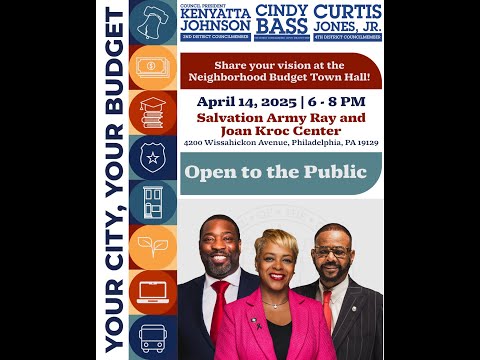
Council President Johnson and several council members present repeatedly reminded the audience that the document presented is the mayor’s proposal and that council will negotiate changes before approving a final budget. Several members — including those who spoke from the dais during the town hall — invited constituents to submit priorities to staff so they could be considered during council’s budget negotiations.
The administration emphasized reserves and contingency planning to handle federal uncertainty and rising costs such as pensions and debt service. Staff said the proposal includes $550 million set aside for labor reserves to support ongoing negotiations with municipal unions.
With the proposal still only a starting point, council members and staff invited attendees to file comments and requested follow-up information from budget staff on specific line items raised by residents.
Looking ahead, council will conduct hearings and negotiations; the mayor’s proposal will be subject to amendment and appropriation by the Council during the statutory budget process.