Get Full Government Meeting Transcripts, Videos, & Alerts Forever!
Get email alerts on the Entertainment Zones And Legislation topic
No spam. Unsubscribe anytime.
Commission hears updates on state bills AB342 and SB395, mayoral entertainment‑zone proposals and Western SoMa zoning cleanup
Summary
City staff and the commission discussed state and local legislation that would expand hospitality and entertainment‑zone tools, and tracked a Supervisor-sponsored cleanup to remove a 200-foot buffer in Western SoMa.
City staff briefed the San Francisco Entertainment Commission on several state and local policy initiatives intended to expand outdoor hospitality options and simplify where nighttime entertainment uses are allowed.
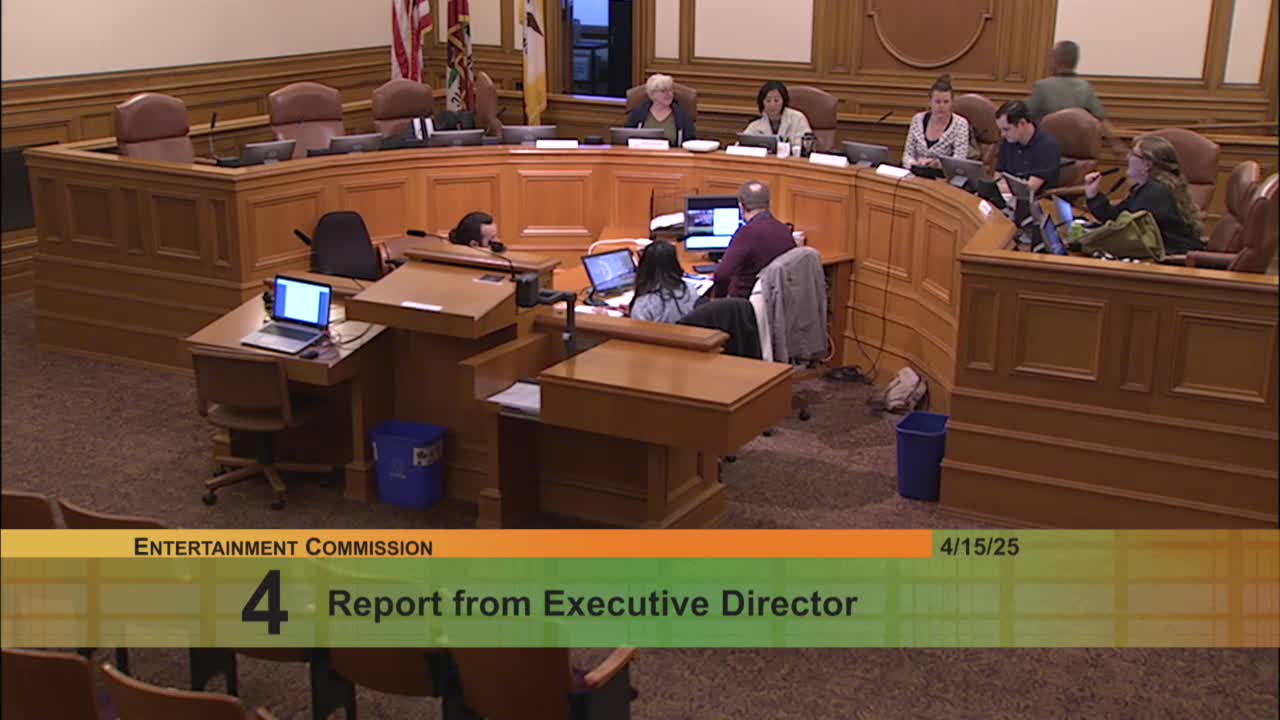
Ben Van Houten, director of Nightlife Initiatives at the San Francisco Office of Economic and Workforce Development, presented the update and described two state bills he is tracking. He said Assemblymember Matt Haney’s AB 342 would permit local governments to designate “hospitality zones” in which businesses could seek extended alcohol service hours on Fridays, Saturdays and state holidays; local implementation would require a resolution, findings about appropriateness and transportation and public-safety plans. Van Houten said the bill had its first hearing the week following the presentation.
Van Houten also discussed SB 395, sponsored by Senator Scott Wiener and the mayor, which would allow San Francisco to issue up to 20 new nontransferable restaurant liquor licenses over three years targeted to support new businesses in the downtown hospitality zone. He said SB 395 passed its initial committee hearing unanimously.
On local policy, Van Houten and staff reviewed the mayor’s recent legislation to designate five new entertainment zones — Valencia Street, Pier 30 1/2 (Pier 30-1/2), Folsom Street, Yerba Buena Lane and Ellis Street — and noted that the Castro entertainment zone had been approved on second reading by the Board of Supervisors. By staff count, 21 entertainment zones are either pending or adopted, though not all have yet been implemented because local stakeholders may not be ready to run them.
Van Houten described the statutory construct: state law uses the term “entertainment zone,” but implementation depends on a local ordinance and a management plan developed by OEWD and a lead community stakeholder (often a business or merchant association). Management plans commonly require a lead point of contact, a security plan and coordination with the local SFPD district station; staff said conditions are tailored to each zone.
Staff also tracked Supervisor Dorsey’s zoning cleanup for Western SoMa, which removes a 200-foot buffer in certain zoning districts. Van Houten said that change would allow a small set of addresses — including Mars Bar and 655 Folsom, both named in the staff report as likely to seek permits — to apply directly to the Entertainment Commission for permits rather than being constrained by the buffer. The Planning Commission gave the cleanup a unanimous vote of approval at its recent hearing, staff said, and the item will continue through the legislative process at the Board of Supervisors.
Van Houten framed these measures as tools to support downtown and corridor revitalization and to help restaurants and bars participate directly in outdoor activations that can be revenue-generating and sustain arts and culture activity. Commissioners asked clarifying questions about how management plans work, security plan expectations and how rules might vary from zone to zone; Van Houten said SFPD and the lead stakeholder shape security plans and that management plans can produce different operating rules across zones.
Van Houten said extended-hours proposals could allow service up to 4 a.m. on targeted days and locations, and that the hospitality-zone approach aims to localize extended hours where resources and context make it appropriate rather than applying citywide. He also noted regional interest: other jurisdictions, including Sacramento, are watching San Francisco’s approach.
No formal action was taken; staff said they will continue to track the bills and update the commission as items move through Sacramento and the Board of Supervisors.