Get Full Government Meeting Transcripts, Videos, & Alerts Forever!
Get email alerts on the Autonomous Vehicles topic
No spam. Unsubscribe anytime.
Public and advocates clash over mayoral decision to allow Waymo on Market Street
Summary
The SFMTA board heard extensive public comment and staff briefings after the mayor authorized Waymo vehicles to operate on Market Street. Supporters said the service could improve accessibility and downtown access; opponents warned it threatens Muni reliability, pedestrian safety and opens the door to broader privatization.
The San Francisco Municipal Transportation Agency Board of Directors heard hours of public comment and questions from board members on a mayoral directive allowing Waymo autonomous vehicles to operate on Market Street.
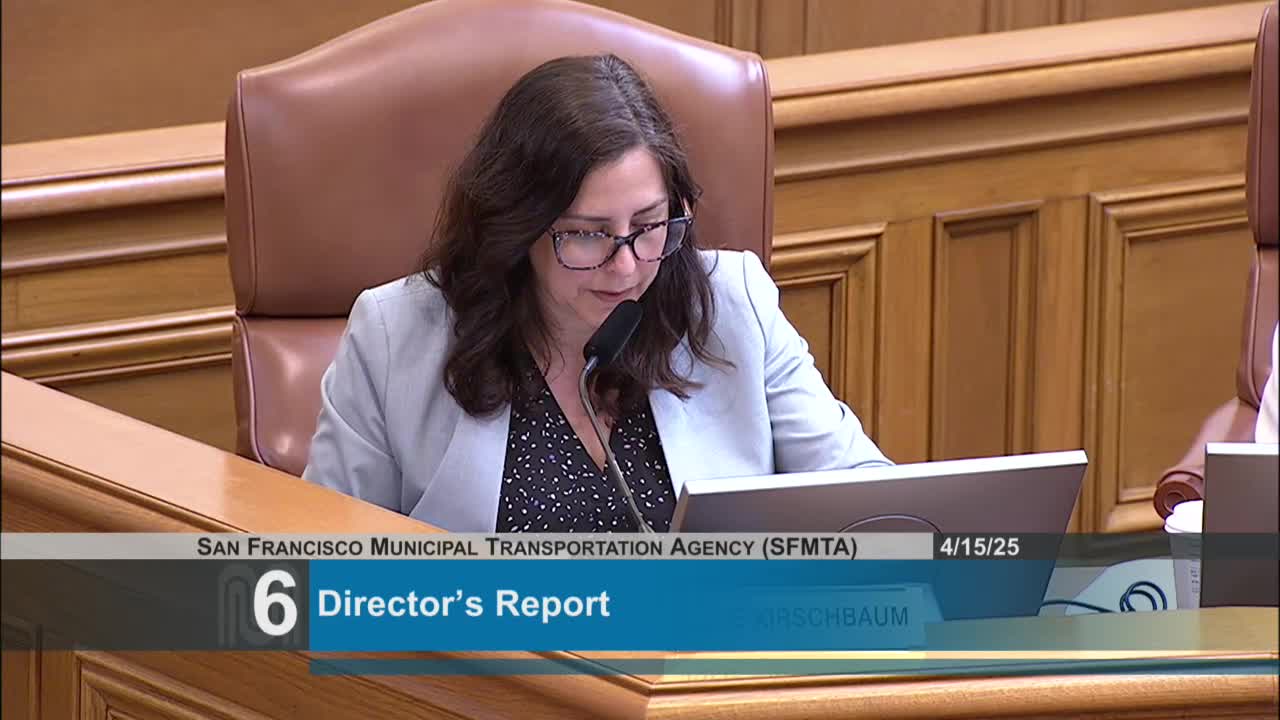
The matter was raised during Director Julie Kirschbaum’s director’s report and prompted more than two hours of public testimony. Director Kirschbaum said the rollout will be phased: Waymo vehicles will first map the corridor with safety drivers before offering passenger rides, and staff will “monitor the rollout carefully to ensure that everyone who travels on Market Street will have a safe experience.”
Why it matters: Market Street functions as San Francisco’s principal transit corridor, where Muni has focused decades of work to improve pedestrian and bicycle safety and transit reliability. Advocates on both sides told the board the decision could be consequential for safety, equity and the city’s transit-first policy.
Supporters — including disability advocates and some downtown business groups — told the board Waymo could improve direct access to Market Street locations and provide a reliable, accessible option for people with disabilities and older residents. Caitlin O’Mellier of Lighthouse for the Blind said Waymo’s service would “allow complete ease of access directly to our headquarters” and described company outreach to the blind community. Lana Nieves, executive director of Independent Living Resource Center San Francisco, said Waymo “offers choice” and called it “much less likely to get into an accident or hit a pedestrian than any other vehicle.”
Opponents — transit and pedestrian advocacy groups, neighborhood residents, taxi and transit labor representatives — urged the board to oppose the mayor’s unilateral move and asked for a formal public process. Dylan Fabris of San Francisco Transit Riders said the mayor’s decision “goes against the spirit” of the city’s Market Street car-free policy and warned that allowing Waymo “opens the door for anyone with a commercial license to send fleets down Market Street.” The San Francisco Bicycle Coalition and other speakers asked the board to place a resolution on the next agenda opposing further private vehicle access to Market Street.
Several speakers linked the announcement to broader concerns about cuts to Muni service. “As public affordable service gets cut on Market, those with means will be able to replace or subsidize their trips with autonomous vehicles,” said a public commenter, arguing this would accelerate a privatization trend.
Staff: Victoria Wise, SFMTA’s director of streets, told the board that the SFMTA does not regulate autonomous vehicle operations and that statewide regulators oversee such vehicles, but that the agency is collaborating with the mayor’s office and Waymo on a phased introduction. Wise said the city’s regulatory framework currently allows transit, taxis, paratransit and commercial fleets — and, where autonomous vehicles are considered a commercial fleet, those vehicles may operate on Market Street. “We will be collaborating very closely with the mayor’s office and others to measure the impacts,” Wise said.
Board questions focused on data sharing, metrics and safety. Directors repeatedly asked whether Waymo would share operational data and what metrics staff would use to evaluate impacts on transit reliability and pedestrian safety. Wise said the agency is still defining metrics and expected more detail in “the next month to two months.” Director Hinsley asked explicitly whether data‑sharing agreements exist; staff said it was “early days” and that more details would be reported back to the board.
What the board did: The board did not take a formal vote on Market Street vehicle access at this meeting. Several directors asked staff to return with a briefing that defines the phased rollout, proposed metrics, planned data sharing and evaluation timelines.
Context and next steps: Staff said the phased approach will begin with mapping runs by Waymo vehicles with safety drivers, followed by controlled passenger service. The agency plans to publish metrics and return to the board with updates on the rollout and its impacts — including any necessary mitigation if Muni reliability or pedestrian safety is affected.
Public comments and community requests at the meeting asked for an explicit public process, more data from Waymo, and enforcement plans to protect existing Muni gains on travel time and safety. Several speakers recommended an agenda item for a board resolution opposing additional private vehicles on Market Street, which they said would create a “Pandora’s box” for further car access.
The board’s staff committed to a public update and additional engagement with disability, pedestrian and transit advocacy groups as the phased rollout proceeds. The timeline for a return to the board to present metrics and data‑sharing agreements was estimated at one to two months.