Get Full Government Meeting Transcripts, Videos, & Alerts Forever!
Get email alerts on the Education Planning topic
No spam. Unsubscribe anytime.
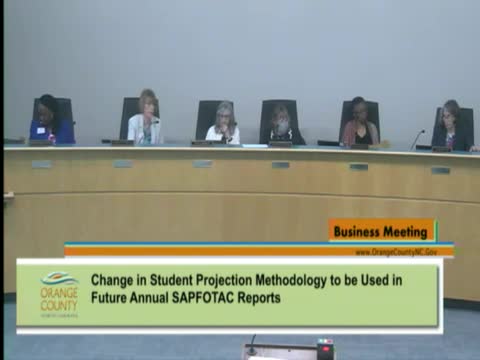
Board authorizes new forecasting method for school enrollment; Carolina Demography to provide annual projections
Summary
The board approved switching to a Carolina Demography forecasting methodology for Orange County Schools and Chapel Hill-Carrboro City Schools to improve enrollment projections by accounting for births, migration, development and charter/private-school changes.
The Orange County Board of Commissioners authorized staff to use a new student-enrollment forecasting methodology produced by Carolina Demography to support school-capacity planning for Orange County Schools and Chapel Hill-Carrboro City Schools.
Kirk (staff) summarized weaknesses in the county—s prior projection approach, which relied principally on trend-based analysis and did not explicitly incorporate the impacts of new development, charter and private-school market-share changes, COVID-19 effects or changing birth trends. The board previously requested competitive proposals and heard presentations by two firms; the SApFOTEC (school adequate public facilities technical advisory) committee unanimously recommended Carolina Demography.
Dr. Nathan Dollar, director of Carolina Demography (Carolina Population Center), outlined the approach the unit will use: compile school-enrollment data and charter-billing information, incorporate demographic inputs (births, migration, age structure, race/Hispanic origin trends), and combine planning- and permitting-level inputs (building permits, development timing and unit-occupancy expectations) to estimate likely students per housing unit. The model will also incorporate Opportunity Scholarship impacts, charter-school enrollments and homeschool counts (the latter are county-level data available from the state and treated as limited but included).
Carolina Demography emphasized that forecasts are the most-likely scenario based on current inputs, not exact predictions, and that forecasts are updated annually to reflect new enrollment data, births and market-share shifts. The board discussed how the new forecasts will be used primarily for capital planning (school capacity and site decisions) while the districts will continue to rely on state attendance-count rules for operating-budget allocations; staff said capital planning will benefit from improved, development-sensitive forecasts.
The board voted to authorize staff to adopt the Carolina Demography methodology and to have Carolina Demography and its partners provide ongoing, annual enrollment forecasts; the motion passed with an affirmative voice vote.
Why this matters: Accurate enrollment forecasting informs capital planning, affects school capacity decisions and helps districts plan for facility needs; the new model adds demographic and development inputs that were not fully captured previously.
Next steps: Carolina Demography will compile school data, incorporate planning and building-permit inputs, and deliver forecasts; the county and school districts will evaluate the model—s performance annually and adjust assumptions as needed.