Get Full Government Meeting Transcripts, Videos, & Alerts Forever!
Get email alerts on the Housing Zoning topic
No spam. Unsubscribe anytime.
Supervisors debate accessory dwelling unit rules as state law limits local rent-control authority
Summary
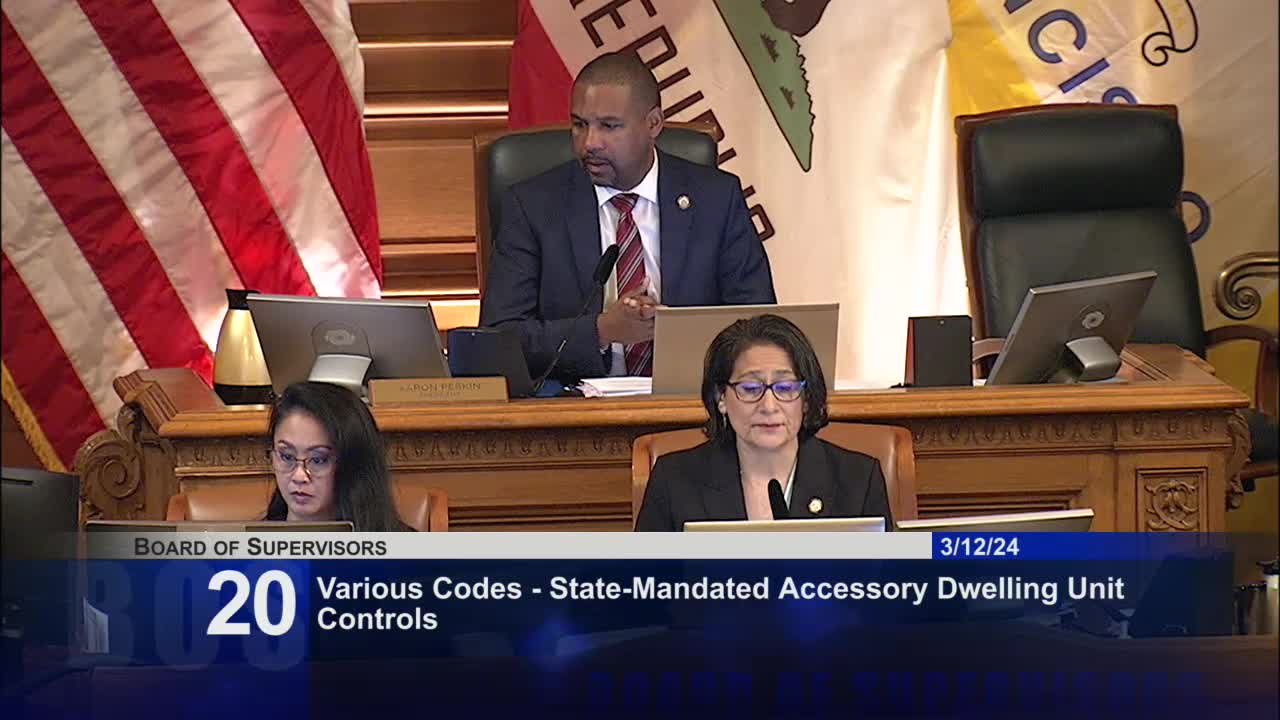
At the March 12 board meeting, President Aaron Peskin and several supervisors debated changes to the city’s accessory dwelling unit approval process and said state law and HCD limit San Francisco’s ability to require rent control for ADUs created under the state pathway.
At the March 12 board meeting, President Aaron Peskin and several supervisors discussed proposed amendments to San Francisco’s accessory dwelling unit (ADU) approval process and the limits imposed by state law and the California Department of Housing and Community Development (HCD).
"This ordinance updates our state mandated accessory dwelling unit program to conform to changes in state law," President Aaron Peskin said. He described three approval pathways under state law — a state program, a hybrid program, and a local program — and said the city's local program historically subjects ADUs to San Francisco's rent-stabilization rules.
Peskin said he and other supervisors drafted amendments to steer more ADU applications into the local, rent-controlled program, but that HCD communicated through outside housing organizations that the city risked losing a "pro housing" designation and state funding if it retained the proposed amendments. "We've discovered that because of how the state law is written. Even if we made the local program identical to the state program, we could not require rent control because the state law as written doesn't allow it," Peskin said.
Supervisor Shalon Walton and Supervisor Rafael Mandelman supported continuing to pursue local tools to make the local ADU pathway more attractive — for example, through waivers, deferrals and process improvements — while acknowledging that HCD's position limited the city’s ability to require rent control under the state-compliant path. "By making our local program attractive…we will continue to work on it," Melgar (chair of the land use committee) said, adding that the committee would keep seeking legislative changes with HCD to allow local rent-control mechanisms.
Supervisor Safaie asked whether ADUs approved under the state program would lose existing rent-control protections; Peskin said units created under the city’s local program remain subject to rent control while units produced under the state program are not.
Council staff did not provide a definitive legal answer during the floor discussion on some narrower restrictions (for example, short-term rental limits) and deferred to counsel for specifics; supervisors said they will continue to pursue changes with HCD and the state legislature. No final change to local rent-control authority was adopted at the March 12 meeting; item 20 was reported out of committee as a recommendation and further legislative steps were discussed.
The debate highlighted a recurring tension between state ADU mandates and San Francisco’s local policy goals to preserve rent-control protections for newly legalized units. Supervisors said they will pursue additional measures — including potential state legislative changes — to permit local rent-control requirements for ADUs if possible.