Get Full Government Meeting Transcripts, Videos, & Alerts Forever!
Get email alerts on the Government Transparency topic
No spam. Unsubscribe anytime.
Board passes ordinance to centralize nonprofit contract oversight with controller after negotiations
Summary
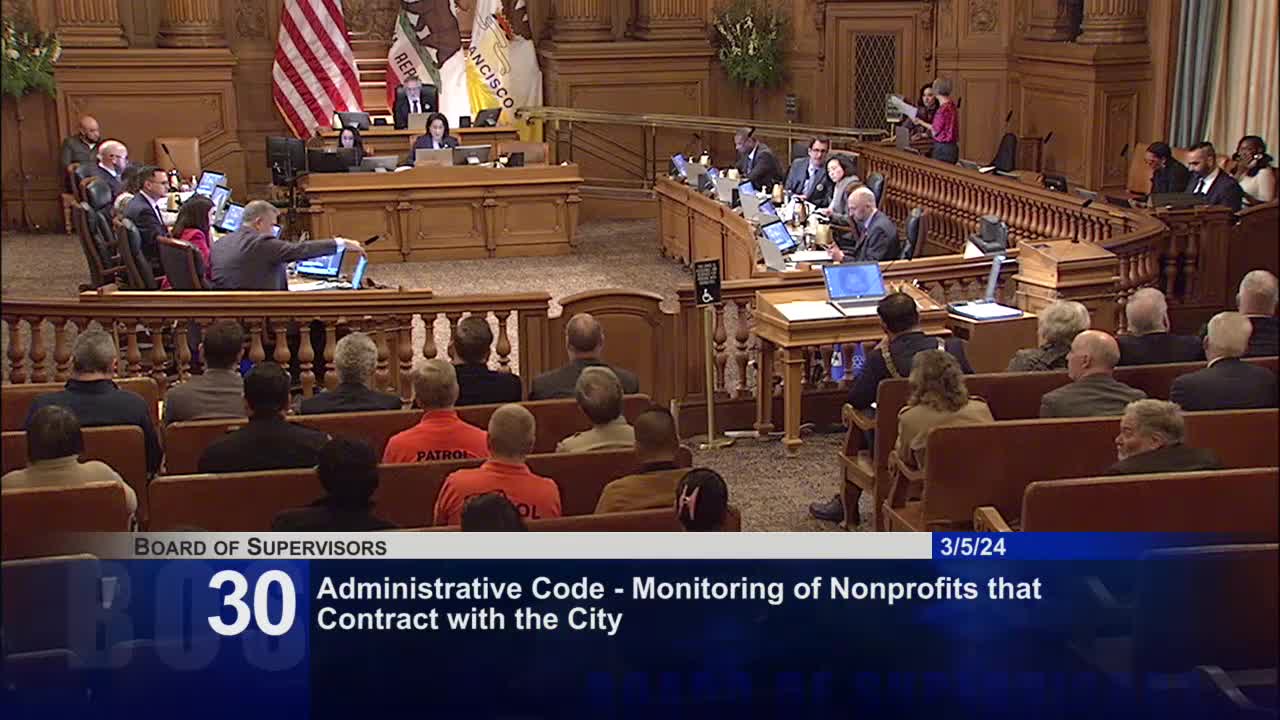
The Board approved on first reading an ordinance assigning the city controller new audit and monitoring responsibilities for nonprofit contractors, including measurable performance goals and fiscal audits for larger contractors, following outreach with small nonprofits.
Supervisor Stephanie introduced an ordinance to amend the Administrative Code to clarify and centralize the controller's responsibilities for auditing and monitoring nonprofit organizations that contract with the city. The Board passed the measure on first reading.
The ordinance directs the city controller to establish measurable performance goals for contracts with nonprofit organizations, periodically review and revise compliance policies, and perform annual reviews of departmental contract management. It also requires fiscal audits for contractors receiving at least $750,000 in city funds and mandates a transparent public rule-making process.
Sponsor comments and rationale Supervisor Stephanie said she first introduced the ordinance in September and returned it to the Rules Committee so the measure could be strengthened after consultations with smaller nonprofits. "I'm immensely proud of the legislation that's before you today," she said, and noted the ordinance was drafted to advance accountability and equity without undermining smaller nonprofits.
Supervisor Hillary Ronan, a cosponsor, supported the ordinance and emphasized the need for earlier intervention to address financial instability or potential misconduct among contractors, saying the controller's office should "step in earlier" to support partner organizations and protect city resources.
Outcome and implications The Board took the item on first reading and approved it without recorded objection on the floor; the ordinance passed first reading and will return for subsequent actions as required by the charter. Supporters said the ordinance would improve fiscal oversight while preserving support for smaller organizations; opponents did not register a floor vote against it during the session.
Distinction between discussion and decision The Board's action established the ordinance on first reading. Implementation details, including rule-making and thresholds for audits beyond the $750,000 fiscal audit trigger, will be set by the controller under the ordinance and through the rule-making process.
Quotations in this article are drawn directly from the Board transcript of the March 5, 2024 meeting.