Get Full Government Meeting Transcripts, Videos, & Alerts Forever!
Get email alerts on the Overdose Prevention topic
No spam. Unsubscribe anytime.
Supervisors debate wellness centers and supervised consumption as funding fight delays action; Overdose Awareness resolution continued
Summary
Board members clashed over how to spend $19 million approved to open three wellness centers and whether to prioritize jail-based services, resulting in a vote to continue a resolution recognizing Overdose Awareness Day until next week.
San Francisco supervisors clashed Sept. 5 over how to use funding approved this year to open three neighborhood wellness centers and whether the city should prioritize supervised consumption services (often called overdose prevention sites) or redirect some dollars to custodial and reentry services.
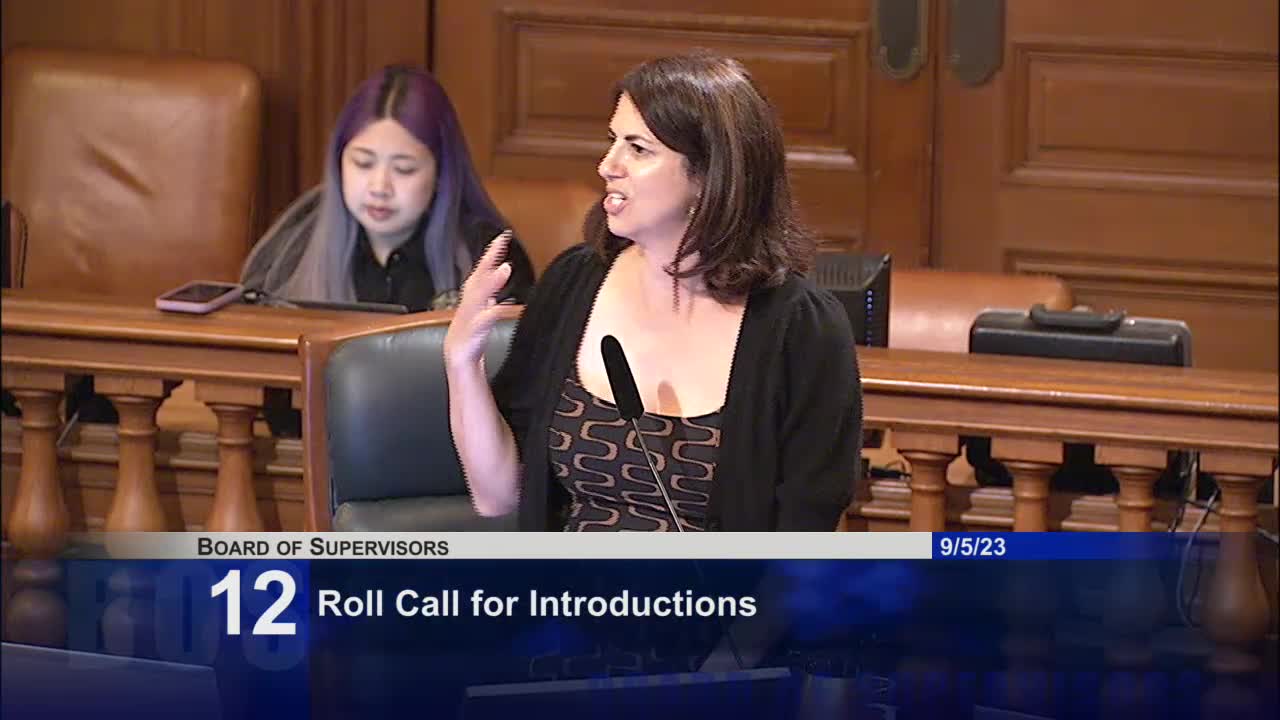
Supervisor Ronan outlined a plan to open three wellness centers — one each in the Mission, the Tenderloin and SoMa — saying the centers should open at the same time and that each should include a full ``wellness" service mix with counseling, wound care, meals and, ultimately, overdose prevention rooms. "We can't open OPC tomorrow unless we have the wellness center open," Ronan said, using the commonly used shorthand for overdose prevention rooms.
Ronan said $19,000,000 was included in the recently adopted budget to open three wellness centers this fiscal year and urged the mayor to give a clear mandate to the Department of Public Health (DPH) to issue requests for proposals and move quickly. She described wellness centers as a place to keep people engaged and alive long enough to enter treatment: "The longer they keep them inside, the longer the staff is building meaningful healthy relationships with these people."
Supervisor Aaron Peskin presided over the debate after several supervisors voiced support for overdose prevention sites, but disagreement surfaced on the record when Supervisor Dorsey asked that the resolution recognizing International Overdose Awareness Day be continued so the board could separately consider whether to reallocate the $19 million to jail-based and reentry services. Dorsey said jail health services told him they do not need more money but that care coordination for people leaving custody is a pressing need; he moved to continue the resolution to Sept. 12 so the matter could be debated without requiring a unanimous vote.
After discussion and several supervisors expressing both support for overdose prevention and concern about implementation and legal risk, the board voted without objection to continue the item one week. Supervisor Chan, a cosponsor of related measures, said she preferred to keep the budget allocation intact and to let experts at DPH and community providers work through the service model. "I am open to all options because I think we're very different people," Chan said, urging reliance on public-health expertise.
Other supervisors, including Mandelmann and Melgar, said they supported the goal of saving lives but expressed caution about whether the city's current legal and operational structures can stand up supervised consumption immediately. Mandelmann noted national experts who have warned about possible unintended consequences and urged a balanced approach that includes robust recovery services.
The continuing debate also turned procedural: because resolutions on the adoption-without-committee calendar require unanimous approval, Dorsey said the policy-heavy final clause asking the mayor to open the wellness centers created a legal and procedural barrier to unanimity. The board agreed to continue the resolution to the Sept. 12 meeting to allow a fuller debate and votes outside the unanimous-adoption rule.
The exchange highlighted divisions on both policy and process: several supervisors urged immediate action to implement aspects of the city's overdose prevention plan, while others urged more attention to custodial treatment, reentry care coordination and legal risk. Ronan said she would continue to press the mayor and DPH to make the openings happen and to provide weekly progress updates to the board.