Get Full Government Meeting Transcripts, Videos, & Alerts Forever!
Get email alerts on the Land Use Environment topic
No spam. Unsubscribe anytime.
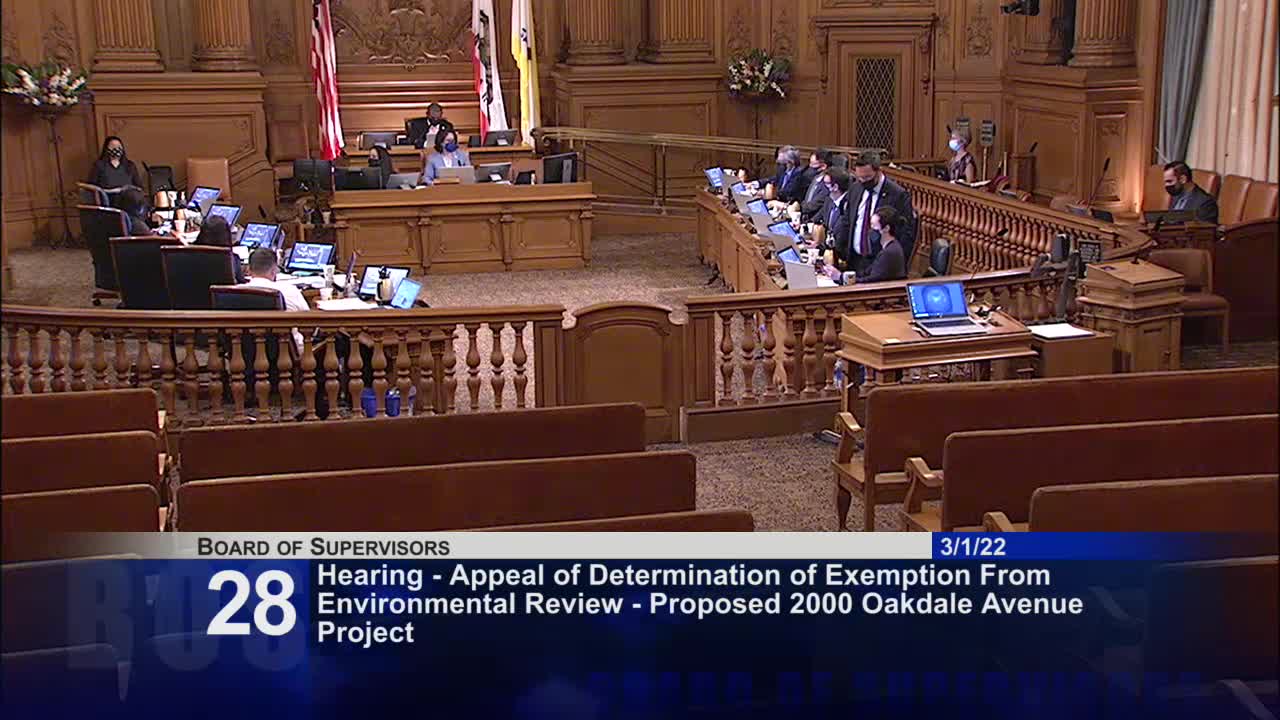
Board affirms planning department’s CEQA exemption for proposed cannabis shop at 2000 Oakdale after public hearing on odors
Summary
The Board of Supervisors unanimously affirmed March 1 that the planning department properly issued a common-sense CEQA exemption for a proposed cannabis microbusiness at 2000 Oakdale, rejecting an appeal that raised potential odor impacts.
The Board of Supervisors on March 1 affirmed a planning department determination that a proposed cannabis retail and microbusiness at 2000 Oakdale Avenue is exempt from further environmental review under CEQA’s “common-sense” exemption (Guidelines §15061(b)(3)). The board approved item 29 by unanimous roll call and tabled related items 30 and 31.
What was before the board: The hearing addressed an appeal by a nearby property owner (Libriq Investment Corp.) challenging the Planning Department’s September 8, 2021 determination that the project did not require an environmental review. The appellant argued the planning department failed to demonstrate “with certainty” that activities at the proposed site would have no possibility of significant environmental impact, focusing on potential odor impacts from on-site processing and manufacturing activities.
Appellant’s case: The appellant’s attorney, Mike Lozzo, presented an expert review that recommended specific odor-control measures — negative-pressure rooms, properly sized ventilation and activated-carbon filtration, automatic door closers and recordkeeping — and argued that the planning department had not considered the absence of a submitted odor-control plan when claiming the exemption. Lozzo said, “The city has the burden to demonstrate there is no possibility of an odor impact in this case,” and urged the board to reverse the exemption.
Planning department and sponsor: Lauren Beal of the Planning Department and representatives from the Office of Cannabis explained that the city’s multi-stage permitting process requires applicants to submit an odor mitigation plan and related operation-and-maintenance documentation before final permits are issued, and that the approved odor-control plan becomes a condition of the cannabis business permit. The project sponsor, Tiara Mitchell, presented community outreach evidence — multiple community meetings, letters of support and engagement with the Bayview Hunters Point advisory committee — and said the sponsors had met with the appellant multiple times in an effort to resolve concerns.
Board decision and reasoning: After public comment and staff presentations the board found that the department’s exemption determination was supported by the record and that the appellant had not produced substantial evidence showing the department’s determination was unsupported. The board approved item 29 (to affirm the exemption) and tabled items 30 and 31 (motions to reverse or prepare findings in support of reversal) by unanimous roll call.
Public comment: Multiple callers spoke both in support of the appellant’s odor concerns (including asthma and other public-health risks) and in support of the project (emphasizing local equity ownership, workforce training and community benefits). Planning staff told the board that odor-control requirements are standard elements of the Office of Cannabis permitting process and that onsite plans will be required and reviewed before final permits are issued.
Outcome: Item 29 approved (affirm exemption) by unanimous roll call; items 30 and 31 tabled.