Get Full Government Meeting Transcripts, Videos, & Alerts Forever!
Get email alerts on the Land Use Demolition topic
No spam. Unsubscribe anytime.
Board disapproves Planning Commission on 249 Texas Street, citing misrepresentation and loss of rent‑controlled housing
Summary
The Board of Supervisors conditionally disapproved the Planning Commission’s approval of a conditional use authorization for a Potrero Hill demolition and rebuild at 249 Texas Street, saying project sponsors and staff misstated facts about an existing two‑unit, rent‑controlled building and that state and local requirements were not met.
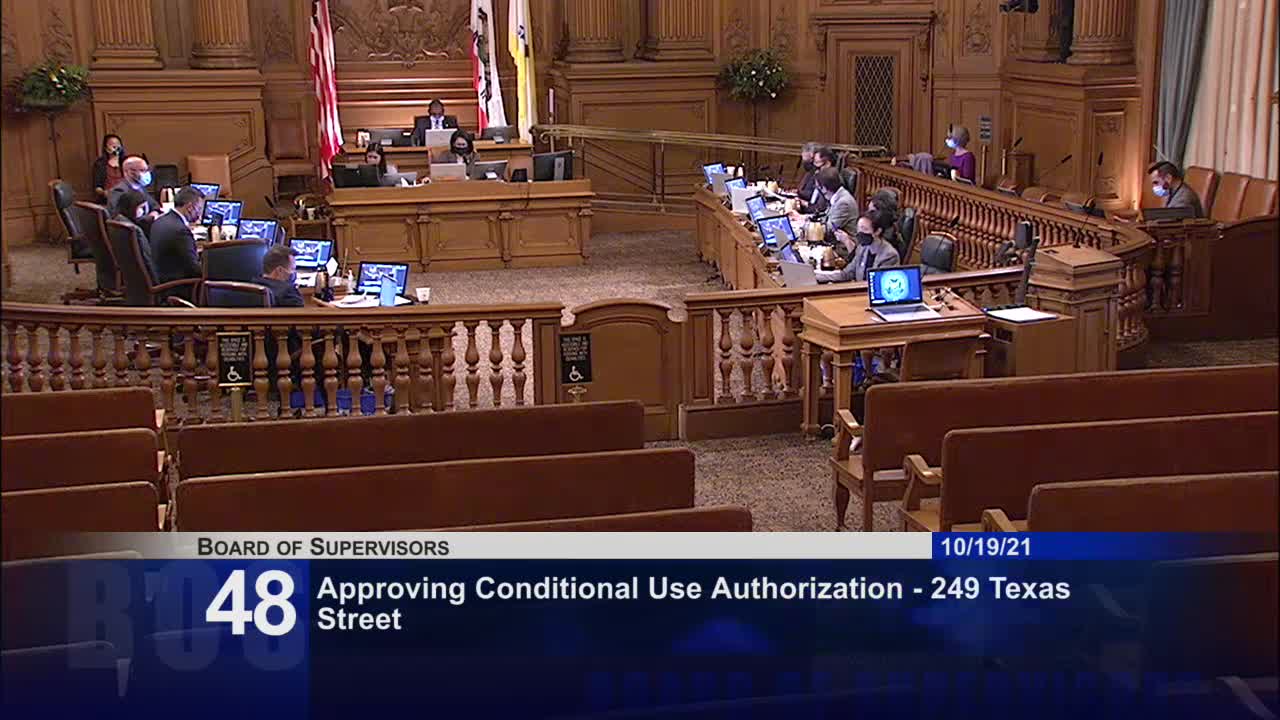
The San Francisco Board of Supervisors on Oct. 19, 2021 voted unanimously to conditionally disapprove the Planning Commission’s approval of a conditional use authorization for a proposed demolition and rebuild at 249 Texas Street in Potrero Hill, after residents and tenant advocates argued the project would remove rent‑controlled units and failed to comply with state and local demolition rules.
Appellants and tenants told the board that the house at 249 Texas had long functioned as two rent‑controlled units and that the project sponsor and their consultants repeatedly mischaracterized the property as a single‑family home during early hearings. “A 2‑unit naturally affordable rent‑controlled building that housed two working‑class families for decades will be replaced with a large single‑family luxury home over a studio basement,” appellant Seisha Gala said in her opening remarks, arguing the Planning Department and sponsor concealed the existence of the second unit.
The board’s motion to conditionally disapprove the Planning Commission decision (mover: President Walton; second: Supervisor Preston) tabled the motion to affirm the Commission (item 48) and approved the motions to disapprove and to direct the preparation of written findings (items 49 and 50). The vote on the motion to disapprove was 11–0.
Why the board acted: Appellants and many neighborhood speakers presented three categories of concerns. First, they said the downstairs unit at 249 Texas had been occupied for years, including within the five‑year lookback relevant to state law, and the sponsor’s filings and Planning Commission packet omitted or contradicted key tenancy evidence. Second, neighbors and tenant advocates argued the sponsor did not follow the requirements of Senate Bill 330 (repeated in testimony as “SB 3 30”), which governs replacement and protections for demolished rental units: appellants said the project did not replace the same number of bedrooms on a one‑for‑one basis and did not use the SB 330 preliminary/replacement application process described in Planning Bulletin No. 7. Third, they disputed the sponsor’s financial and technical claims that legalizing the lower unit was infeasible, supplying an independent contractor estimate far below the sponsor’s figure.
Planning department response and sponsor defense: Planning staff told the board the record supported the Commission’s findings. Planner Aaron Starr said the department had affidavits and prior rental applications showing that the upper unit occupants’ incomes were above the 80% AMI threshold used under SB 330 and that the sponsors had agreed, as a condition, to have the resulting units be subject to the city’s rent ordinance. The department’s presentation also characterized the lower level rooms as not code‑compliant bedrooms (ceiling height, lack of rescue windows) and said the proposed new building would result in more code‑compliant bedrooms overall.
Project counsel and the owners contested the appellants’ version. Scott Emblidge, attorney for Joanne Hsu and Carrie Shapiro, said the property had assessor and DBI records listing it as a one‑unit residence and argued the sponsors had voluntarily proposed SB‑330‑style rent‑control conditions to guarantee future affordability if units were rented. He called the tenants’ exit a voluntary early lease termination and said the sponsor worked to accommodate departing occupants. The sponsors also supplied an independent appraiser and as‑built drawings to support their measurements of ceiling heights.
Board focus and outcome: Supervisors pressed planning staff and the sponsors on whether a separate SB‑330 preliminary application had been filed, how the department determined tenant incomes, and whether the lower unit should have been legalized instead of demolished. Supervisor Preston’s questioning emphasized the need for a clear record about SB‑330 requirements and the sequence of filings. After deliberation the board voted to direct written findings supporting conditional disapproval, effectively reversing the Planning Commission’s approval and sending the matter back with the board’s direction.
What the decision means: The board’s action prevents the sponsor from proceeding under the Commission’s prior approval. The disapproval centers on procedural and statutory compliance questions—whether the sponsors and Planning met SB‑330 and Planning Code demolition standards and whether the loss of rent‑controlled bedrooms was authorized. The matter may return to the Planning Department or the Planning Commission for additional review tied to the board’s findings.
Votes and next steps: The motion to conditionally disapprove (tabling item 48 and approving items 49 and 50) was made by President Walton, seconded by Supervisor Preston, and approved 11–0. The board directed staff to prepare written findings in support of the disapproval.
Ending: Tenants, neighborhood leaders and housing advocates who spoke at the hearing urged the Board to act to preserve existing rent‑controlled housing stock. The sponsors and Planning Department said the record supported approval; the board’s unanimous reversal means the legal and factual questions appellants raised must be resolved before a demolition and rebuild can proceed.