Get Full Government Meeting Transcripts, Videos, & Alerts Forever!
Get email alerts on the Employment Equity topic
No spam. Unsubscribe anytime.
Independent review finds systemic problems in cityEEO; DHR outlines reforms and staffing plan
Summary
An independent review by Stanford law professor William Gould concludes San Francisco's Equal Employment Opportunity process is fragmented, slow and lacks transparency. The city's Department of Human Resources acknowledged the findings, described immediate steps to reduce backlog and pledged organizational changes and new staff.
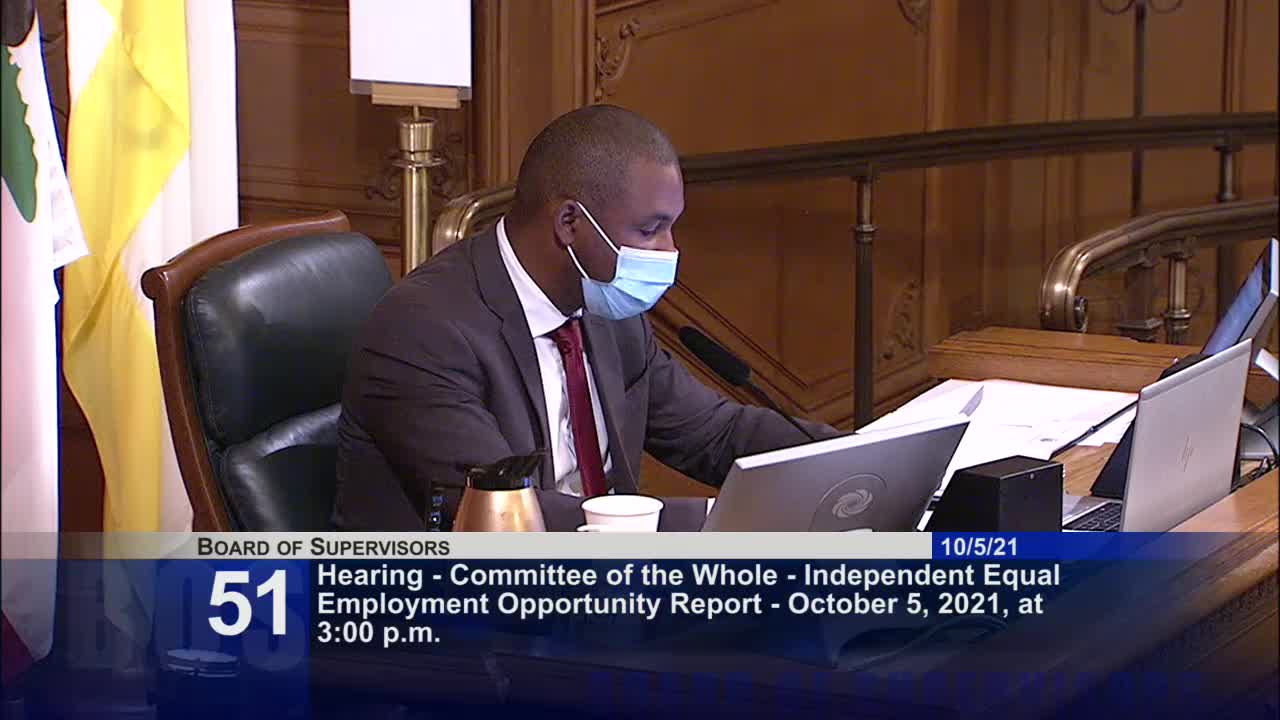
San Franciscou2019s independent review of the cityu2019s Equal Employment Opportunity system found widespread delays, decentralization and limited transparency that have eroded employee trust — particularly among Black employees. The review, delivered at a Committee of the Whole hearing Tuesday, recommended centralizing complaint handling in the Department of Human Resources, expanding staffing, shortening investigation timelines and creating clearer remedies.
Professor William Gould, who led the independent review, told the Board of Supervisors the cityu2019s EEO process suffers from "too many cooks" and inconsistent procedures across departments, contributing to significant delays and a lack of transparency for complainants. Gould recommended consolidating delegated EEO units under DHR, creating a triage system for complaints, and shortening the target investigation period from 180 to 120 days where possible.
Why this matters: City employees and supervisors said the current system leaves employees uncertain about how complaints proceed, discourages reporting and allows unresolved disputes to fester. The board held the Committee of the Whole to review Gouldu2019s findings and to hear DHRu2019s response and implementation plans.
Gould summarized three broad problem areas: the complaint process (opaque timing and decentralization), dispute-resolution (confusion between grievance arbitration and EEO filings), and upward mobility for Black employees (large disparities in representation in skilled trades and supervisory ranks). He said many investigations had been pending for years and that employees lacked information about case status and benchmarks.
DHR officials acknowledged the shortcomings and detailed steps already under way. Director Eisen said DHR has hired new leadership in EEO and employee relations and is rebuilding the EEO division. Amalia Martinez, named EEO director in June, said the division had been "seriously understaffed" and used ad hoc systems including spreadsheets. Martinez reported that DHR inherited 518 open EEO complaints in late June, closed 109 since her start, received 78 new complaints, and currently has 487 open cases. She said 47% of open cases are less than one year old, 37% are under two years, and 15% are more than two years old.
DHR told the board it has funding to add six EEO staff and will procure a centralized case-management system in 2022. The department will implement triage at intake, create a strike team to reduce backlog, and produce a "what to expect" document for complainants. DHR also said it supports bifurcating investigatorsu2019 roles so investigators do not also perform appellate or defense functions, which Gould identified as a conflict affecting perceived neutrality.
The Budget and Legislative Analyst (BLA) reported that in 12 surveyed cities EEO offices are generally housed within human-resources departments and recommended increasing public reporting and giving the Human Rights Commission authority to monitor and report on discrimination complaints.
Board reaction and next steps: Supervisors pressed for timelines, department-level breakdowns of complaints and a stronger firewall between investigators and appellate defense. Several supervisors asked DHR to report back with case counts by department once the new case-management system is live. DHR said it could produce more granular department-level data after system implementation and expected to show metric improvements before the end of the current fiscal year. Gould urged quick, transparent reforms; DHR said it will begin bargaining with unions early next year to consider whether arbitrators should be able to award compensatory remedies in discrimination grievances.
Public comment: Employees, union representatives and community advocates told the board they have lost faith in the current system and called for immediate staffing increases, better timelines, stronger accountability for supervisors and the ability to seek meaningful remedies.
The hearing produced no formal board action other than commitments to follow-up. Supervisors said they will pursue further hearings and potential legislation or charter-level changes if needed.