Get Full Government Meeting Transcripts, Videos, & Alerts Forever!
Get email alerts on the Land Use Development topic
No spam. Unsubscribe anytime.
Board sends 2300 Harrison environmental review back to Planning after residents say project will displace PDR and Latino jobs
Summary
The San Francisco Board of Supervisors on Aug. 18 directed the Planning Department to do further environmental review of a proposed mixed‑use project at 2300 Harrison Street after residents and neighborhood groups warned that the work would expand tech office space in a zone intended to protect production, distribution and repair businesses.
The San Francisco Board of Supervisors on Aug. 18 directed the Planning Department to do further environmental review of a proposed mixed-use project at 2300 Harrison Street after months of public criticism that the project would convert industrial space to offices and accelerate displacement in the Mission District.
The board voted to table the motion to affirm the Planning Department’s community plan evaluation and instead conditionally reverse the department’s determination, approving two motions that send the project back to Planning for additional findings and analysis. The vote to reverse and send the matter back carried by the full board (11 ayes).
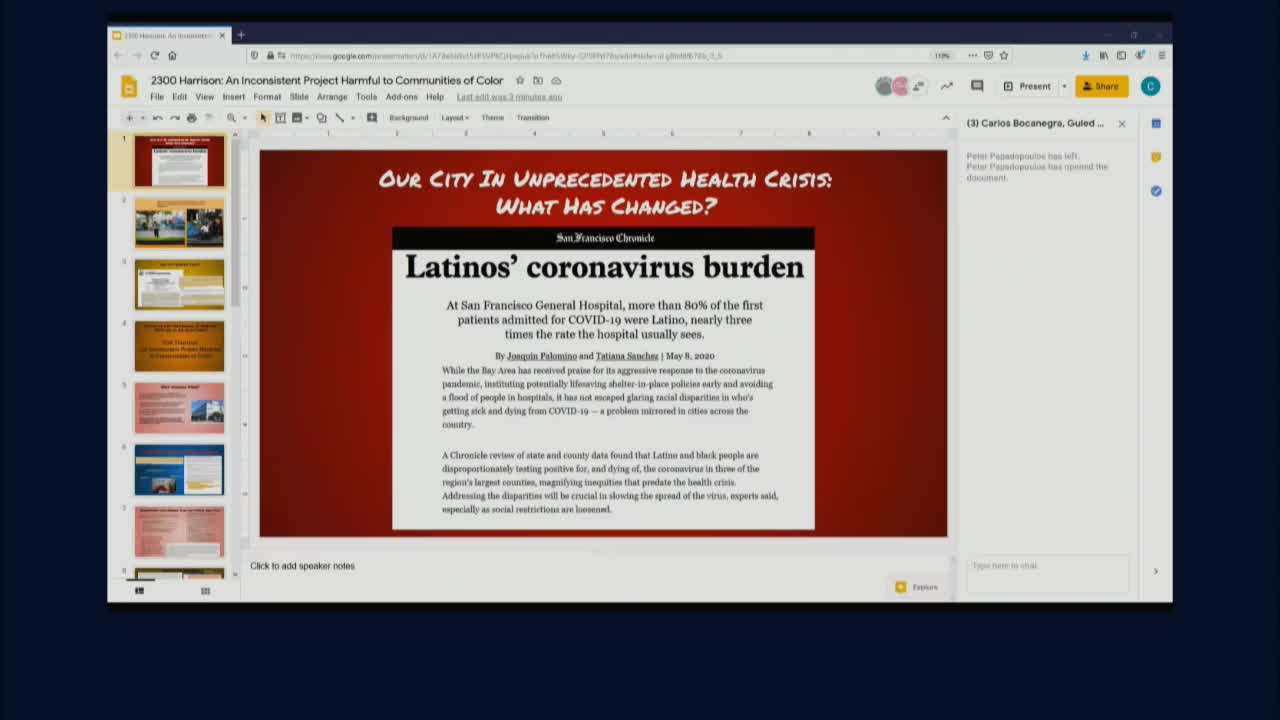
Supporters of the appeal — including neighborhood residents, artists, small manufacturers and community groups — told supervisors that the project would add roughly 96,000 square feet of connected office space while providing just 24 dwelling units and a token amount of PDR (manufacturing and repair) space. Appellant Carlos Bocanegra said the project exploited a state density‑bonus process “intended to increase housing” to secure broad office floor plates that would not provide jobs or ownership for existing Latino and immigrant residents.
Planning Department staff told the board the site is zoned UMU under the Eastern Neighborhoods/Mission Area Plan and that prior environmental analysis for that plan (the Eastern Neighborhoods PEIR) supports a community plan evaluation (CPE) for projects consistent with that plan. Ryan Shum, a senior environmental planner, said the Department judged the project consistent with zoning controls and therefore eligible for streamlined review under CEQA section 15183.
The project sponsor’s representative said the proposal would replace a private surface parking lot with two floors of office, three floors of housing (including six below‑market units), ground‑floor retail and a small arts activity space, and that the existing three‑story office building would remain. The sponsor disputed assertions that the project would displace PDR on the site, and said the total amount of new office for the new structure was smaller than opponents described.
Supervisors and community members pressed Planning and the sponsor on the project’s effect on PDR and on the Mission Area Plan objective to “limit new office and retail development so that PDR could grow.” Members of neighborhood organizations, veterans of PDR businesses and artists described widespread loss of industrial/manufacturing space across the Mission and urged supervisors to require analysis showing the cumulative effect of office conversions.
After the hearing, Supervisor Ronan moved to conditionally reverse the Planning Department’s CPE determination, table the motion to affirm, and direct the clerk to prepare written findings (items 27–29 on the agenda). Supervisor Walton seconded the motion. The board approved the motion by roll call (11 ayes), effectively returning the project to the Planning Department for additional environmental analysis and findings addressing the concerns raised.
The Planning Department and project sponsor will have to prepare the additional material the board directed. The action does not itself approve or deny the project; rather it requires Planning to prepare further documentation and findings before the board can take final action.
Votes and immediate next steps: the board tabled the item that would have affirmed Planning’s CPE (item 27) and approved the motions to reverse and to prepare findings (items 28 and 29). Planning must now prepare the additional analysis and findings the supervisors requested.
The public hearing at the Aug. 18 meeting drew scores of speakers in support of the appeal, including residents, PDR business owners, community groups and worker‑organizers who said the Mission’s industrial base and the district’s Latino workforce would not benefit from large tech office floorplates. Planning staff and the project sponsor answered questions under time limits imposed by the board.
The board’s action returns the project to Planning for more detailed, project‑specific analysis that addresses neighborhood‑scale effects and the Mission Area Plan priorities the appellants cited.
A more detailed record of the hearing, the Planning Department’s CPE and the project sponsor materials are part of the administrative record at the Planning Department and in the clerk of the Board’s legislative file for 2300 Harrison.