Get Full Government Meeting Transcripts, Videos, & Alerts Forever!
Get email alerts on the Housing Affordability topic
No spam. Unsubscribe anytime.
Mayor Breed urges fee cuts for affordable and in‑law housing, vows 1,000 new shelter beds in two years
Summary
Mayor London Breed told the Board of Supervisors that cutting Department of Building Inspection fees for affordable housing projects and in‑law units will speed housing production, and said the city will expand shelter capacity — including 1,000 additional beds over two years — while acknowledging challenges with pop‑up shelter uptake.
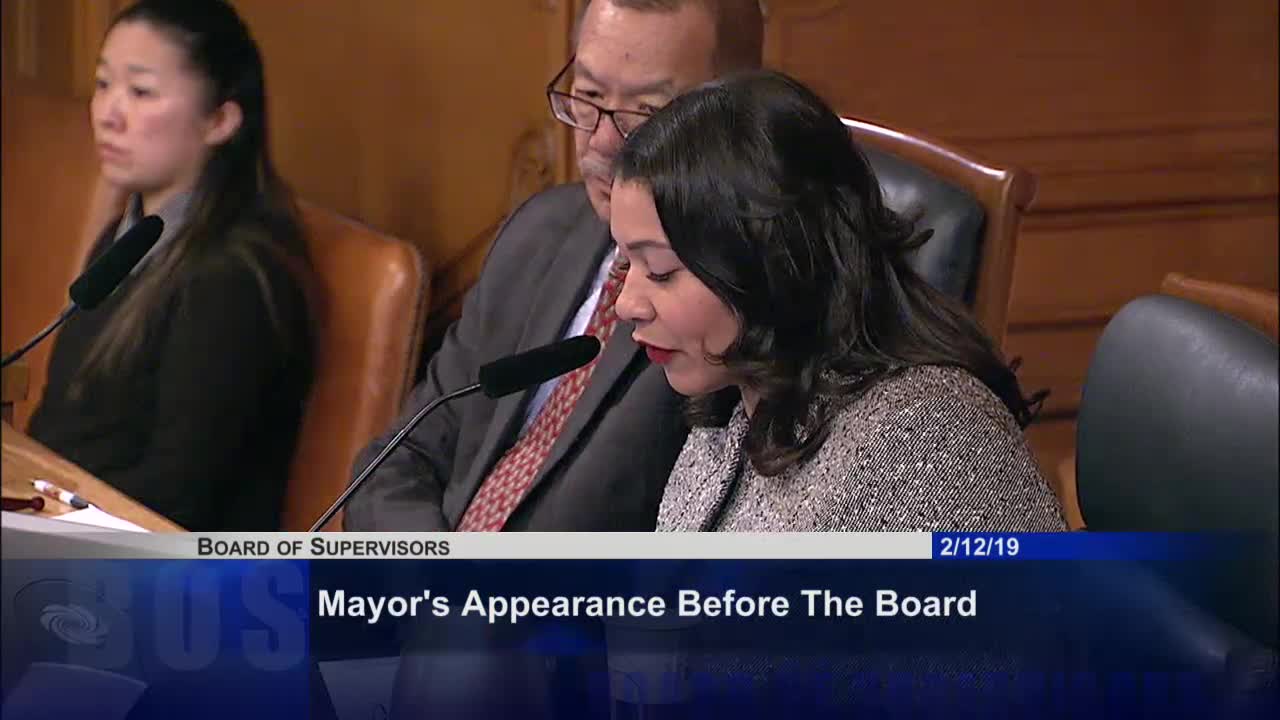
Mayor London Breed told the San Francisco Board of Supervisors on Feb. 12 that the city can reduce one barrier to building housing by eliminating Department of Building Inspection fees for affordable housing projects and for in‑law units, and pledged to expand shelter capacity for people experiencing homelessness.
"When we are investing resources in affordable housing, it makes absolutely no sense to then charge significant amounts of city fees for these particular projects," Breed said, urging fee eliminations and a directive to streamline the in‑law process. She described in‑law units as "an easy way to quickly add density" and said removing thousands of dollars in fees would encourage more construction.
The mayor also defended the city's use of emergency pop‑up shelters and longer‑term shelter capacity as part of the homeless response. Breed said the city operates the winter interfaith shelter program in partnership with the San Francisco Interfaith Council and Episcopal Community Services, and cited additional nightly capacity at Saint Anthony's and the MSC South shelter. She said shelter occupancy is high — roughly 93 percent most nights — and acknowledged that pop‑up shelters have sometimes been underused.
"To improve the utilization of these shelter beds, we have begun using taxi vouchers to provide people with transportation to empty shelter beds throughout San Francisco," Breed said, adding that the city will "open additional 1,000 beds in the next two years." She linked that expansion to the mayor's shelter crisis ordinance and to emergency rental assistance (ERAP) funding the board was considering.
Supervisor Norman Yee, who presided over the special order, and Supervisor Connie Chan (questioning by district was led by Supervisor Brown during the District 5 exchange) pressed for neighborhood‑level approaches and for shelters located in areas where people are reluctant to travel across town. Supervisor Brown told the mayor she had constituents standing in rain who would not accept shelter that was far from their neighborhood.
Breed acknowledged those concerns, saying trust issues and behavioral health obstacles can prevent people from accepting shelter offers. "We need to make sure that we have places for people to go, but there will continue to be a difficulty, especially when there are certain neighborhoods that are in more high demand than others," she said.
The mayor framed the fee proposal and shelter expansion as complementary parts of a larger housing and homelessness strategy: reduce bureaucratic barriers to build more housing across income levels while increasing immediate shelter capacity and services.
Ending: The board’s discussion with the mayor was part of a scheduled District 5 policy exchange; Breed answered questions from supervisors and did not present formal legislation on the floor. The board later took votes on related ERAP and budget measures elsewhere on the agenda.