Get Full Government Meeting Transcripts, Videos, & Alerts Forever!
Get email alerts on the Land Use And Historic Preservation topic
No spam. Unsubscribe anytime.
Board affirms planning department's categorical exemption for 953 Treat Avenue after contested hearing
Summary
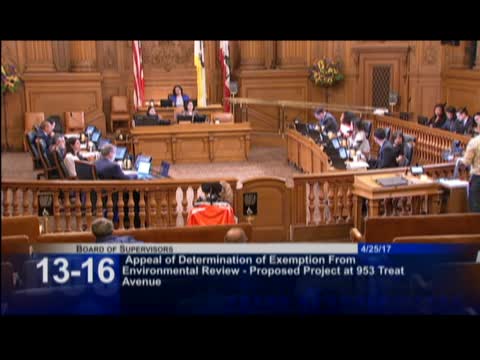
After a two-hour public hearing with expert witnesses on both sides, the Board of Supervisors voted 7-4 to uphold the Planning Department's finding that demolition and new construction at 953 Treat Avenue are categorically exempt from further CEQA review.
The San Francisco Board of Supervisors on April 25 voted 7-4 to affirm the Planning Department's categorical exemption (CE) for a proposed project at 953 Treat Avenue, allowing the demolition of a one-story 1887 cottage and construction of two new four-story residential buildings with a total of six units.
The item drew an extended public hearing and expert testimony on whether the existing cottage qualifies as a historic resource under the California Environmental Quality Act (CEQA). Appellants argued the building, constructed in 1887 and described in a 2010 survey record, contributes to the neighborhood's historic fabric and should trigger further environmental review and preservation alternatives. Planning staff and peer reviewers maintained the property is not eligible for listing in the California Register and concluded it does not meet CEQA's criteria for a historic resource.
"This appeal is not an attempt to stop development," architectural historian Catherine Petron told the board, arguing the project could be redesigned to preserve the cottage while adding housing. Planning Department preservation planner Justin Greving responded that "the subject property does not meet any of these criteria" for listing on the California Register and that the department had found the property insufficiently representative or materially altered relative to comparable Italianate worker cottages.
The board's debate considered three principal questions raised by the appellants: whether survey records had been mischaracterized, whether the cottage is a convincing example of the vernacular Italianate worker housing the Mission Area Plan seeks to protect, and whether the cottage is significant for its association with John Center, an investor whose waterworks operations played a role in limiting the 1906 fire. Planning staff said the property had a survey-status code indicating further evaluation was needed (status code 7) and that a status code of 3 appearing on a map was an error; staff also argued the building had been significantly altered (shingle cladding, irregular fenestration, changed footprint) and was not sufficiently directly tied to Center's productive life to qualify under the California Register's association criterion.
Multiple outside preservation professionals testified on both sides. Page & Turnbull's historic-resource evaluation (prepared for the project sponsor) and independent peer reviewers concluded the building was not individually eligible; a separate set of preservation specialists and neighborhood advocates, including representatives of San Francisco Heritage and the Latino Historical Society, urged the board to require CEQA review to examine feasible alternatives that might retain the cottage.
Supervisor Aaron Peskin, who joined Supervisor Hillary Ronan in discussing the broader implications for the city's preservation surveys, and Supervisor Ronan, who moved to reverse the Planning Department determination and require additional environmental review, expressed concern about process and data in the historic resources survey. That motion failed. The board later voted to affirm the Planning Department's categorical exemption (item 14), with the final roll-call reading: Cohen, Farrell, Feuer, Safaie, Tang, Yi and Breed voted "aye"; Supervisors Kim, Peskin, Ronan and Sheehy voted "no." The item passed 7-4. The board tabled the alternative motions seeking reversal and directing findings (items 15 and 16).
Decision and next steps: The Planning Department's categorical exemption stands as affirmed by the board; the developer may proceed with the project subject to any other required permits and approvals. The record of the hearing and the competing expert reports remain part of the administrative record; interested parties may pursue any available administrative or legal options outside the board process.
Ending: The hearing underscored tension between the city's housing goals and preservation objectives. The board's split vote reflected divergent views on when CEQA environmental review should be required for projects involving older housing stock in changing neighborhoods.