Get Full Government Meeting Transcripts, Videos, & Alerts Forever!
Get email alerts on the Bryant Street Appeal topic
No spam. Unsubscribe anytime.
Board affirms planning department exemption for Bryant Street project, approves conditional use; affordable-site dedication to be developed by MOHCD
Summary
The San Francisco Board of Supervisors on Sept. 13 affirmed the planning department's community‑plan exemption for the 2000–2070 Bryant Street project and confirmed the planning commission's conditional‑use authorization to demolish three dwelling units, while tabling related appeals and leaving an off‑site affordable‑housing dedication to the Mayor's Office of Housing and Community Development (MOHCD) to proceed through a separate procurement and permitting process.
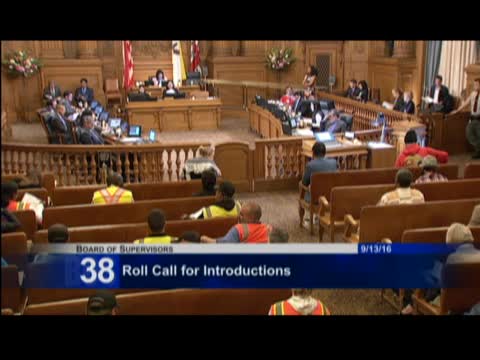
The San Francisco Board of Supervisors on Sept. 13 affirmed the planning department's finding that the proposed mixed‑use development at 2000–2070 Bryant Street qualifies for a community plan exemption from further CEQA review, and separately confirmed the planning commission's conditional use authorization for demolition of three existing dwelling units. The board approved the CPE (item 27) by roll call and later confirmed the conditional‑use authorization (item 31); related appeals were tabled for further consideration.
The board opened the hearing on the two linked appeals after combining consideration of the environmental determination and the planning commission's conditional‑use authorization. Appellants representing community groups including the Beauty on Bryant committee and United to Save the Mission urged the board to require a full project‑level environmental impact report, arguing that housing growth in the Mission has exceeded the range studied in the Eastern Neighborhoods program EIR and that cumulative impacts — including displacement, traffic and loss of PDR (production, distribution and repair) space — were not adequately addressed by the earlier EIR.
Planning department staff and the city's environmental review officer replied that, under CEQA's program‑level rules, the Eastern Neighborhoods EIR remains an appropriate baseline for reviewing projects consistent with the plan's zoning and density, and that project‑specific checklists and technical studies had been completed for Bryant Street. Staff said the EIR anticipated many of the plan‑level impacts now appearing in the Mission and that the CPE process allows focused study of impacts peculiar to a given site.
Project sponsor representatives described changes since earlier proposals, highlighted a proposed land dedication to the Mayor's Office of Housing and Community Development (MOHCD), and outlined commitments to PDR and community arts space. MOHCD staff told the board they have preliminarily certified that the dedicated parcel could support affordable housing (MOHCD stated the dedication could yield up to 98 affordable dwelling units “as of right,” per MOHCD testimony). The project sponsor and MOHCD also discussed a timetable to issue a request for proposals for a nonprofit affordable housing developer if the board allows the project to proceed.
During the hearing the sponsor offered additional commitments reached in discussions with staff and the district supervisor: (1) provision of shared car‑share parking in the market‑rate garage to increase usable PDR/art space in the MOHCD parcel, (2) an additional roughly 2,500–3,000 square feet of arts/PDR area on the dedicated site, (3) a $500,000 capital commitment to help build out a community arts space, and (4) about 4,000 square feet of below‑market PDR space in the market‑rate building at a reduced rent for 55 years. Planning staff said the project as approved by the planning commission provides approximately 12,000 square feet of ground‑floor PDR in the market‑rate building plus concept PDR/art space on the dedicated parcel.
Board action and votes - On the environmental appeal (item 27): Supervisor David Campos moved to approve the planning department's community plan exemption and to table the two related appeals (items 28 and 29). The roll call recorded 11 ayes; the motion carried. - On the conditional use appeal (items 31–33): After additional discussion and new sponsor commitments, Supervisor Campos moved to confirm the planning commission's conditional use authorization (item 31) and to table the remaining appeals (items 32 and 33). The board voted 11–0 to confirm the conditional use authorization; the other appeals were tabled.
What this means next Because the project includes a land dedication to MOHCD rather than an on‑site inclusionary calculation, MOHCD must separately select a nonprofit developer and carry the dedicated parcel through design, permitting and construction. MOHCD testified it would issue an RFP within roughly four weeks if the project proceeds; MOHCD said predevelopment funds are available and described a typical timeline that would include roughly 12 months for schematic design and about another 12 months for permitting, subject to financing and the selection process. Appellants and some community members said they will continue to press for larger policy changes to limit displacement; the board and planning department acknowledged those policy concerns and noted ongoing work on the Mission Action Plan (MAP 2020) and other planning tools.
Why it matters The Bryant Street project became a flashpoint for broader debates over the pace and character of development in the Mission: protesters argued that programmatic EIRs prepared before the current development boom cannot substitute for project‑level review when cumulative, neighborhood‑scale change has accelerated; supporters said the project advances affordable housing and arts/PDR goals while delivering hundreds of homes. The board's voting record preserves the project's entitlements as approved by the planning commission while leaving the MOHCD land‑dedication parcel to a separate affordable‑housing procurement and permitting process.
Ending note The board emphasized that zoning and plan‑level tools — not CEQA alone — are the appropriate levers for long‑term policy changes such as growth caps, moratoria or zoning amendments; several supervisors urged accelerated work on MAP 2020 and other legislative measures to address displacement and PDR loss across the Eastern Neighborhoods.