Get Full Government Meeting Transcripts, Videos, & Alerts Forever!
Get email alerts on the Police Transparency topic
No spam. Unsubscribe anytime.
Supervisors back state bill to publish sustained police-misconduct findings after narrow amendment
Summary
The Board endorsed state Senate Bill 1286, which would make records of sustained police misconduct publicly available, after a contentious debate and a floor amendment that removed a local public-hearing requirement. The measure passed by an 8-3 vote.
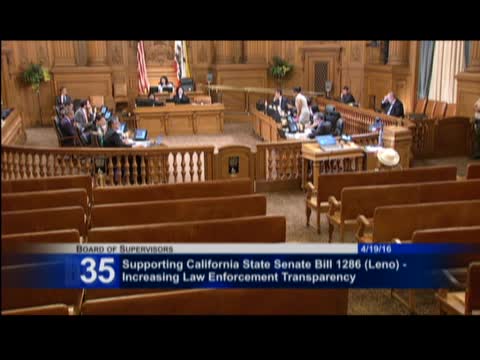
San Francisco — The Board of Supervisors voted Tuesday to support state Senate Bill 1286, a measure to expand public access to records of sustained police misconduct and use-of-force findings.
The resolution, sponsored locally by Supervisor Malia Cohen and introduced in the state Senate by Sen. Mark Leno, drew sharp debate at the board, reflecting an ongoing citywide concern about policing, accountability and officer safety. "The good names of these public servants should not be tarnished by the actions of those amongst their ranks who may engage in wrongdoing," Cohen said, reading the bill's preamble, but she argued the balance had swung too far against public access.
Nut graf: SB 1286 would allow public access to records of sustained charges of misconduct, including use of force, racial or identity profiling, and related findings; the board adopted a support resolution after removing language that would have required local public hearings under the state bill and after a separate floor amendment tightened some officer protections.
Supporters said the bill increases transparency and strengthens public trust in law enforcement. Senator Leno, Cohen and other backers told the board the legislation includes protections for officers against frivolous complaints and limits the use of records older than five years in litigation context. Opponents, including Supervisors London Breed (President) and Mark Farrell, warned that disclosing non-sustained allegations or incomplete records could be unfair to officers and invite misuse.
Supervisor Scott Wiener, among those who pressed for a narrower approach, said he would support a version focused on sustained complaints in the most serious cases but could not back full disclosure in the bill's current form. Supervisor Farrell said he could not support disclosure of mere accusations because they can have power equivalent to sustained findings and could be abused.
The board divided the resolution on the floor to remove a line commending the bill's author; after amendment the board approved the support resolution, with 8 supervisors voting yes and 3 (Farrell, Tang and Weiner) voting no.
Ending: The resolution is advisory to the state legislature; if supported by Sacramento the bill would still need to pass both houses and the governor. Local supporters said they will continue to press the bill's authors and the state legislative delegation for final language that balances transparency with due-process protections.