Get Full Government Meeting Transcripts, Videos, & Alerts Forever!
Get email alerts on the Transportation Shuttles topic
No spam. Unsubscribe anytime.
Board continues commuter shuttle CEQA appeal after contentious hearing; pilot program faces looming expiry
Summary
Supervisors voted 9–2 to continue the CEQA appeal and give staff and stakeholders two weeks to negotiate mitigations for the commuter shuttle program; the program’s pilot was set to expire and the SFMTA warned enforcement capacity and fee collection would lapse if no interim action is taken.
The Board of Supervisors voted on Jan. 26 to continue consideration of a CEQA appeal of the San Francisco Municipal Transportation Agency’s permitting for a commuter shuttle program, sending the matter back for two weeks of additional negotiation and potential mitigation measures.
Lede facts: The board approved a motion to continue the hearing on items 33–36—an appeal of the planning department’s categorical exemption for a proposed commuter shuttle permit program—by a recorded vote of 9 in favor and 2 opposed (Supervisors Katy Tang and Scott Wiener). The continuance moved the item to the Feb. 9 meeting, giving the SFMTA and stakeholders time to discuss added mitigations, including neighborhood protections and environmental measures.
Why it matters: The shuttle program has been described by proponents as a transit alternative that removes cars from streets and by opponents and some neighborhood groups as an environmental and congestion concern. The pilot program’s scheduled expiration at midnight on the Sunday immediately following the hearing created urgency: SFMTA staff warned that enforcement powers, dedicated parking control officers and user-fee revenue would lapse if no interim authorization were in place.
Hearing highlights Supporters at the hearing—including shuttle users and drivers—said shuttles reduce private vehicle trips, support local workers and help thousands of residents remain in the city without car ownership. Shuttle drivers and labor representatives (Teamsters) pressed for labor-harmony provisions and protections for driver jobs.
Opponents and several supervisors urged more study and safeguards. Supervisor Norman Yee, who supported the continuance, said he sought additional mitigations for environmental and social impacts and wanted assurances that benefits would extend to residents and neighborhoods, not only to corporate commuters. Supervisor Wiener opposed the continuance and said the board already had extensive data and that delaying the decision risked ending the program abruptly. "The pilot program expires at midnight on Sunday. As of 12:01AM Monday morning, if we do not resolve this today, there will not be a commuter shuttle program," Wiener said.
SFMTA and legal context SFMTA staff told the board the pilot program had relied on a CEQA exemption and that the permanent program adopted by the agency in November relied on a similar CEQA determination. Agency staff said they were exploring options to keep shuttle operations continuous while the board and stakeholders negotiated, but warned that user-fee collections (projected at about $100,000 per week in the adopted permanent program) and enforcement by 10 dedicated parking control officers would not be available without a valid permit framework. The SFMTA said those PCOs were reassigned from vacancies to the pilot program and that existing staffing would be difficult to sustain absent program revenues.
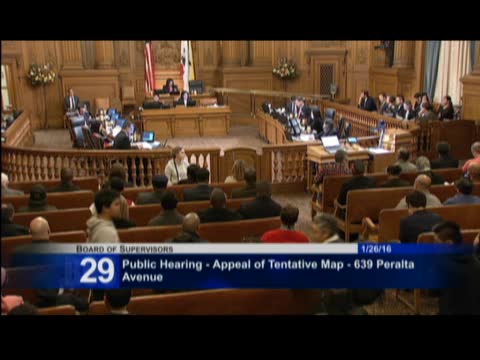
Votes and formal actions - Motion: Continue CEQA appeal (items 33–36) to Feb. 9, 2016 (mover: Supervisor Campos; seconder: Supervisor Peskin). Vote: 9 ayes, 2 nos (Tang, Wiener). Outcome: passed. - Related continuances earlier in the meeting included a continuance of items 29–32 (Peralta Ave. condominium tentative map appeal) to May 24, 2016 (unanimous).
Next steps: The continuance gives two weeks for SFMTA staff, shuttle operators, labor representatives and community groups to try to negotiate mitigations (for example, limits on idling, routing, stop locations, fees, labor provisions, and environmental safeguards). The board also encouraged SFMTA to explore whether a short-term or temporary program could be adopted or whether a retroactive solution for enforcement can be found should the agency board approve an interim program.
Ending: The outcome preserves options for stakeholders and prevents an immediate regulatory gap, but supervisors and the SFMTA warned there is still a tight timeline to resolve environmental, labor and neighborhood concerns before the pilot’s legal protections lapse.