Get Full Government Meeting Transcripts, Videos, & Alerts Forever!
Get email alerts on the Transportation topic
No spam. Unsubscribe anytime.
Board narrows enforcement of stop‑sign tickets for slow‑moving cyclists; ordinance passes as amended 6‑5
Summary
After hours of debate, the board adopted amendments that instruct police to make rolling‑stop enforcement a low priority for bicyclists who yield at intersections, then duplicated the amended file and sent it back to committee; final language passed first reading with a 6–5 vote.
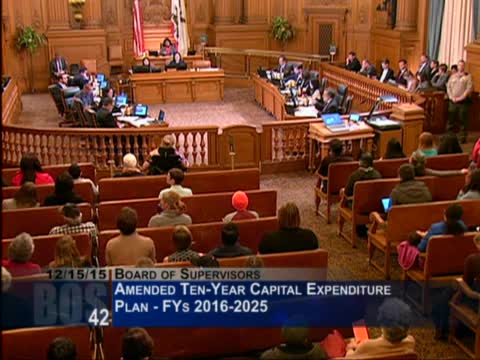
The Board of Supervisors on Dec. 15 adopted an ordinance setting a local right‑of‑way policy that treats cautious, slow bicycle “rolls” through stop signs as the lowest enforcement priority for the San Francisco Police Department, and asked the department to focus enforcement on the city's Vision Zero priorities.
Supervisor John Avalos introduced the measure, saying it reflected the reality of bike travel in San Francisco and sought to prevent officers from spending scarce enforcement time citing cyclists who slow and yield at intersections. “If bicycles are not coming to a complete stop, what is the maximum speed that they should be negotiating intersections? And that's 6 miles per hour,” Avalos said during the discussion.
Key points and amendments: The ordinance requires cyclists to yield to pedestrians and to slow to a negotiating speed—specified in the amended language as 6 miles per hour—when moving through intersections where they do not come to a full stop. It also encourages the Municipal Transportation Agency to run an education campaign about yielding and safe intersection behavior. President Breed proposed language clarifying Vision Zero enforcement priorities and adding a requirement that cyclists maintain at least six feet of separation from pedestrians.
The board accepted small wording fixes and a plan to duplicate the amended file and return it to committee for follow‑up. Members then voted on the ordinance as amended. The vote on first reading was 6 in favor and 5 opposed; supervisors Cohen, Farrell, Peskin, Tang and Yi voted no, while supervisors Weiner, Avalos, Kim, Marr, Breed and Campos voted yes.
Why it matters: Supporters framed the measure as a practical safety step that acknowledges how many cyclists already navigate San Francisco’s dense street grid and as a way to focus police enforcement on more dangerous behaviors at high‑injury corridors. Critics said the change could confuse road users, harm pedestrians and erode adherence to the California Vehicle Code.
Implementation and next steps: The board voted to duplicate the amended file and return it to committee, but also passed the ordinance on first reading as amended; the measure will return for final consideration. Supervisors asked the police department for data on bicycle enforcement and the transportation agency to create an education campaign informing cyclists and pedestrians about how the policy works.
Ending: The vote was closely divided, reflecting a broader debate over balancing cycling safety, pedestrian protection and consistent enforcement of traffic law in San Francisco’s increasingly congested streets.