Get Full Government Meeting Transcripts, Videos, & Alerts Forever!
Get email alerts on the Criminal Justice topic
No spam. Unsubscribe anytime.
Supervisors halt jail construction plans, order working group to study alternatives
Summary
The San Francisco Board of Supervisors amended and deferred key actions tied to a proposed rehabilitation and detention facility, directing staff to explore alternatives such as mental-health investments while preserving the option to acquire land.
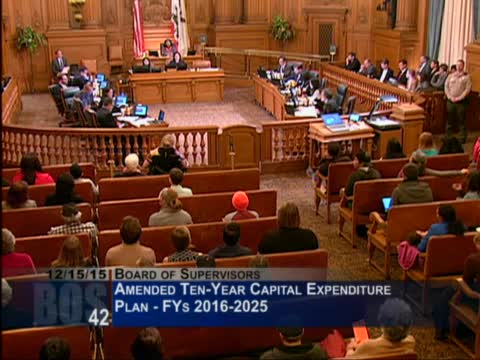
The San Francisco Board of Supervisors on Dec. 15 amended and sent back to committee several items tied to a proposed rehabilitation and detention facility, tabling interim construction funding and ordering a working group to study mental‑health and alternative investments before any commitment to a new jail.
President Breed said she would remove the financing that committed the city to a new jail and instead limit certificates of participation to cover land acquisition while directing a cross‑agency working group to plan for the permanent closure of county jails 3 and 4 and to identify investments in mental‑health and diversion programs.
Breed said the board needed to “tear down the system of mass incarceration” tied to the old Hall of Justice and to ensure any replacement reflected the city’s priorities on treatment and diversion. “I am certainly not opposed to a new facility next to 850 Bryant, but I am strongly opposed to this jail,” she said, arguing the proposal was “too big, it’s too expensive, and it’s too singularly focused on incarcerating people.”
Why it matters: The board’s action preserves the city’s eligibility for state funding while pausing any construction approvals that would commit the city to a stand‑alone jail. Supervisors repeatedly cited the city’s falling average jail population and urged investing in mental health, substance‑use treatment and diversion to reduce incarceration and long‑term costs.
What the board did: Breed introduced amendments that (1) limited certificates of participation being sought to the projected cost of property acquisition rather than the full $215 million construction package; (2) sent the revised items and related resolutions back to committee for further consideration; and (3) tabled two items that would have provided interim construction commercial paper and accepted state lease revenue bonds. The motions and amendments were taken without objection and passed unanimously at the board meeting.
Supporters and critics: Supervisors Jane Kim and Scott Wiener joined Breed in pushing for alternatives and for use of land acquisition authority without locking the city into construction funding for a new jail. Kim said the city had “been learning that these policies are not only incredibly expensive and burdensome … but they are not achieving the goals that we had hoped for.” Supervisor Wiener stressed the need to “get this right” and warned that alternatives must be real and resourced if beds are to be reduced.
Several supervisors said they favored retaining the parcel option—buying land adjacent to the Hall of Justice—so the city would own the property needed for any future use, whether that later becomes a public health facility, courthouse space or another municipal need. Breed moved that real‑estate purchases remain possible while the working group made recommendations.
Next steps: The board directed the director of Public Health and the sheriff’s office to convene a working group including mental‑health providers, the district attorney, public defender, police, adult probation, pretrial diversion staff, capital planning and community advocates and former inmates. The working group was asked to report back in February with a plan that identifies investments and demonstrates how the city could preserve eligibility for state funds while prioritizing treatment over incarceration.
The board also tabled two funding items tied directly to construction and deferred other capital plan amendments pending the working‑group report. That preserves the city’s flexibility but delays any construction timeline.
Context: The measures were part of a broader package (items 36–42) that would have funded a rehabilitation and detention project to replace aging County Jail 3 and 4, and that included requests for certificates of participation and state bond awards. The Board’s action marks a pivot from an immediate construction path toward a deliberative planning process focused on mental‑health services and alternatives to incarceration.
Ending: The working group’s February report will be the first major checkpoint for the board to decide whether to move forward with a new facility and, if so, in what form. For now, the city has preserved the option to buy adjacent property while pausing commitments that would lock in a stand‑alone jail.