Get Full Government Meeting Transcripts, Videos, & Alerts Forever!
Get email alerts on the Housing topic
No spam. Unsubscribe anytime.
Board re‑certifies 2004/2009 housing‑element EIR after appeal; court writ noted by appellants
Summary
The Board of Supervisors voted to uphold the Planning Commission’s certification of the 2004/2009 housing‑element Environmental Impact Report after an appeal. Appellants argued the revised alternatives remained conclusory and pointed to a superior‑court writ ordering further CEQA compliance; the board approved certification 10–1.
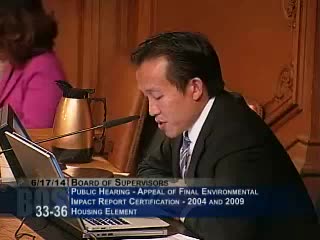
The San Francisco Board of Supervisors on Tuesday voted to uphold the Planning Commission’s certification of the final Environmental Impact Report (EIR) for the city’s 2004 and 2009 housing element in a 10‑to‑1 vote, rejecting an appeal by neighborhood groups that had previously won limited relief in Superior Court.
Appellants, represented by attorney Kathy Devincenzi for San Franciscans for Livable Neighborhoods, told the board the revised EIR still failed to substantiate its analysis of alternatives and that the Superior Court’s prior writ requires the court — not the board — to determine whether the city has cured the deficiencies before reapproval. Devincenzi warned the board that the court’s writ “will remain in effect until this Court determines … that you have fully complied with CEQA as to the matters set forth herein,” and she argued the revised alternatives section remained conclusory and unsupported by facts.
Planning Director John Raham and Planning Department staff said the department followed the court’s instructions by revising only the alternatives chapter, recirculating it for public review, issuing responses to comments, and returning the EIR to the Planning Commission. Staff noted the court previously found the EIR adequate in other chapters and concluded the revised alternatives chapter satisfied CEQA. Tanya Schaner of the Planning Department summarized the department’s position that additional alternatives urged by appellants would be infeasible or would not meet the housing element’s basic objectives.
During the hearing, members of the public and civic groups amplified concerns about concentrated market‑rate production, impacts on transit capacity, and whether alternative approaches — including targeted fee or mitigation strategies for market‑rate units — had been adequately analyzed.
After debate, Supervisor Wiener moved to affirm the Planning Commission’s certification; the motion passed 10‑1 (Supervisor Farrell cast the lone no vote). The board then advanced a related ordinance on first reading to re‑adopt the housing element.
What this means: The board’s action clears a local hurdle to moving forward with the city’s housing‑element guidance, but the Superior Court’s prior writ and the appellant’s claims leave open the possibility of further judicial review and require the city to be able to show it has complied with the court’s instructions on the alternatives analysis before final re‑adoption of aspects that had been enjoined.
Provenance: See transcript segments where the EIR appeal is opened and the final certification vote is recorded.